Understanding Paragraph Structure That Actually Works
You dictate a quick update while walking between meetings: the deadline moved, design still needs to review the draft, and you'll send the revised version after lunch. The speech-to-text result captures every word, but on your screen it's one dense paragraph. The grammar is mostly fine. The reader still has to work out which detail matters and how the thoughts fit together.
That's a paragraph-structure problem. Understanding paragraph structure means learning to give each paragraph one clear job, then arranging its sentences so readers can follow the point without reconstructing your thinking. The same skill helps with emails, reports, technical notes, and voice-drafted messages.
Table of Contents
- Why Paragraphs Break and How Structure Fixes Them
- The Four Building Blocks of Any Strong Paragraph
- Choosing the Right Paragraph Shape for Your Purpose
- Making Sentences Actually Connect
- A Three Minute Editing Protocol for Any Paragraph
- Dictating and Polishing Paragraphs With Voice Tools
- Common Misconceptions That Keep Writers Stuck
- A Repeatable Workflow and Quick Answers
Why Paragraphs Break and How Structure Fixes Them
A paragraph isn't just a block of text between blank lines. It's a small unit of meaning: one main idea, developed in a way that helps a reader understand why it matters. That definition applies whether you're writing an academic paper, a clinical note, or a short update for a colleague.
A common failure starts with a reasonable spoken draft. You say, “The launch date has moved because the review isn't finished, and I also need to check with Priya about the screenshots, and the customer wants a copy before Friday.” Those details may all belong in the same update, but they don't necessarily belong in the same paragraph. The deadline, review, and customer request need an order that makes their relationship clear.
Professional readers often scan for the information they need instead of reading every sentence in sequence. American University's guidance on paragraph unity and coherence describes unity as developing one idea thoroughly and connecting it to the larger piece, and coherence as arranging sentences logically with clear transitions. When a paragraph switches among unrelated points, readers have to supply the missing logic themselves.
That extra work can make a clear message feel confusing or unfinished. It can also weaken the link between your evidence and your conclusion: a reader may see the details but miss what they're meant to prove.
The dependable rule is simpler than any sentence-count formula: one paragraph, one controlling idea. Every sentence should advance that idea, explain it, support it, or guide the reader onward. If it can't do one of those jobs, revise it, move it, or give it a paragraph of its own.
The Four Building Blocks of Any Strong Paragraph
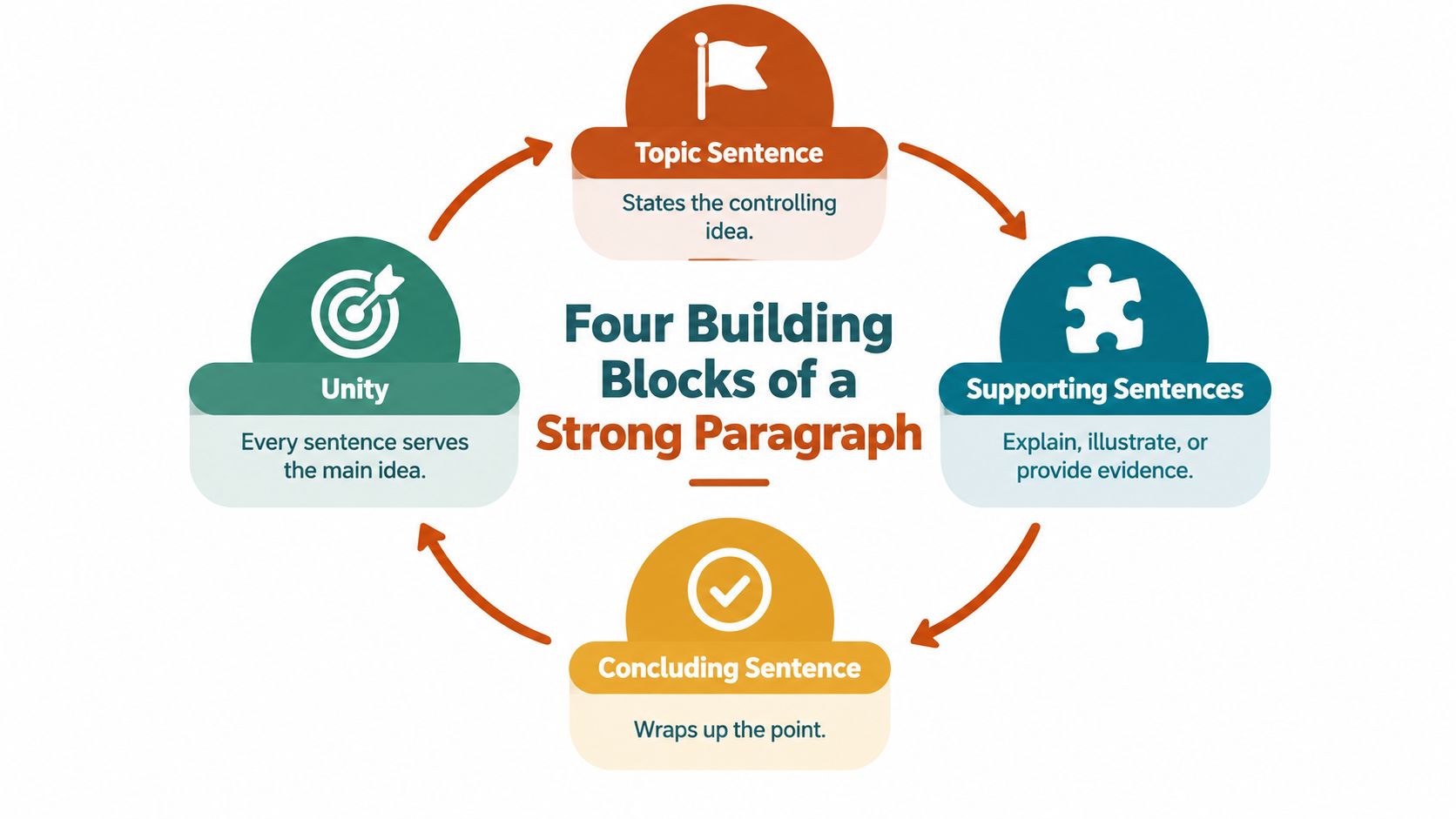
Think of a strong paragraph as a small building. The topic sentence sets the direction, supporting sentences supply the material, coherence helps each part fit together, and a closing or transition sentence shows where the point lands.
Build around a controlling idea
A topic sentence names the subject and what you want readers to understand about it. “The handoff is delayed” names a subject; “The handoff is delayed because the design review hasn't been completed” adds a controlling idea. That second sentence gives the remaining sentences a clear test: do they help explain the delay?
Supporting sentences do the work of explanation. They might provide evidence, examples, or context. A final sentence can clarify the implication or connect the point to what follows. Not every short paragraph needs a formal ending, but longer or more complex paragraphs often benefit from one. The University of Sheffield's guide to paragraph structure identifies these functional parts as a topic sentence, optional explanation, evidence or examples, comment, and conclusion.
Here's the structure in action:
- Topic sentence / claim: The handoff is delayed because the design review isn't complete.
- Supporting detail / evidence: The team still needs approval on the updated screens.
- Comment / implication: Sending the materials now could leave the customer with a version that changes again.
- Link / close: I'll send the confirmed version as soon as the review is finished.
Compare that with a weak version: “The handoff is delayed. Priya sent the screens yesterday. I also have a dentist appointment. The customer asked about the new design.” Several sentences may be true, but they don't develop one clear point. The appointment is unrelated, and the other details haven't been arranged to show how they support the update.
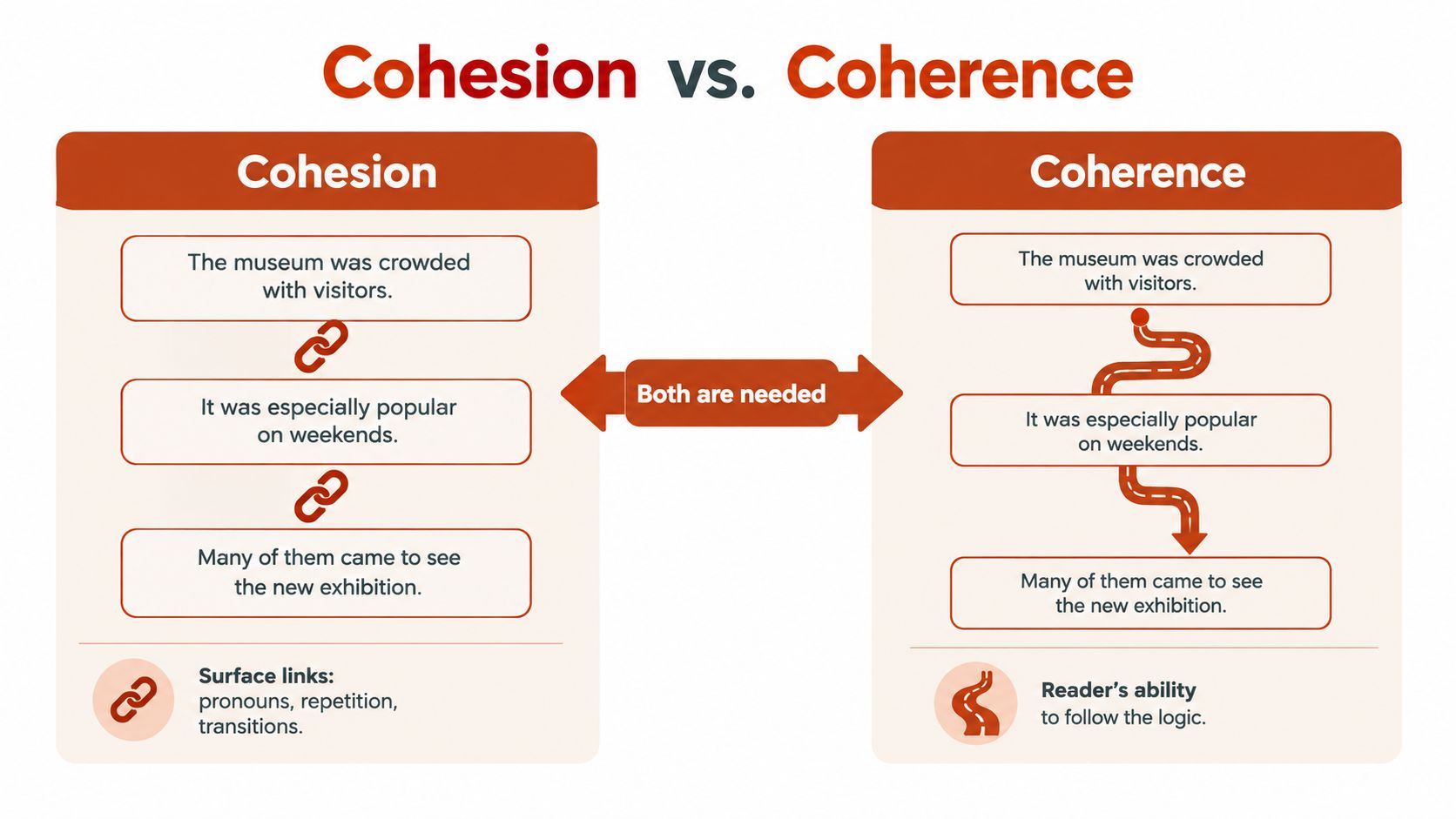
Unity means each sentence serves the paragraph's main idea. Coherence means readers can follow the relationships among those sentences. One without the other isn't enough: related sentences in a confusing order still make readers pause, and beautifully linked sentences can still drift off topic.
Practical rule: Label the parts claim, evidence, comment, and link. If a sentence doesn't fit a label, check whether it belongs elsewhere.
For a broader look at how ideas can be arranged across a whole piece, see this guide to content structure. And if you're shaping an application paragraph around the role's needs, this guide explains how to tailor your cover letter to the job.
Choosing the Right Paragraph Shape for Your Purpose
There isn't one paragraph formula that suits every situation. The useful question isn't “How many sentences should this have?” It's “What does the reader need this paragraph to do?”
| Purpose | Internal sequence | Best for |
|---|---|---|
| Expository | Define the subject, explain it, give an example, clarify the takeaway | Explaining a process or concept |
| Persuasive | State a position, give reasons or evidence, address the consequence | Making a recommendation |
| Analytical | Present a claim, describe evidence, interpret its meaning, connect to the larger point | Discussing findings or a proposal |
| Narrative | Set the scene, describe an event, show a response, reveal what changed | Sharing a short account or case |
An expository paragraph makes an unfamiliar idea easier to understand. In a product specification, you might define a feature, explain what it does, give a use case, and note a constraint. A persuasive paragraph makes a case for action. A support reply might state the recommended fix, explain why it addresses the problem, and tell the customer what to do next.
An analytical paragraph does more than repeat evidence. It interprets what the evidence means and why the reader should care. That shape is useful in research summaries, product reviews, or meeting recaps where a fact needs to lead to a decision. If you're organizing a research discussion, a literature review outline template can help you plan how themes and evidence relate before drafting.
A narrative paragraph moves through an event or sequence. A project update might describe what happened, how the team responded, and what changed as a result. Clinical documentation has its own purpose-driven conventions too: a note may organize information around the reported symptom, assessment, and plan rather than an essay-style claim and conclusion.
Use the shape that serves the reader, not a school template you've outgrown. A brief email may need only a direct point and the next action. A technical explanation may need a definition, an example, and a limitation. The paragraph is well structured when its sequence makes the intended purpose easy to recognize.
Making Sentences Actually Connect
A paragraph can contain plenty of transition words and still be hard to follow. That's because cohesion and coherence are related but different: cohesion is the visible linking between sentences, while coherence is the logic a reader can follow.
For example, “The schedule changed. However, the budget is ready. Therefore, the design team has questions.” The connectors suggest relationships, but they don't tell us what the schedule change has to do with the budget or the questions. Adding “however” or “therefore” can't repair a missing chain of reasoning.
Try four linking moves, in this order:
- Order the ideas logically. Give readers the context before the consequence.
- Repeat a key noun when needed. Repeating “the schedule” can be clearer than using a vague “it.”
- Keep pronouns consistent. Make sure “they” or “this” has an obvious referent.
- Add a transition only when it clarifies a real relationship. Use a connector to mark a contrast, result, or addition, not to disguise a jump.
Before revision: “The client hasn't approved the screens. Therefore, I sent a reminder. However, the delivery date is Thursday. The screens need accessibility review.”
After revision: “The client hasn't approved the screens, so I sent a reminder. The accessibility review also needs the final screen designs. Because the delivery date is Thursday, the team needs approval before it can complete the review.”
The revision gives each sentence a reason to follow the one before it. It also repeats “screens” where that makes the reference clear. A content-analysis study in the Journal of Information and Communication Technology reported that cohesion relied much more on repeated key nouns and consistent pronouns than on transition signals, while logical ordering made up a smaller share of the cohesion devices examined. The practical lesson isn't to count devices. It's to avoid treating transition words as a substitute for clear reasoning.
A Three Minute Editing Protocol for Any Paragraph
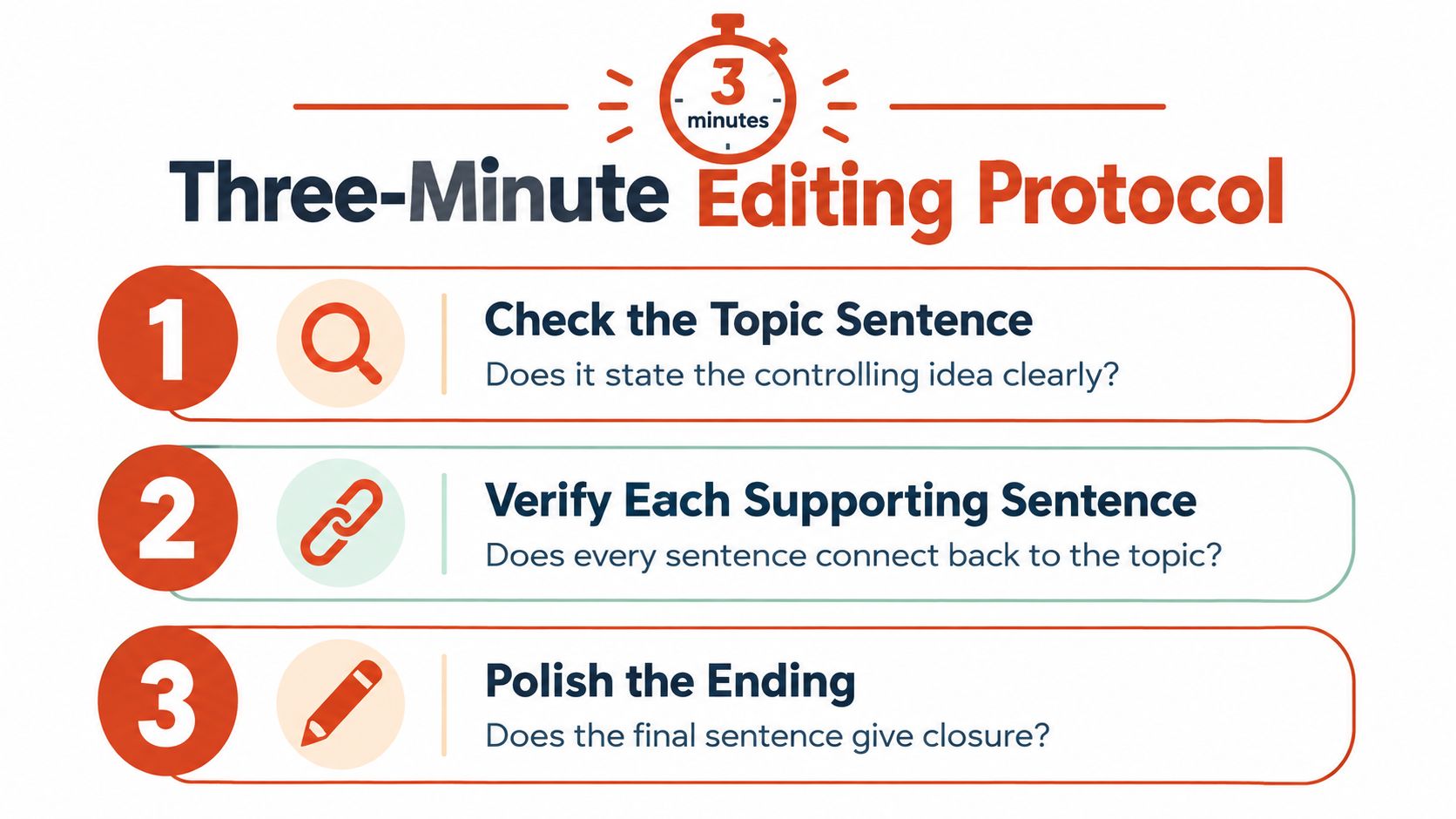
A useful edit starts with the paragraph's job, not its punctuation. Try this routine on an email, a report, or a voice transcript. It turns a vague instruction like “make this clearer” into a series of concrete decisions.
Label each sentence
Read the paragraph once and assign each sentence a job: claim, evidence, comment, or transition. A definition or example can count as supporting material. If a sentence has no clear function, don't automatically delete it. Ask whether the topic sentence needs to be revised to include it, or whether the sentence belongs in another paragraph.
For instance, a rough update might read: “The release is moving to Thursday. I called support yesterday. The final screens are not approved yet. The release notes need the updated screenshots. I'll send the notes after review.” The call to support may be useful in another update, but here the central point is the release delay and its effect on the notes.
Revise, then check the progression
A focused revision could read: “The release is moving to Thursday because the final screens still need approval. The release notes need updated screenshots, so I'll send them after the review is complete.” The point arrives first, the reason follows, and the final sentence explains what happens next.
Now read the paragraph aloud. Listen for a jump in subject, an unclear “it,” or a sentence that doesn't support the point. If you stumble, your reader may have to stop and reconstruct the logic too. An AI grammar-correction workflow can help polish mechanics, but you still need to decide whether the sentences make a coherent argument.
Save this compact checklist where you draft:
- Name the point: Can you state the paragraph's main idea in one sentence?
- Check the opening: Does the first sentence make that idea clear?
- Label the support: Does each remaining sentence explain, illustrate, or support the point?
- Test references: Are names and pronouns clear?
- Check the order: Does each sentence build on what came before?
- Finish deliberately: Does the ending close the point or prepare for what follows?
Dictating and Polishing Paragraphs With Voice Tools
Voice drafting is fast, but speech doesn't arrive with paragraph breaks neatly attached. Speakers repeat themselves, change direction halfway through a thought, or add a detail before explaining why it matters. A cleanup tool can improve punctuation, but a good workflow starts with the way you speak.
Before dictating, decide what the paragraph needs to accomplish. Say the main point first, then explain or support it. When you finish that idea, pause or say “new paragraph” before moving to the next. That small habit gives transcription software a useful signal and gives you a natural point to review.
Match cleanup to the paragraph's job
After transcription, check the output against the building blocks:
- Topic sentence: Is the main idea stated early, or does the reader have to dig through your setup?
- Supporting sentences: Did the transcript keep relevant explanations together and move a digression elsewhere?
- Coherence: Can you follow the reasoning without relying on a string of “and then” or “so”?
- Closing: Does the final sentence finish the thought, state the next action, or set up the next paragraph?
The amount of intervention depends on the draft. Local dictation is useful when you want a quick transcript close to your original phrasing. AI-assisted cleanup can be useful when spoken self-corrections and filler make the text difficult to read, but review the edits before you send them. The software can reshape wording; you're responsible for making sure it preserves your intent.
A custom dictionary helps with names and technical terms that speech recognition might otherwise mishear. Context rules can also help maintain the right register, such as a professional tone for an email or technical wording for documentation. For more on choosing an appropriate voice tool, see this guide to dictation software for writers.
For teams assembling proposals, paragraph structure matters because reviewers need to locate the answer, supporting detail, and next step quickly. A practical overview of bid writing tools for UK SMEs may help teams consider how writing tools fit into that work.
Common Misconceptions That Keep Writers Stuck
Myth: Every paragraph needs exactly five sentences. A fixed count can be a classroom exercise, but it isn't a universal standard. Use topical consistency instead: keep the sentences that develop the point, and split the paragraph when it starts doing another job.
Myth: A paragraph needs to start with a transition word. A transition can help when it signals a real connection to the previous idea. But “however” at the beginning won't fix a confusing topic sentence or an illogical sequence.
Myth: Grammar corrections will solve structural problems. A polished sentence can still be irrelevant to the paragraph around it. Check the idea and its progression before spending time on commas.
Structure instruction can improve writers' attention to how ideas connect during revision, as reported in research on coherence instruction for ESL learners. Multilingual writers may also bring discourse patterns from other languages into English. That doesn't automatically mean their grammar is wrong. Review the paragraph's purpose and intended meaning before rewriting it wholesale.
A Repeatable Workflow and Quick Answers
Name the idea, choose a shape that fits the purpose, draft, label the sentences, and remove or relocate anything that doesn't serve the point. Then read aloud for logical progression. You've got a repeatable way to turn a rough paragraph into one a colleague can scan and understand.
How long should a paragraph be? Long enough to develop one idea, and no longer than the idea can stay focused.
What if I have two ideas? Give each idea its own paragraph unless one clearly supports the other.
Why do my transitions still feel off? Check sentence order and the reasoning first. Add a transition only when it names a real connection.
What if dictation produces one long sentence? Add paragraph breaks at changes in purpose, then check that each paragraph has one controlling idea.
Try the workflow on your next dictated email: state the point, check each sentence's job, and read the result aloud. AIDictation turns speech into text and offers AI cleanup for formatting, filler words, and self-corrections, so you can review the structure before sending.
Frequently Asked Questions
What does Understanding Paragraph Structure That Actually Works cover?
You dictate a quick update while walking between meetings: the deadline moved, design still needs to review the draft, and you'll send the revised version after lunch. The speech-to-text result captures every word, but on your screen it's one dense paragraph.
Who should read Understanding Paragraph Structure That Actually Works?
Understanding Paragraph Structure That Actually Works is most useful for readers who want clear, practical guidance and a faster path to the main takeaways without guessing what matters most.
What are the main takeaways from Understanding Paragraph Structure That Actually Works?
Key topics include Table of Contents, Why Paragraphs Break and How Structure Fixes Them, The Four Building Blocks of Any Strong Paragraph.
Ready to try AI Dictation?
Experience fast voice-to-text on your device. Free to download.
Download FreeRelated Posts
Transcribing Audio Files: A Practical Workflow That Works
Learn a practical workflow for transcribing audio files, from prep and engine choice to cleanup, timestamps, and HIPAA-ready privacy.
Transcription Audio to Text: A Practical Workflow Guide
Learn transcription audio to text with a clean workflow covering tools, recording, cleanup, and accuracy tips that work on macOS and beyond.
10 Professional Email Writing Tips for 2026
Master your inbox with these 10 professional email writing tips. Learn to write clear, concise, and effective emails that get results. For 2026.