Specification Writing: A Practical How-To Guide for 2026
You're probably staring at a draft that started as a clean idea and turned into a negotiation between engineering, operations, compliance, procurement, and whoever last edited the shared document. The drawings look fine. The meeting notes made sense at the time. Then someone asks a simple question about materials, tolerances, workflow, acceptance, or substitutions, and suddenly nobody is sure what the spec requires.
That's the point where specification writing stops being admin work and becomes delivery work.
A good specification doesn't just describe a result. It gives every person touching the project the same interpretation of what must happen, what must not happen, and how decisions get made when reality gets messy. That applies whether you're writing for construction, product delivery, software, clinical workflows, or any cross-functional system where ambiguity gets expensive fast.
Table of Contents
- Why Clear Specifications Are Your Project's Foundation
- Define Your Goals and Audience First
- The Anatomy of an Actionable Specification
- Drafting with Precision and Clarity
- Accelerate Spec Writing with AIDictation
- Navigating Pitfalls and the Sign-Off Process
- From Document to Done
Why Clear Specifications Are Your Project's Foundation
Most projects don't fail because nobody cared. They fail because each team filled in the blanks differently.
A developer reads “fast response.” Procurement reads “lowest acceptable cost.” Operations reads “stable in production.” A contractor reads “use common practice.” Legal reads “we left ourselves room.” The work moves forward anyway, and the collisions happen later when changes are harder, slower, and more political.
That's why specification writing matters. It creates a shared operating language before money is committed, before dependencies lock in, and before the review cycle becomes damage control. This isn't a new discipline. Specification writing has been part of formal construction documentation for nearly two centuries, with early works published in the 1840s, and its growth tracked the rise of the general contractor model that needed a standard way to communicate complex requirements, as noted in this historical review from NBS.
Start with intent, not formatting
Teams often jump straight to templates. That's backwards.
Before you write a sentence, define two things:
- Who must act on this document. Designers, engineers, vendors, reviewers, installers, testers, operators, or approvers all read specs differently.
- What decision the spec must support. Bidding, design alignment, procurement, implementation, validation, or sign-off each demand different levels of detail.
If those aren't clear, the rest of the document becomes polished confusion.
Practical rule: A spec is working when two different readers reach the same conclusion without a follow-up meeting.
Bureaucracy is the wrong frame
People resist specs when they've only seen bad ones. Bloated text. Copied boilerplate. Requirements that read like they were written to avoid accountability. That isn't discipline. That's drift.
Useful specs are closer to execution docs than paperwork. They define materials, products, quality standards, and installation or implementation expectations in a way that lets teams work from the same criteria. That's the same principle behind strong modern technical documentation strategies. The goal isn't more pages. It's fewer interpretations.
When I see a team struggling with rework, the cause usually shows up long before build or procurement. It shows up in the pre-writing phase, where nobody forced the hard questions early enough. That's the cheapest place to remove ambiguity, and still the place teams often rush through.
Define Your Goals and Audience First
The best specification writing starts before the draft. If you can't explain why the document exists, who it serves, and what “acceptable” looks like, you're not ready to write. You're still collecting assumptions.
That's worth saying plainly because many teams treat specs like a formatting exercise. They open the last project, duplicate a section, swap names, and start editing. That approach creates documents that look finished but carry old decisions, outdated language, and hidden conflicts.
The professional standard is much higher. The American Society of Civil Engineers treats specification writing as a formal skill and offers a course worth 1.6 CEUs / 16 PDHs, and related industry guidance emphasizes that master specifications should be reviewed at least annually to keep up with codes and standards in ASCE's specification writing course overview.
Ask the questions that shape the whole document
Before drafting, lock down the charter behind the spec.
| Question | Why it matters | What a strong answer sounds like |
|---|---|---|
| Who is the primary reader? | It controls vocabulary and level of detail. | “Procurement and installers will use this for selection and execution.” |
| What problem is this solving? | It prevents generic requirements. | “We need a standard for acceptable finish quality in humid conditions.” |
| What is in scope? | It keeps the doc from swallowing adjacent work. | “Surface prep and installation are included. Ongoing maintenance is not.” |
| What does success look like? | It forces measurable acceptance. | “Independent review can verify compliance without follow-up interpretation.” |
| What constraints already exist? | It keeps the spec realistic. | “Must align with budget, approved materials, and applicable standards.” |
These answers don't need to be long. They need to be explicit.
Write for the person who has to act
A common mistake is writing for reviewers instead of operators. Reviewers want completeness. Operators need execution.
That trade-off changes how you phrase requirements. A designer may want broad flexibility. A field team or implementation team needs a usable instruction. A PM wants scope boundaries. Compliance wants traceability. Good specification writing respects all of them, but it doesn't flatten them into vague prose.
Use this quick audience split:
- Decision-makers need scope, constraints, and trade-offs.
- Executors need exact requirements, tolerances, and acceptance rules.
- Reviewers need references, versions, and consistency with related documents.
- Approvers need risk visibility and confidence that conflicts were resolved.
If the same paragraph is trying to satisfy all four groups at once, it usually satisfies none of them.
Define done before you define detail
Most disputes happen because teams specify activity instead of outcome. They describe what someone should do, but not what counts as complete.
A stronger approach is to write acceptance logic early. Ask:
- What can someone verify independently?
- What would trigger rejection or revision?
- What local or project-specific conditions require a supplement?
That last point matters more than many teams realize. Precision doesn't mean pretending every site, region, environment, or workflow is identical. It means defining the baseline requirement and then clearly stating where local conditions modify it.
A spec should answer, in plain language, “What are we requiring, for whom, under what constraints, and how will we know it was met?” If you can answer that before drafting, the writing gets easier. If you can't, the draft becomes the place where your uncertainty leaks out.
The Anatomy of an Actionable Specification
A usable spec has structure before it has style. You can write clean sentences and still ship a bad document if key sections are missing, mixed together, or buried in the wrong place.
The workflow specification writing teams need is straightforward: requirements intake, drafting, multi-stakeholder review, and revision. Industry guidance also recommends standardized classification systems such as Uniclass or CAWS so specs stay consistent across related project artifacts, as outlined in Deltek's guidance on specification writing services.
The sections that do real work
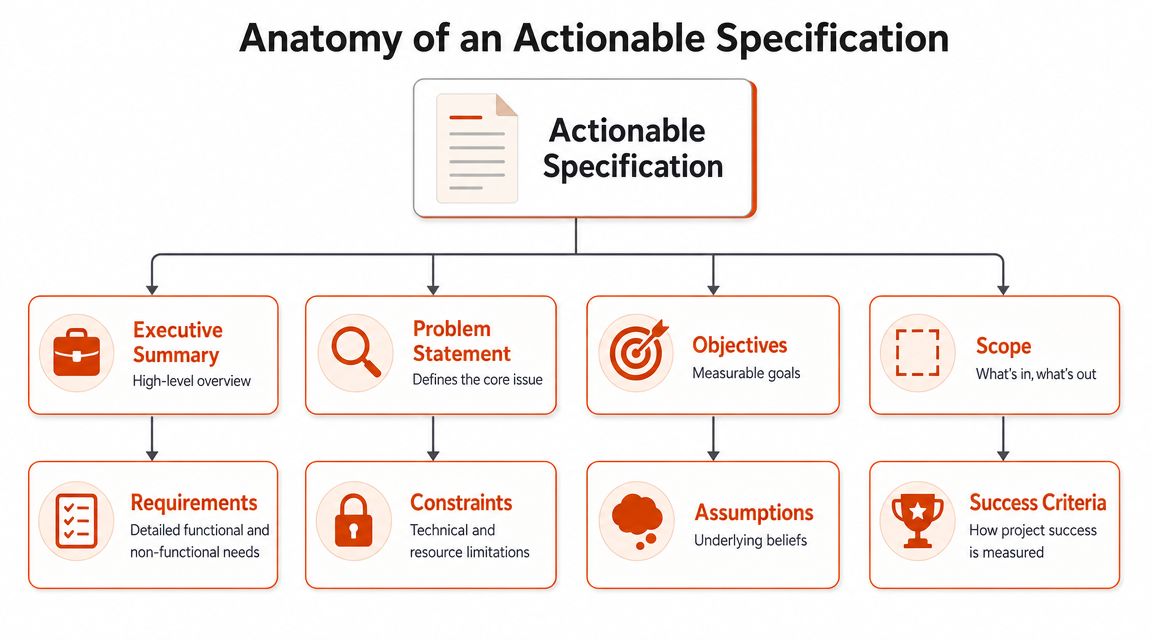
An actionable specification usually needs these components:
- Executive summary. This is the short orientation layer. It tells a busy reader what the spec covers and why it exists.
- Problem statement. Name the issue being solved. If this is fuzzy, every downstream requirement drifts.
- Objectives. State the intended outcomes in verifiable terms.
- Scope. Be explicit about what's included and what is not.
- Requirements. Separate functional needs from quality, performance, operational, or compliance constraints.
- Constraints. Budget, technical environment, approved products, compatibility limits, and regulatory boundaries belong here.
- Assumptions. This section surfaces hidden dependencies that would otherwise stay implicit.
- Success criteria. Define the conditions under which the work is accepted.
That list is simple on purpose. Teams overcomplicate the skeleton and underinvest in the quality of the content inside it.
What each section prevents
A spec template isn't useful because it looks formal. It's useful because each part blocks a common failure mode.
| Section | Failure it prevents |
|---|---|
| Problem statement | Solving the wrong issue well |
| Scope | Scope creep disguised as helpfulness |
| Constraints | Promises the project can't actually support |
| Assumptions | Hidden dependencies surfacing late |
| Success criteria | Endless debate about whether the work is done |
The missing section often tells you what kind of trouble is coming. If there's no assumptions section, expect surprises. If there's no out-of-scope boundary, expect “small additions” to pile up. If success criteria are weak, expect approval fights.
Keep related artifacts coordinated
The document itself is only one part of the system. The spec has to align with drawings, schedules, digital models, task lists, test plans, or procurement records. That's where classification systems and cross-references matter.
A spec in isolation is usually a liability. A spec that matches the rest of the project becomes a control point.
A practical pattern is to assign every major requirement a stable identifier and use the same terminology everywhere else. Don't call it one thing in the drawing set, another in the schedule, and a third in the review comments. Coordination failures often start as naming failures.
If you want one simple test for structure, use this: can a new reviewer find the purpose, scope, key requirements, exceptions, and acceptance rules in a few minutes? If not, the anatomy needs work before the prose does.
Drafting with Precision and Clarity
Most weak specs don't fail because the writer lacked expertise. They fail because the language left too much room for interpretation.
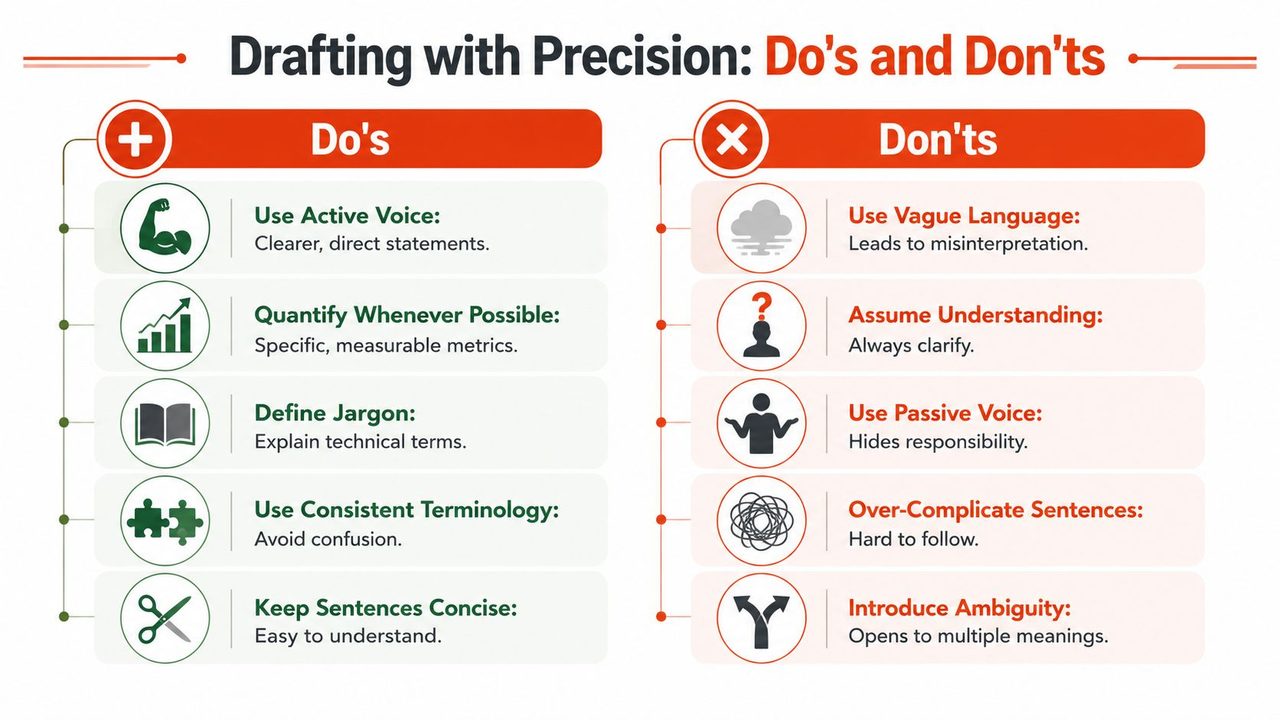
The benchmark used across expert guidance is that a specification should be clear, concise, correct, complete, consistent, and coordinated. The biggest drafting problem is still vague language, and the practical fix is to replace subjective wording with specific, measurable criteria, as summarized in this industry guidance on effective specification writing.
Write so a stranger can execute it
The fastest way to improve drafting is to stop writing for people who already know what you mean.
Bad specification writing assumes context. Good specification writing makes context unnecessary.
Compare these examples:
| Weak wording | Stronger wording |
|---|---|
| Use durable material | Use the approved material listed in the project submittal set and install per stated project requirements |
| Provide fast response | Response requirement must meet the acceptance criteria defined in the performance section |
| Finish shall be high quality | Finish must match the approved sample and pass review against documented acceptance criteria |
| Use standard installation | Use the installation method identified in the referenced project documentation |
The stronger versions aren't flashy. They reduce interpretation.
Sentence mechanics matter more than people admit
A lot of ambiguity is grammatical, not technical. Long sentences hide responsibility. Passive voice blurs ownership. Mixed conditions and exceptions create accidental loopholes.
Use these drafting habits:
- Prefer active voice. “Contractor submits sample for approval” is clearer than “Sample shall be submitted for approval.”
- Keep one issue per paragraph. If a paragraph contains requirement, exception, rationale, and note, split it.
- Put subjects close to verbs. Don't separate actor and action with a pile of qualifiers.
- Cut filler phrases. If a phrase doesn't change meaning, delete it.
- Define jargon once. Then use the same term consistently.
A practical way to enforce consistency is to maintain a project term list. If your team uses internal acronyms, product names, shorthand, or client-specific labels, lock them down early. Tools that support controlled terminology help here. For example, a custom term list or project-specific dictation dictionary setup can reduce cleanup when technical names and abbreviations repeat across a draft.
Use measurable language where it matters
You won't quantify every line, and you shouldn't force artificial metrics where they don't belong. But if a requirement can be checked, write it so it can be checked.
Good replacements for vague wording include:
- Instead of “appropriate,” write the applicable standard, approved reference, or named condition.
- Instead of “user-friendly,” define the task outcome or acceptance test.
- Instead of “as needed,” state the trigger condition.
- Instead of “high performance,” define the required result.
Ask an unfamiliar reviewer to read the requirement and tell you what action they would take. If they hesitate, the sentence is still doing too much guessing.
Why voice drafting can help, if you control it
Many experienced writers draft better by speaking first. That sounds counterintuitive for technical documents, but it works when the tool doesn't dump raw transcript into the spec.
Spoken drafting helps capture intent, exceptions, and edge cases quickly. The catch is that raw speech is messy. People self-correct, repeat themselves, and wander. That's why voice tools only help if they can clean filler, preserve technical terms, and format output predictably.
For specification work, the useful pattern is to speak the rough requirement, then edit for testability. Voice gets the thought out. Deliberate drafting turns it into enforceable language. Teams that skip the second step don't save time. They just move ambiguity into a different format.
Accelerate Spec Writing with AIDictation
The common assumption is that faster drafting produces sloppier specs. That's true if speed means dumping words into a document and calling it done. It's not true if speed means capturing clearer inputs earlier, standardizing terminology, and reducing cleanup during revision.

A lot of specification work is still bottlenecked by friction at the wrong stage. Subject matter experts talk faster than they type. PMs gather requirements in meetings, site walks, calls, and ad hoc reviews. Engineers spot edge cases while looking at drawings or reviewing dependencies, not while sitting down to write polished prose. The core problem isn't lack of knowledge. It's poor capture.
That's where voice-to-text becomes practical, not gimmicky.
Where voice fits in the workflow
Used well, voice drafting helps in three places:
-
Requirements intake
Capture raw constraints, decisions, exceptions, and open questions while stakeholders are speaking. This is especially useful when details arrive fragmented across meetings. -
First-pass drafting
Dictate section summaries, assumptions, rationale, and issue lists faster than typing them from scratch. -
Revision and clarification
When reviewers leave comments, speak the proposed replacement language while the issue is fresh, then tighten it before release.
This works best when the output is cleaned automatically rather than preserved as literal transcript. That's one reason AI-assisted documentation workflows are getting more attention. If you want a broader view, Trupeer's guide to AI in documentation is a useful read on where these tools help and where human review still matters.
What actually helps in a spec environment
For specification writing, the useful features are specific.
- Voice drafting with cleanup helps capture ideas without keeping every filler word, restart, or verbal correction.
- Custom dictionaries matter because specs use acronyms, manufacturer names, internal codes, and technical language that generic dictation often mangles.
- Context-aware formatting matters because a requirements list, approval note, and design rationale shouldn't all come out in the same tone.
- Local processing options matter when teams are handling proprietary, regulated, or client-sensitive material.
One tool that fits this pattern is AIDictation's voice typing workflow for structured writing. It's a macOS voice-to-text app that can switch between on-device and cloud-based modes, clean filler words, apply grammar and punctuation, support a custom dictionary, and adapt formatting by context. In practice, that makes it suitable for turning spoken requirement drafts into cleaner working text before formal review.
Use it for capture, not authority
This is the key trade-off. A voice tool can accelerate the document. It cannot validate the requirement.
Don't treat dictated output as approved language. Treat it as a higher-quality first draft. The writer still needs to verify terminology, remove accidental ambiguity, align with related documents, and check that every requirement survives independent interpretation.
A simple operating model looks like this:
- Dictate raw requirements after stakeholder sessions.
- Normalize terminology against your project glossary.
- Convert vague statements into measurable or reference-based requirements.
- Run cross-functional review.
- Freeze approved language and version it.
After you've seen the workflow in action, a short demo helps connect the pieces:
The biggest mistake teams make with tools is expecting automation to remove judgment. It won't. What it can do is reduce the lag between expert knowledge and usable draft text, which is often where quality starts slipping.
Navigating Pitfalls and the Sign-Off Process
A spec isn't finished when the writing stops. It's finished when the right people agree on the right version and can use it without reopening settled questions.
The hard part is that review often rewards noise over value. Someone wants to add detail because detail feels safer. Someone else wants flexibility because local conditions vary. Another reviewer pastes old manufacturer language that doesn't fully fit the project. This is how a clean spec turns into a contradictory one.
Public-sector guidance speaks to the core balancing act. Teams need to avoid vague terms while still keeping specs usable, which means replacing subjective language with specific, measurable criteria and creating supplements for regional or site-specific conditions where needed, as reflected in New Jersey transportation guidance on specification language.
The review mistakes that keep repeating
The same problems show up across industries:
- Vagueness disguised as flexibility. “Use suitable material” sounds adaptable but gives nobody a real decision rule.
- Gold plating. Reviewers add preferences, edge cases, and nice-to-haves until the spec becomes harder to execute.
- Outdated inserts. Copied language brings old assumptions, old standards, and old conflicts into a new job.
- Unowned comments. Everyone suggests changes, but nobody resolves trade-offs.
The sign-off process works when every open issue has an owner, a decision, and a recorded reason.
Run review like a decision process
Don't hold a meeting where people “go through the document” line by line with no triage. That burns time and hides priority.
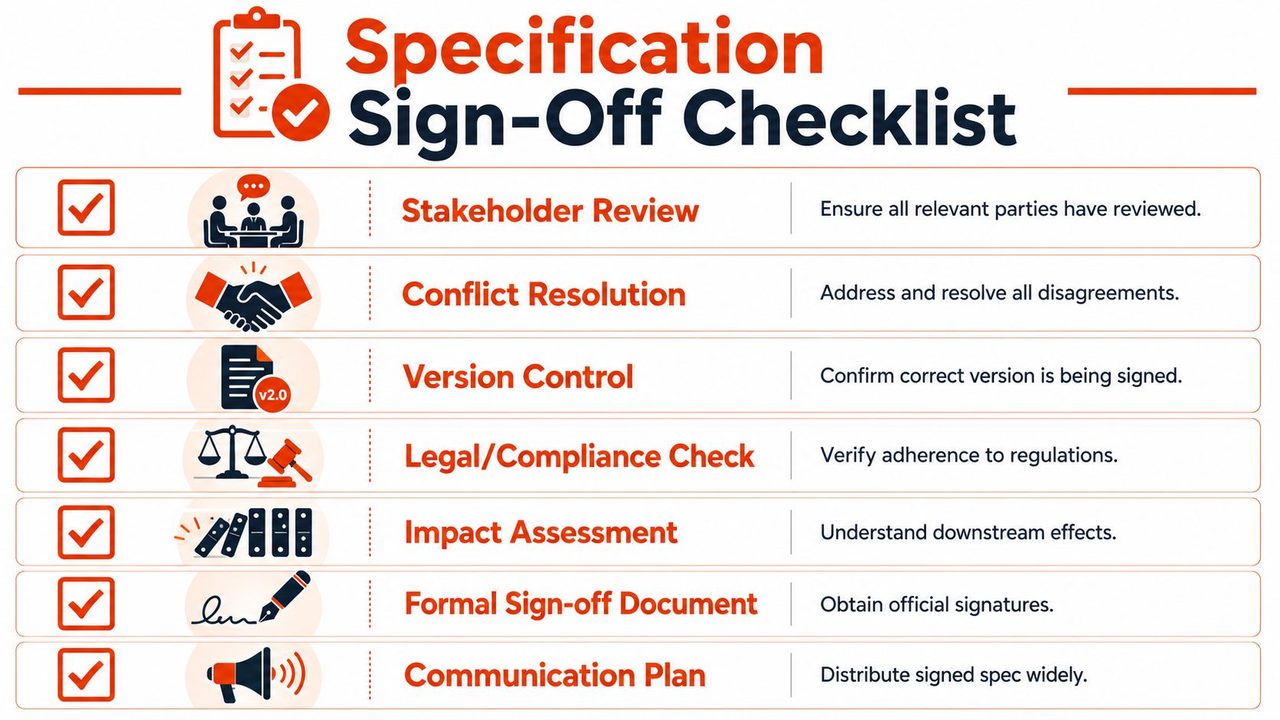
Use a sign-off checklist instead:
-
Confirm the current version
Everyone must review the same draft. This sounds basic because it is. It's also one of the easiest things to get wrong. -
Sort comments into categories
Split feedback into required correction, optional improvement, conflict, and out-of-scope request. -
Resolve conflicts live
If engineering and operations disagree, don't leave both comments in the document. Force a decision and record it. -
Check downstream impact
A single wording change can break alignment with drawings, schedules, test procedures, or procurement assumptions. -
Require formal approval
Sign-off should identify who approved, what version they approved, and any controlled exceptions.
Protect flexibility without creating ambiguity
This is where mature specification writing stands out. You don't want a rigid document that breaks the first time site reality changes. You also don't want a loose document that invites dispute.
The fix is to separate core requirements from local supplements. Keep the baseline requirement stable. Add regional, climatic, site, operational, or client-specific adjustments in a clearly named supplement rather than muddying the main language.
That gives teams a spec they can enforce and adapt.
From Document to Done
Strong specification writing is a leadership skill disguised as document work. It forces clarity early, reveals hidden disagreements, and gives teams a shared reference when pressure rises.
The workflow is simple even when the work isn't. Define the goal and audience. Build a structure that makes decisions visible. Draft with measurable language. Review for coordination, not just grammar. Then lock sign-off to a controlled version.
If your team still drafts specs manually from scattered notes, voice capture can remove a lot of friction. A practical starting point is to see how voice recognition in Google Docs fits early drafting workflows, then apply the same discipline of cleanup, review, and approval to your formal spec process.
A good spec saves time long after the writing is over. It reduces follow-up questions, lowers interpretation risk, and gives everyone less room to guess.
If you want to turn spoken notes, review comments, and technical terminology into cleaner draft text without losing control of the final wording, AIDictation is built for that kind of workflow on macOS. It can help capture requirements faster, standardize terminology with a custom dictionary, and keep sensitive drafting local when needed.
Frequently Asked Questions
What does Specification Writing: A Practical How-To Guide for 2026 cover?
You're probably staring at a draft that started as a clean idea and turned into a negotiation between engineering, operations, compliance, procurement, and whoever last edited the shared document. The drawings look fine.
Who should read Specification Writing: A Practical How-To Guide for 2026?
Specification Writing: A Practical How-To Guide for 2026 is most useful for readers who want clear, practical guidance and a faster path to the main takeaways without guessing what matters most.
What are the main takeaways from Specification Writing: A Practical How-To Guide for 2026?
Key topics include Table of Contents, Why Clear Specifications Are Your Project's Foundation, Start with intent, not formatting.
Ready to try AI Dictation?
Experience fast voice-to-text on your device. Free to download.
Download FreeRelated Posts
Verbal Ink Transcription Workflows Today
Explore verbal ink transcription workflows, accuracy benchmarks, and how modern AI dictation tools compare to traditional human transcription services.
Apple Voice Recognition Software: Key Pros and Cons
Learn how Apple voice recognition software turns speech into text on your device, where it excels, and what tasks still challenge it in 2026.
Dictation on macOS: Setup, Apps, and Pro Tips
Master dictation on macOS with clear setup steps, app comparisons, privacy settings, and accuracy tips to turn your voice into clean text fast.