Medical Transcription AI: A Clinical Guide
The most common advice about medical transcription AI is also the least useful: choose the system with the highest accuracy score. A transcript can achieve strong word-level performance and still produce an unsafe clinical note if it drops a negation, assigns a statement to the wrong speaker, omits an allergy, or invents a medication detail during summarization.
Healthcare teams should treat these systems as clinical documentation assistants, not autonomous authors of the medical record. The practical question is not whether software can turn speech into text. It's whether the resulting draft preserves clinically important meaning across specialties, speakers, accents, documentation formats, and EHR workflows, with a review process that catches what the model gets wrong.
Table of Contents
- The Hidden Risks of AI Clinical Documentation
- How Medical Transcription AI Actually Works
- Evaluating Accuracy Across Different Clinical Settings
- Navigating HIPAA Compliance and Dialect Equity
- Comparing Vendor Models and Deployment Options
- Implementing AI Transcription in Clinical Workflows
- The Future of Assisted Medical Documentation
The Hidden Risks of AI Clinical Documentation
Word error rate is a useful engineering measure, but it isn't a patient-safety measure by itself. It treats every word as though it carries the same clinical weight. A missed article is inconvenient. A missed “no” in “no history of stroke” can reverse the meaning of an encounter. A plausible but incorrect dosage can create a dangerous instruction that looks polished enough to escape a hurried review.
The more advanced the system becomes, the less obvious some errors are. Basic speech recognition may produce visibly broken text. Ambient documentation tools can produce fluent, well-structured notes that contain omissions, hallucinations, and internal inconsistencies. The note may read naturally while the assessment conflicts with the history, a patient statement appears as a clinician finding, or a treatment plan includes information that nobody said.
Why fluent notes deserve more scrutiny
A 2025 evaluation found that AI ambient notes were comparable to physician-written notes overall, yet they were less succinct and more prone to hallucination. Hallucinations appeared in 31% of ambient notes compared with 20% of physician notes, according to the evaluation of AI-generated ambient clinical notes.
That finding changes how reviewers should work. Reading every sentence with equal attention isn't an efficient safety strategy. Reviewers should focus first on medications, allergies, diagnoses, negations, quantities, speaker attribution, and changes from the previous plan. These are the places where a polished draft can cause more harm than an obviously incomplete transcript.
Practical rule: The more confidently a system states a clinical fact, the more important it is to verify that the fact appears in the encounter or an approved source record.
Clinical governance also needs a clear response to hallucination rather than a vague promise that models will improve. Teams evaluating approaches to keeping AI models trustworthy should apply the same discipline to documentation: identify failure modes, preserve an audit trail, define escalation rules, and keep a qualified clinician responsible for the signed note.
The right acceptance criterion is therefore not “the AI writes a good note.” It is “the AI produces a useful draft that a clinician can verify without losing control of the record.” That distinction should shape procurement, pilot design, staff training, and every EHR write-back permission.
How Medical Transcription AI Actually Works
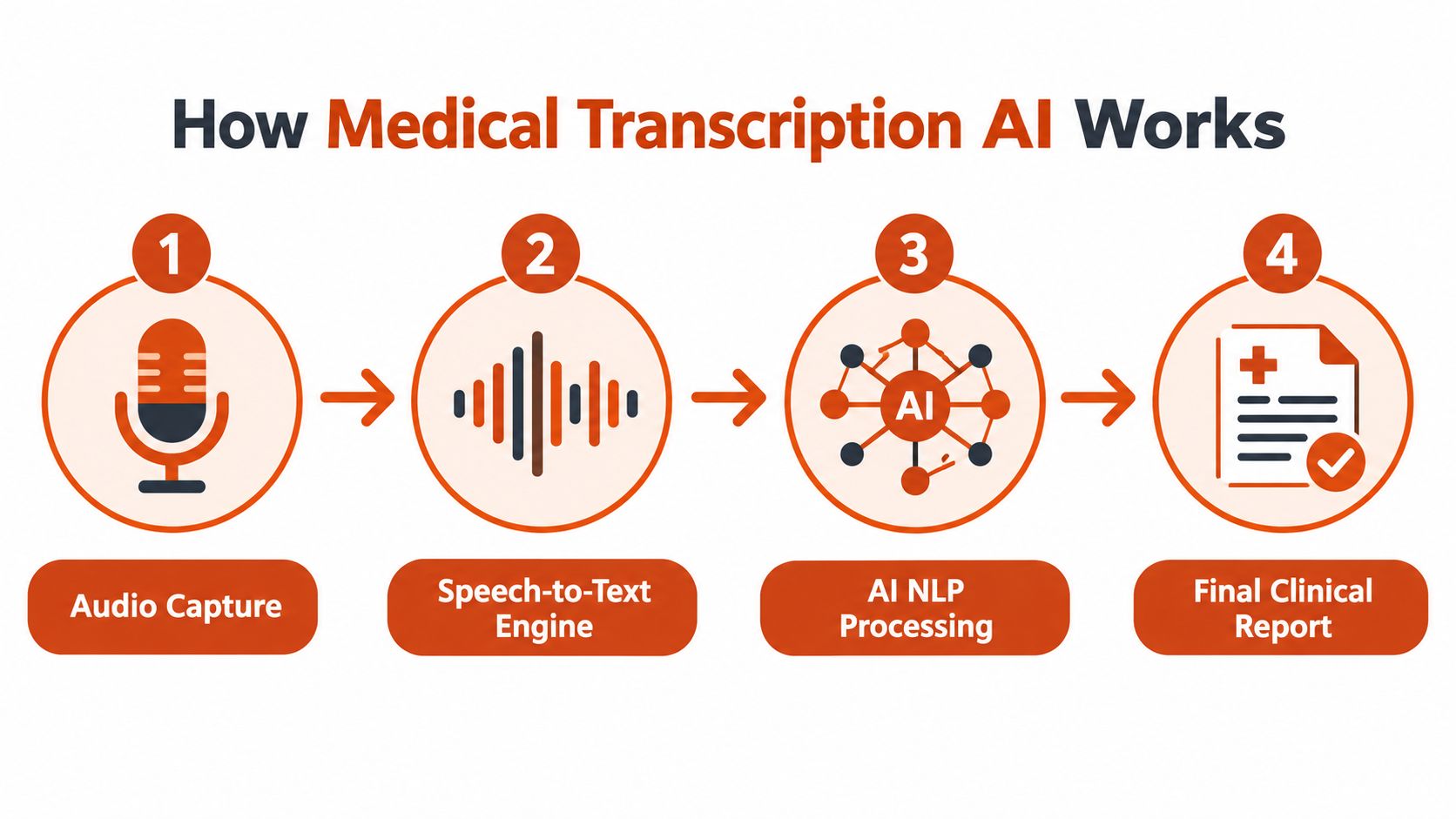
Medical transcription AI is a pipeline, not a single capability. Each stage solves a different problem, and an error introduced early can survive every later stage.
From sound to words
First, the system captures audio through a microphone, mobile device, workstation, or approved ambient recording setup. Audio quality matters because background noise, distance from the speaker, overlapping voices, room acoustics, masks, and quiet speech all affect what the recognition engine receives.
The speech-to-text stage converts sound into a draft transcript. Structured dictation is the easiest environment because one clinician speaks directly to the system, often using predictable phrases and deliberate pacing. Ambient documentation is harder. The system must identify speech from a natural conversation, separate speakers, handle interruptions, and decide which sounds belong in the clinical note.
Medical language models then apply vocabulary and context. They may recognize drug names, anatomical terms, procedures, abbreviations, and common note structures more effectively than a general-purpose system. They can also format content into sections such as history, examination, assessment, and plan. That formatting is helpful, but it introduces a new risk: the software is no longer copying words only. It is interpreting and reorganizing them.
A useful overview of the distinction between recognition engines and broader language processing appears in this guide to artificial intelligence in speech recognition.
Where the clinical note can change
Speaker separation assigns words to the clinician, patient, caregiver, or another participant. If attribution fails, a patient's concern can become a documented diagnosis, or a clinician's suggestion can appear as a confirmed symptom. Summarization adds another layer. It compresses conversation into a structured note, which can improve readability while also removing qualifiers, chronology, or uncertainty.
The final stage sends the draft into an EHR, clipboard workflow, document editor, or review queue. Integration isn't merely a technical convenience. It determines whether the clinician sees the source transcript, can compare the draft with the audio, can correct errors easily, and can prevent an unsigned draft from being treated as a final record.
A safe architecture makes uncertainty visible and preserves human control. It should support correction, retain appropriate provenance, restrict automatic write-back, and make it clear which content came from spoken audio versus a template or external patient record.
Evaluating Accuracy Across Different Clinical Settings
Medical transcription AI doesn't have one stable accuracy level. Performance depends on how speech is produced, who is speaking, how many people are present, how specialized the vocabulary is, and whether the system must summarize rather than transcribe.
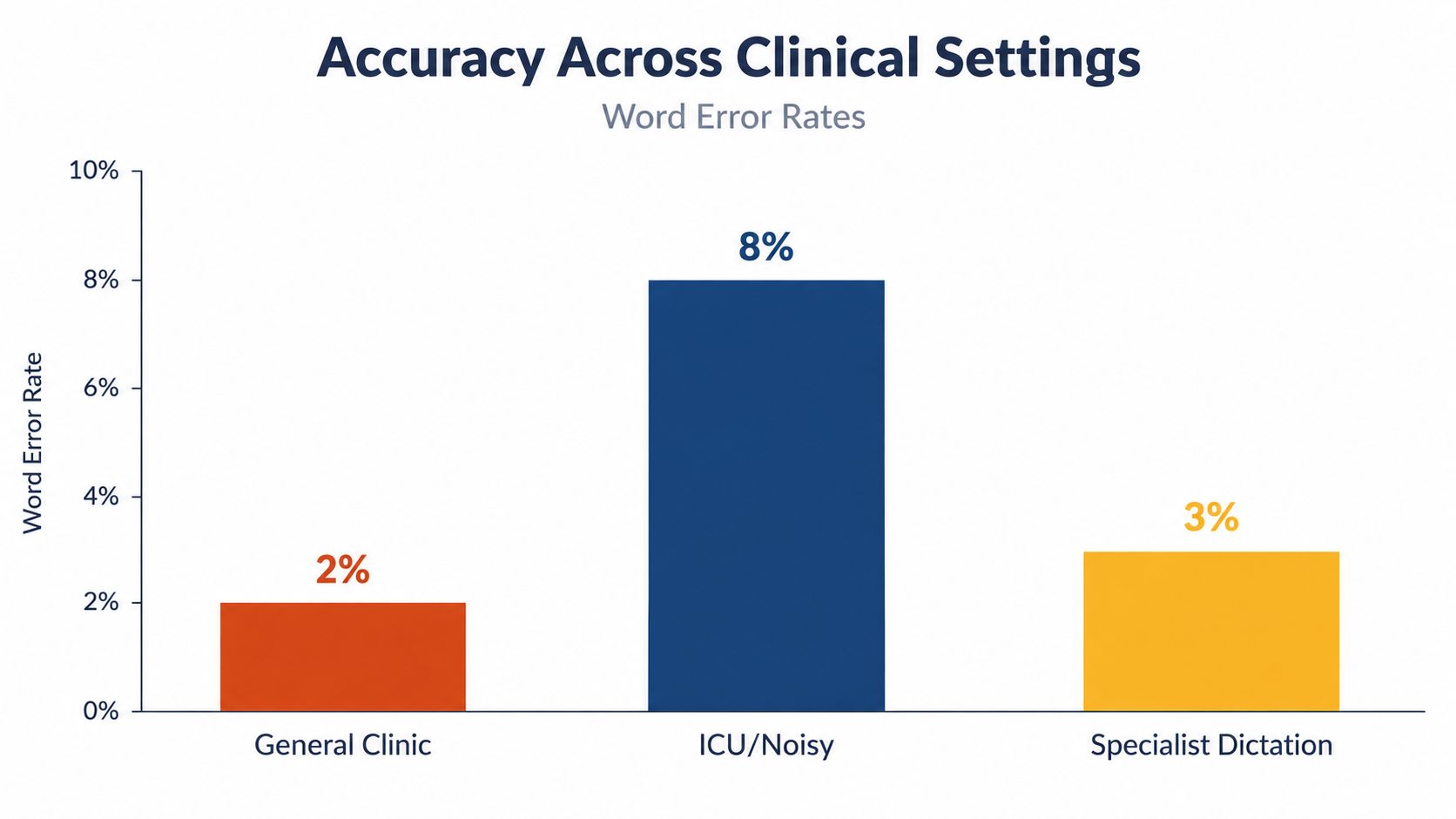
A 2025 systematic review reported word error rates ranging from 0.087 in controlled dictation settings to more than 50% in conversational or multi-speaker scenarios, while F1 scores varied from 0.416 to 0.856 depending on the use case, as documented in the systematic review of medical speech recognition and clinical documentation. Those figures don't describe a contradiction. They describe different operating conditions.
Dictation isn't the same as conversation
A physician dictating a discharge summary in a quiet room gives the system a clean signal, one speaker, and a familiar structure. An emergency encounter includes interruptions, family members, alarms, incomplete sentences, rapid handoffs, and speech that doesn't follow a documentation template. Nursing and mental-health documentation can also involve conversational language, multiple speakers, or sensitive details that are difficult to classify correctly.
The clinical practice review reports that some studies found word error rates as high as 71% in emergency or nursing documentation and 97% to 98% in some mental-health settings, reinforcing the need to validate a system in the actual environment where it will be used. The review of clinical practice and medical ASR evaluation also supports practical safeguards such as speaker segmentation, constrained dictation styles, and mandatory review for high-risk notes.
Build a specialty-specific test
A vendor demonstration tells you how the product performs on selected audio. It doesn't tell you how it will behave with your clinicians, patients, terminology, room layout, and EHR templates. Run the pilot on representative recordings and score more than overall transcript quality.
Assess:
- Clinical entities: Check drug names, dosages, diagnoses, procedures, anatomy, allergies, and laboratory findings separately from ordinary words.
- Negation and uncertainty: Test phrases that distinguish ruled-out conditions from confirmed findings, and possible diagnoses from established ones.
- Attribution: Verify whether the system correctly identifies patient history, caregiver observations, clinician findings, and recommendations.
- Omissions: Compare the note with the encounter and identify what disappeared during summarization.
- Correction effort: Record whether clinicians can find and fix errors without replaying the entire visit.
- Workflow fit: Test note templates, copy-forward behavior, EHR insertion, and signing controls.
One clinical-encounter benchmarking study reported 93.6% transcription accuracy, but model results differed substantially. One system averaged 14.4 discrepancies per encounter, while another averaged 30.8 discrepancies per encounter. The lesson isn't that one universal score settles procurement. It's that model selection, note structure, and task design affect the correction burden.
For difficult environments, teams should also test far-field microphones, overlapping speech, handoffs, and accents rather than relying on clean dictated samples. Guidance on speech recognition in noisy environments is useful for designing those tests, but your own clinical recordings should determine the final decision.
Navigating HIPAA Compliance and Dialect Equity
Privacy compliance is necessary, but it doesn't establish clinical reliability. A system may use appropriate safeguards for protected health information and still perform unevenly for different speakers. Healthcare leaders need to evaluate data protection and representation accuracy as connected responsibilities.
A 2026 review of ambient documentation noted racial and dialect-based disparities in automatic speech recognition. It cited a study in which a top-performing system had a median word error rate of 50% for Black patients compared with 33% for White patients, as summarized in this discussion of medical transcription software and equity considerations.
Compliance questions to ask before approval
A vendor review should document where audio and transcripts are processed, who can access them, how long they remain available, whether they are used for model improvement, and how the organization can delete or retrieve them. Ask whether the vendor will sign the required healthcare data agreement and whether subcontractors, support teams, and integration services are included in the same controls.
Cloud processing can offer stronger models, easier updates, and broader ambient features. Local processing can reduce exposure by keeping audio on an approved device or internal environment. Neither option removes the need for governance. Local software still needs access controls, device management, update policies, and a clear response when a user exports or copies a note.
Teams that need a plain-language overview can consult this resource from Technovation LLC on HIPAA compliance, then confirm every requirement against their own legal, privacy, and security policies.
Test the people your clinic serves
A representative evaluation should include the accents, dialects, speech patterns, languages, and communication aids present in the patient population. Include clinicians and patients, because the model may perform differently with trained dictation than with spontaneous speech. Review not only whether words are recognized, but whether the system drops culturally specific terms, changes names, misattributes statements, or turns uncertainty into certainty.
Equity is a chart-integrity issue, not only a model-performance issue.
A privacy review should therefore sit beside a clinical equity review. The questions are linked: whose speech is captured accurately, whose statements require more correction, and whether a clinician has enough time and visibility to detect the difference. A secure system that produces unreliable notes for part of the population still creates unacceptable risk.
For implementation details around protected audio and controlled transcription workflows, see this guide to secure medical transcription. Use it as an input to your requirements, not as a substitute for a formal security assessment.
Comparing Vendor Models and Deployment Options
The best deployment model depends on the workflow you're trying to improve. A cloud ambient scribe can listen to a full encounter and generate a structured note, while a local dictation tool can keep the clinician in control of what gets spoken and submitted. These approaches solve different problems.
Cloud systems often provide richer summarization, centralized administration, continuous model updates, and easier support for ambient encounters. Their trade-offs include network dependence, broader data-transfer questions, vendor retention policies, and less direct control over the processing environment.
Local or hybrid tools can be a better fit for structured physician dictation, sensitive workflows, weak connectivity, or organizations that want audio to remain on managed hardware. The trade-off is that local systems may offer less conversational interpretation, require compatible devices, and place more responsibility on the organization for updates and configuration.
| Feature | Cloud Ambient Scribe | Local/Hybrid Dictation |
|---|---|---|
| Primary workflow | Natural clinician-patient conversation | Clinician-controlled dictation |
| Speaker handling | Must separate multiple speakers | Usually centered on one speaker |
| Connectivity | Typically depends on network access | Can support offline processing |
| Data control | Requires vendor governance and contractual review | More direct control over local audio |
| Note generation | Stronger support for automated summaries and templates | Often focused on transcription and formatting |
| Deployment effort | Centralized rollout, with integration dependencies | Device and application management |
| Main risk | Hallucinated or omitted content in a polished note | Correction burden and limited ambient context |
A hybrid design can use local recognition for private, immediate dictation and cloud processing only when the clinician explicitly requests cleanup or formatting. That arrangement doesn't automatically make a workflow compliant, but it can narrow the amount of sensitive audio sent outside the device.
The right questions are operational:
- Can clinicians review source audio or transcript alongside the generated note?
- Does the system support a custom medical dictionary?
- Can teams control templates and context rules?
- What happens when the connection fails?
- Can administrators prevent automatic EHR signing?
- Are corrections logged and available for quality review?
The following video provides another way to assess the interaction between voice capture and finished documentation. Watch for whether the workflow keeps the clinician in the editing loop rather than hiding the transformation from speech to note.
Don't compare vendors only by model quality. Compare the complete path from microphone to signed chart, including failure handling, retention, permissions, correction speed, and the staff time required to maintain the system.
Implementing AI Transcription in Clinical Workflows
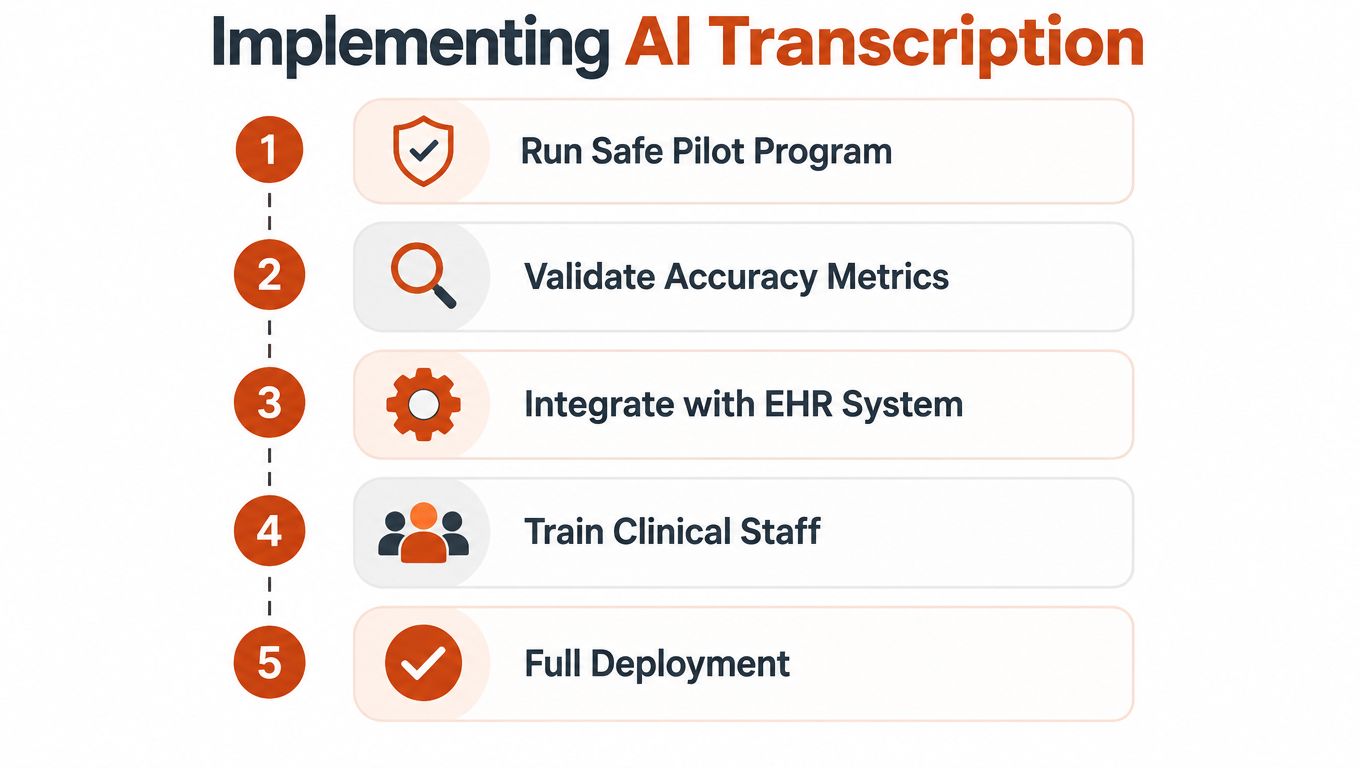
Pilot success requires measuring correction patterns and chart-review findings, not just usage numbers. Start with one specialty, one documentation type, and a group of clinicians prepared to review drafts closely. Include routine encounters alongside difficult cases involving accents, overlapping speech, rare terminology, and incomplete clinical context. A system that performs well only in ideal conditions will not earn clinical trust.
A safer rollout sequence
- Define the permitted use. Specify which note types may use AI assistance, which encounters require direct dictation, and which categories require added review. High-risk documentation should not inherit the same approval path as routine notes.
- Capture a baseline. Record current documentation time, common delays, and the fields that generate rework. Without this comparison, a pilot can appear successful because clinicians use the tool, even when they spend the same time correcting its output.
- Test error classes. Review medication names, negations, dosages, speaker attribution, omissions, hallucinated details, and contradictions. A single accuracy score can hide errors that change clinical meaning.
- Keep signing human-controlled. The clinician must approve, edit, and sign the final note. Drafts should not enter the legal medical record without an explicit review step.
- Expand after review. Share examples of useful and unsafe output. Adjust templates, microphones, custom vocabulary, and training before adding specialties or higher-risk workflows.
A simulated clinical-encounter study reported high transcription accuracy, but model performance varied substantially, with one engine producing fewer discrepancies per encounter than another. Those discrepancies represent the review work required before signing and may include omissions or plausible wording that changes the record's meaning. Treat model variation as a workflow concern, not only a procurement detail.
Make the correction path easy
Clinicians will not consistently report errors if reporting requires a separate form or a long support ticket. Put correction controls beside the note, let users flag recurring vocabulary problems, and maintain a specialty dictionary covering drug names, abbreviations, procedures, and local terminology. Track repeated corrections by speaker, specialty, and note type so teams can identify dialect-related failures instead of treating every error as an isolated event.
Training should cover speaking technique without requiring clinicians to sound unnatural. Clear turn-taking, short dictation segments, explicit section cues, and careful pronunciation of rare terms can help. Staff also need to know what the software cannot infer safely. A fluent sentence is not evidence that the underlying fact is correct.
For teams assessing automation around intake, scheduling, and clinical support, this SkipCalls guide to virtual assistants can help distinguish voice automation tasks from documentation tasks. The technologies may overlap, but their safety requirements and escalation paths differ.
Measure adoption through chart review and correction patterns. If clinicians open the tool but rewrite every note, the deployment has not reduced documentation burden. If they accept drafts without adequate review, adoption may be increasing clinical risk. A pilot should expand only when correction work, omission rates, and review behavior support that decision.
The Future of Assisted Medical Documentation
Medical transcription has moved from manual stenography and recorded dictation toward speech recognition, language processing, structured drafting, and ambient documentation. The commercial trajectory reflects that shift. One market estimate projects the AI-based medical transcription market from USD 1.76 billion in 2024 to USD 9.36 billion by 2032, as reported in this medical transcription market analysis.
Growth won't remove the central clinical problem. A larger documentation economy will produce more tools, more integrations, and more opportunities to automate, but every deployment still needs to answer four questions:
- Does it work in the actual clinical context?
- Can reviewers detect hallucinations, omissions, and contradictions?
- Are privacy controls appropriate for the data and deployment model?
- Does performance remain equitable across speakers and specialties?
The strongest systems will function as co-pilots for documentation, reducing typing and cognitive load while leaving clinical interpretation and accountability with the clinician. Buyers should favor transparent drafts, visible provenance, configurable safeguards, and evaluation methods that measure clinically meaningful errors rather than relying on a headline accuracy figure.
Start with a narrow pilot, inspect difficult cases, and expand only when the correction burden and safety controls are understood. The purpose isn't to make the chart look complete. It's to help clinicians produce an accurate record without asking software to make decisions that belong to them.
AIDictation provides clinician-controlled voice dictation with local processing on Apple Silicon, optional cloud cleanup, medical vocabulary support, and formatting for documentation such as SOAP notes and consultation notes. Visit AIDictation to assess whether its local or hybrid workflow fits your privacy requirements and clinical documentation pilot.
Frequently Asked Questions
What does Medical Transcription AI: A Clinical Guide cover?
The most common advice about medical transcription AI is also the least useful: choose the system with the highest accuracy score. A transcript can achieve strong word-level performance and still produce an unsafe clinical note if it drops a negation, assigns a statement to the wrong speaker, omits an allergy, or invents a medication detail during summarization.
Who should read Medical Transcription AI: A Clinical Guide?
Medical Transcription AI: A Clinical Guide is most useful for readers who want clear, practical guidance and a faster path to the main takeaways without guessing what matters most.
What are the main takeaways from Medical Transcription AI: A Clinical Guide?
Key topics include Table of Contents, The Hidden Risks of AI Clinical Documentation, Why fluent notes deserve more scrutiny.
Ready to try AI Dictation?
Experience fast voice-to-text on your device. Free to download.
Download FreeRelated Posts
Privacy by Design for macOS Apps: A Practical Guide
Learn what privacy by design means, why it matters for macOS apps, and how to ship HIPAA- and GDPR-ready products without slowing your team down.
10 Data Security Best Practices for 2026
Explore 10 essential data security best practices for 2026. Learn to protect sensitive data with encryption, access control, and secure hybrid workflows.
Healthcare Data Security: HIPAA Compliance & Tech in 2026
Protect patient data with our 2026 guide to healthcare data security. Learn about HIPAA, technical controls & secure dictation apps to prevent breaches.