Abbreviation Do Not Use List: Best Practices for 2026
Abbreviations are not a convenience layer. In the wrong place, they're a risk control failure. In healthcare, style guidance treats abbreviation governance as a readability rule, and the clinical guidance treats it as a patient-safety control, with formal do not use lists, staff education, and compliance audits recommended to reduce misinterpretation and medication-error risk (NCES style guide, NCBI clinical abbreviation governance guidance). That's the right frame for every team, not just hospitals.
The mistake many teams make is simple. They lump everything into one banned list and call it policy. That creates weak enforcement, because it hides the core decision rule: some shortcuts are hard banned, some are context-conditional, and some are fine only if they're defined on first use and used consistently.
Table of Contents
- Why a Do Not Use List Is a Safety Control, Not a Style Preference
- Do Not Use List vs Style Guide and When You Need Each
- Healthcare Do Not Use List With Safe Alternatives
- General Writing Abbreviations to Avoid
- Sensitive and Demographic Abbreviations to Drop
- Banned vs Define on First Use
- Copy Ready Do Not Use Policy Template
- Enforcement Through Tools and Training
- Voice to Text and Dictation Workflows With a Do Not Use List
- Quick Reference Card and Rollout Plan
- Objections Leaders Raise and How to Answer Them
- Frequently Asked Questions About Do Not Use Lists
Why a Do Not Use List Is a Safety Control, Not a Style Preference
The counterintuitive truth is that the best abbreviation do not use list is less about grammar and more about defense against preventable mistakes. In clinical work, a shorthand can change a dose, a frequency, or a drug name, which is why healthcare guidance calls for formal governance, audits, and full spelling-out of drug names, dosages, and frequencies (NCBI guidance). In editorial and technical work, the same problem shows up as reader confusion, stalled approvals, and rework.
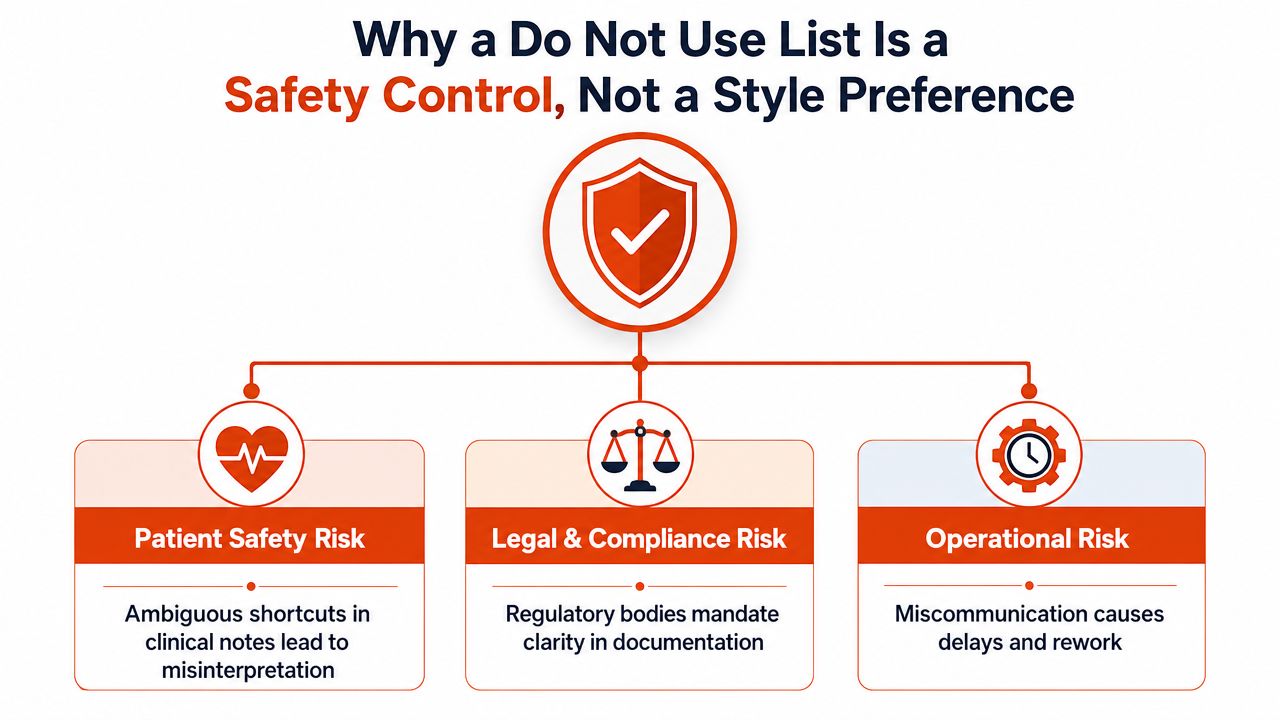
The three layers that actually work
A serious policy needs three layers, not one.
Hard-banned core. These are abbreviations that should not appear in normal documentation because they create direct risk, legal exposure, or stigma. If the shorthand can be read two ways, or if it changes clinical meaning, it belongs here.
Context-conditional gray zone. These are abbreviations that may be acceptable inside a specialized team, in a controlled template, or for an audience that already knows the term. They still need rules, because the wrong audience turns them into noise.
Defined-on-first-use base layer. These are acceptable when they're spelled out the first time, then used consistently. That matches the modern consensus across APA, OECD, ONS, and NCES, and APA explicitly says many abbreviations should be introduced only if they'll appear at least three times in a paper (APA abbreviation guide, NCES style guide).
Practical rule: If a shortcut can hurt someone, misstate a population, or silently change meaning, don't debate it. Ban it.
That framing also helps non-clinical teams. Product managers, editors, and compliance leads don't need one giant banned list. They need a policy that says what is forbidden, what is allowed only in context, and what must be defined at first use. Anything less is just an untested preference dressed up as policy.
Do Not Use List vs Style Guide and When You Need Each
A do not use list and a style guide solve different problems. A do not use list contains entries that are too risky for normal use, no matter how busy the writer is. A style guide governs how acceptable abbreviations behave, including first-use definition, capitalization, and consistency.
The decision rule in plain English
Put the term on the do not use list if the abbreviation can do any of these things:
- Cause direct harm. That covers clinical abbreviations that can be misread in orders, notes, or medication instructions.
- Misrepresent a population. That covers shorthand in race, ethnicity, disability, or other sensitive categories.
- Change meaning. That covers shorthand that looks familiar but means something else in a different field.
Put the term in the style guide if the problem is only that it's wordy, uncommon, or inconsistent. APA, OECD, and UN guidance all converge on the same basic behavior, spell out at first mention, then use the abbreviation only when it's familiar, reused enough to justify the shortcut, and not likely to confuse readers (APA abbreviation guide).
MCC's writing guidance follows the same logic, spell out the term first, then abbreviate from that point forward, except for familiar acronyms. Adobe's guidance is stricter in a different way, saying to create a list only if at least three abbreviations are used and to avoid abbreviations that appear fewer than three times (MCC grammar guide). That's why weak teams end up arguing about taste when they should be applying a rule.
A simple self-check helps. Ask whether your team needs to ban unsafe shorthand or just standardize readable shorthand. If you're not in a regulated field, you still need a do not use baseline for external writing. If you are in healthcare, compliance, or public policy, you need both.
Healthcare Do Not Use List With Safe Alternatives
Healthcare is where abbreviation policy stops being theoretical. A chart note, a medication order, or a handoff note can turn an innocent-looking shortcut into an error. That's why formal guidance says institutions should keep a do not use list, educate staff, audit compliance, and require drug names, dosages, and frequencies to be written out in full (NCBI guidance).
The hard-banned core clinicians should know
Here's the core list I'd hand to a clinical documentation lead, a pharmacist, or a scribe:
| Unsafe shorthand | Why it's dangerous | Safer alternative | Clinical risk pattern |
|---|---|---|---|
| U | Can be mistaken for a number or another symbol | unit | Dose transcription errors |
| IU | Can be misread when the handwritten or spoken context is unclear | international unit | Wrong-unit interpretation |
| q.d. / q.o.d. | Periods and spacing make it easy to misread frequency | daily or every other day | Wrong dosing schedule |
| MS / MSO4 | Can be confused with another drug reference | morphine sulfate | Medication name ambiguity |
| MgSO4 | Chemical shorthand can be misread in fast-moving notes | magnesium sulfate | Drug identity confusion |
| Trailing zeros | A decimal dose can be read as larger than intended | Write the dose without a trailing zero | Decimal misreading |
| cc | Often gets used as shorthand for cubic centimeter or confused with other uses | mL or the full term | Volume confusion |
| @ | Not clinical language, and it can blur meaning in instructions | Spell out the relationship or location | Instruction ambiguity |
| > | Can distort comparison or threshold meaning in plain-text orders | Write the comparison in words | Meaning distortion |
That list is the minimum, not the ceiling. Many organizations extend it with local additions based on their own incident history, template design, and specialty needs. If a term shows up in a real error review, it deserves a local ban.
Make the safe rewrite explicit
Don't just ban the bad form. Show the replacement in the workflow. A voice note that says “give ten units daily” should land as give 10 units daily, not give 10 U daily. A medication record should spell out magnesium sulfate, not rely on a chemistry shortcut that might be obvious to one clinician and opaque to another.
If your team uses speech capture or dictated notes, connect the policy to tooling instead of hoping people remember it. A dictation workflow like speech-to-text medical documentation guidance is only useful if the output matches the policy, not if it reproduces the same ambiguity in cleaner typography.
The safest clinical abbreviation is the one the system never lets through in the first place.
That's the standard worth enforcing. Anything less leaves the burden on busy clinicians, which is exactly where error risk grows.
General Writing Abbreviations to Avoid
Outside healthcare, the problem changes, but it doesn't disappear. In legal email, customer support, and public-facing writing, abbreviations often signal haste, not clarity. The result is tone drift, confusion, and messages that sound colder or more evasive than the writer intended.
The everyday shortcuts I'd still ban
A few patterns belong on the general do not use list for formal writing:
- Latin shorthand in client-facing prose. Use for example and that is if the audience isn't expected to parse e.g. and i.e. instantly.
- Decorative workplace shorthand. ASAP, FYI, and BTW feel efficient inside chat, but they can sound lazy or passive-aggressive in external documents.
- Context-free measurement shorthand. If a term can be misunderstood in plain text, spell it out. Style rules already separate special cases like common abbreviations and statistical symbols from specialized terms that need definition (NCES style guide).
A legal email should read like a legal email. “Please review the attached amendment by end of day” is clean. “Pls review ASAP” is not. A customer-facing support reply should preserve warmth and precision. “We've escalated your case to engineering” lands better than “FYI, we escalated it.” A press release should never sound like internal shorthand leaked outward.
Use tone as part of the rule
Practical rule: If the shorthand would sound fine in Slack but awkward in a published document, it doesn't belong in the published document.
That's the standard I use for external writing teams. A product launch note can be concise without being cryptic. A customer support reply can be friendly without using throwaway abbreviations. A legal notice can be brief without sacrificing precision.
The clean rewrite usually isn't longer in a meaningful way. It's just more legible to people who don't share the writer's habits. That matters because formal writing is read by auditors, customers, partners, and legal reviewers who aren't there to decode shorthand.
Sensitive and Demographic Abbreviations to Drop
This is a layer often overlooked. Abbreviation policy isn't only about length or clarity. It's also about whether the shorthand is respectful, precise, and appropriate for public-facing language. CDC and JAMA both recommend avoiding abbreviations in sensitive demographic or population references unless necessary, and JAMA says race and ethnicity category abbreviations should generally be avoided except when space is constrained (CDC preferred terms guidance).
What to replace and why
If a shorthand flattens identity or makes people sound like categories instead of humans, drop it. Use person-first or precision-first language instead.
- Race and ethnicity shorthand. Avoid compressed labels when they reduce clarity or audience trust. Spell out the group name if you need it, or use the exact category structure required by your setting.
- Ability status shorthand. Don't compress disability language into a label that sounds clinical or detached. Write the full phrase you mean.
- Stigma-coded shorthand. Replace phrases like substance abuser with person with a substance use disorder. That change matters because the shorthand can imply blame rather than condition.
CDC and JAMA are aligned on the core issue, shorthand in these contexts can make language less precise and less respectful. That's not cosmetic. It changes how the reader interprets the subject.
The same logic applies to terms some writers use casually in nonprofit, healthcare, or civic writing. The AMA notes that terms like underserved and under-resourced are sometimes viewed as pejorative and recommends more precise alternatives such as historically and intentionally excluded or disinvested (CDC preferred terms guidance). If the phrase carries baggage, don't hide it behind shorthand.
A good do not use list earns its keep by stopping the team from arguing that a term is “just shorter.” Shorter isn't the point. Clearer and more respectful is the point.
Banned vs Define on First Use
Every abbreviation should go through the same triage. The default rule is define on first use, then use consistently. APA says many abbreviations should appear only if they'll be used at least three times in a paper, and OECD and UN guidance both warn against overusing or inventing abbreviations (APA abbreviation guide). NCES reinforces the broader formal-writing pattern by using Arabic numerals for 10 or greater and for percentages, proportions, decimals, and measurements, which shows that abbreviation style is part of the same disciplined system (NCES style guide).
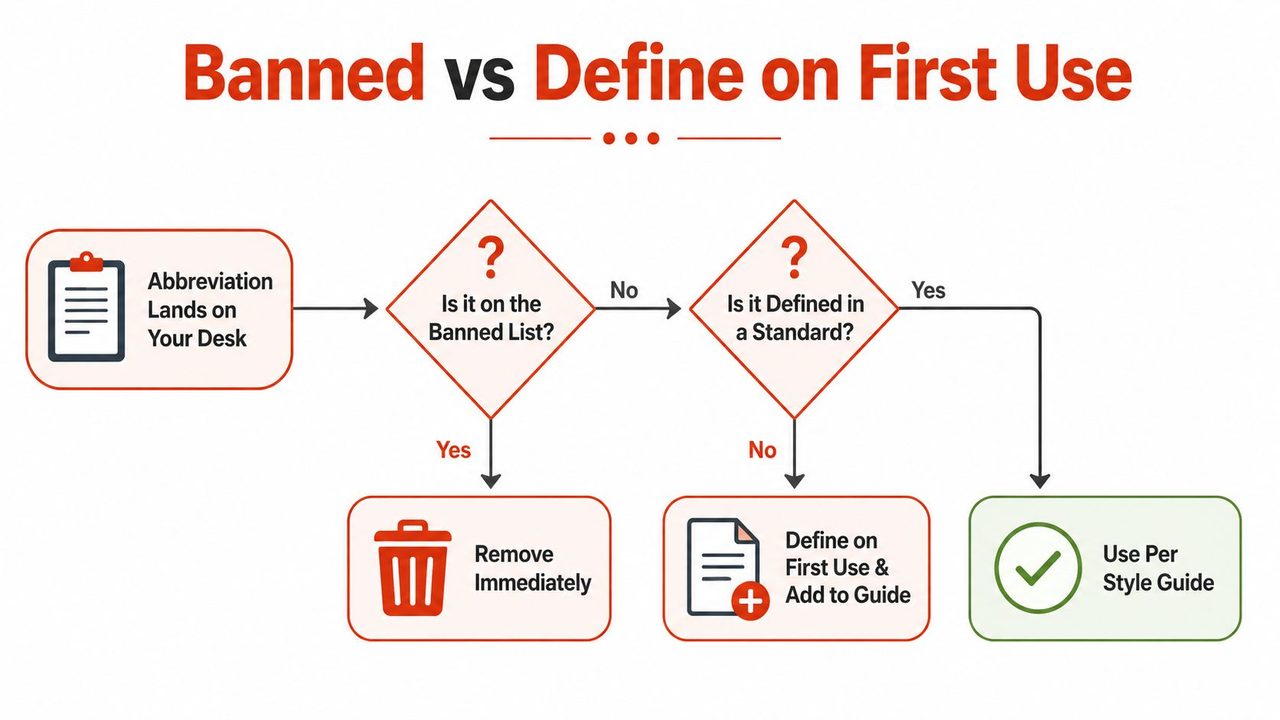
Use this triage order
-
Can it cause direct harm or change meaning?
If yes, ban it. Safety, legality, and stigma beat convenience. -
Is it used enough to justify the shortcut?
If not, spell it out every time. A one-off abbreviation is usually clutter, not efficiency. -
Will a general reader recognize it immediately?
If not, define it on first use and keep using the defined form consistently.
That triage works for editors, compliance teams, and technical writers because it gives a clean decision path. MCC's writing guidance follows the same general structure, spell out a term at first mention and then abbreviate from there, except for familiar acronyms (MCC grammar guide).
Decision rule: If the abbreviation is safe but not universal, it belongs in the style guide. If it's unsafe, stigmatizing, or legally risky, it belongs on the do not use list.
That's the line managers need. It keeps policy from becoming mushy and makes exceptions rare enough to control.
Copy Ready Do Not Use Policy Template
Here's a policy you can drop into a handbook, wiki, or shared doc and adapt in under an hour.
Policy template
Purpose
This policy sets rules for abbreviation use in all internal and external documents produced by [Team or Organization Name].
Scope
This policy applies to [clinical notes, customer support replies, product specs, regulatory filings, editorial content, training materials, emails, and public-facing documents].
Hard-banned abbreviations
The following abbreviations must not appear in any document covered by this policy:
- [Insert healthcare or industry-specific banned terms]
- [Insert sensitive demographic shorthand that your organization has disallowed]
- [Insert local additions based on incident reviews or compliance requirements]
Defined-on-first-use rule
Any abbreviation not listed above must be spelled out on first use, then used consistently if it appears three or more times in the document. If the audience is external or non-specialist, define the term even if the abbreviation is familiar internally.
Audit cadence
The owner of this policy will review the list quarterly and after any incident, regulatory update, or style-guidance change.
Enforcement path
Before publication or sign-off, the document must pass through:
- author self-check,
- peer review,
- tool-based scan or template validation,
- final approval by the document owner or editor.
Worked example
A 12-person product team writing clinical decision-support documentation would use the policy like this. The product manager keeps the banned healthcare abbreviations out of release notes and help text. The technical writer defines specialized terms on first use. The clinical reviewer checks for prohibited shorthand before the document reaches legal or quality review. That gives the team one standard across product specs, onboarding, and support articles.
Rollout note
Distribute the template before the next sprint or publication cycle. Attach it to onboarding. Link it from the style-guide home page so people can find it without asking three different teams.
Enforcement Through Tools and Training
Policies fail when they live only in a folder. Enforcement has to sit inside the tools people already use. A short onboarding module is useful, but it won't hold unless the system blocks or expands forbidden forms before they ship.
Build enforcement into the workflow
Start with training. Give new hires a 30-minute onboarding module, then repeat the policy in a quarterly refresher. Keep the examples real, pulled from your own documents, because people remember the errors they've seen.
Then wire the policy into the systems. In clinical environments, configure order entry or documentation systems to block or require expansion for banned abbreviations. In dictation tools, build custom dictionaries and autocorrect rules that expand banned terms before the text lands in the document. In software and editorial workflows, add a pre-commit hook, a style-check pass, or a publication checklist item.
For teams using transcription cleanup, transcription editing guidance is most useful when it's paired with an abbreviation policy, not used as a separate afterthought. The point is to prevent the bad form from surviving the draft stage.
Practical rule: If the policy only appears in a PDF, it isn't enforced. If the tools catch the bad form before review, it's real.
Measure what matters
Track three things.
- Banned-abbreviation error rate per 1,000 documents
- Mean time to resolve a violation
- Percentage of staff who completed the most recent training
Those metrics tell you whether the policy is changing behavior or just creating paperwork. If the error rate stays high, the banned list or the tool configuration needs work. If resolution time is slow, ownership is unclear. If training completion is weak, onboarding and reminders need a reset.
Voice to Text and Dictation Workflows With a Do Not Use List
Teams don't type every sentence anymore. They dictate, edit, and clean up. That's why abbreviation policy has to reach voice-to-text workflows, not just documents after the fact.
Make the dictation layer enforce the policy
Import the banned forms into your dictation tool's custom dictionary so the software expands or blocks them automatically. If a writer says a forbidden shortcut, the system should convert it to the approved spelling or flag it for review. That's the only reliable way to keep spoken shorthand from sneaking into written output.
AIDictation can be configured with a custom dictionary and context rules so dictated text follows team policy in different apps, including settings that can preserve healthcare-specific expansions or cleaner email rewrites. Its workflow can also fit both local and cloud processing, which matters if your team wants different handling for private clinical notes versus polished external writing. Other platforms can do pieces of this too, including Mac text shortcuts, Windows AutoHotkey, and browser extensions.
The key test is simple. If the tool only suggests the correct spelling, that's not enough. If it enforces the spelling or blocks the banned form, it's useful.
Quick audit checklist
- Can the tool expand banned abbreviations automatically?
- Can it apply different rules by app or document type?
- Can it keep a custom vocabulary list for sensitive terms and local exceptions?
- Can users bypass the rule without leaving a trace?
If the answer to the last question is yes, your policy is still too soft. Dictation should reduce risk, not preserve it in a cleaner font.
Quick Reference Card and Rollout Plan
A good policy should fit on one screen when people need it fast. Keep the full template in your wiki, but give teams a short card they can pin near a workstation or add to a sidebar.
Quick reference card
Clinical, always ban
Write the full form for drug names, units, and frequencies. Avoid shorthand that can be misread in orders, notes, or handoffs.
General writing, avoid in formal documents
Skip casual shorthand, vague Latin abbreviations, and context-free symbols in external writing.
Sensitive or demographic language, use full precise wording
Choose person-first or precision-first phrasing when shorthand could flatten identity or sound pejorative.
When in doubt
If it's safe but specialized, define it on first use. If it's risky, ban it.
30-60-90 day rollout plan
Week 1
Distribute the policy, walk through the banned list, and answer edge cases.
Week 2
Wire the list into templates, dictation tools, and review checklists.
Week 4
Run the first audit and capture violations by document type.
Week 8
Revise the policy based on the audit, then update examples and tool settings.
Week 12
Embed the policy in onboarding and add it to the team's regular publishing or release workflow.
Completion checklist
- Policy is live
- Training is delivered
- Tool settings are configured
- Audit is running
- Owner is named
If those five items aren't true, the rollout isn't finished. It's just announced.
Objections Leaders Raise and How to Answer Them
Leaders usually raise the same three objections, and they sound reasonable until you test them against real risk.
“This will slow us down”
Only if you leave writers to do the enforcement manually. Once dictation tools and templates auto-expand banned forms, the policy speeds up review because editors stop chasing the same errors. The slowdown is in the exception-heavy manual process, not in the rule itself.
“This kills creative voice”
It doesn't. It removes unsafe shorthand. Voice lives in sentence rhythm, word choice, and specificity, not in dumping internal abbreviations into public documents. If a writer wants style, they can have it without sacrificing clarity.
“Edge cases will always exist”
Yes, and that's why the gray zone exists. Put a named owner on exceptions, require context, and review the list on a schedule. That's management, not chaos.
A single banned-abbreviation incident can create a medication error, a regulatory finding, or a public correction. The cost of a careful rollout is small compared with the cost of explaining why a preventable shortcut made it into a final document.
Frequently Asked Questions About Do Not Use Lists
How often should the list be refreshed?
At least annually, and sooner if a safety bulletin, regulatory update, or incident review changes the risk picture.
What about legacy documents?
Annotate them rather than rewriting everything, except for active clinical content or live public documents that still pose risk.
Do industry-specific bans override generic ones?
Yes. Regulatory or organization-specific bans win every time.
What if we don't have a compliance officer?
Use a shared checklist, assign one named owner, and run a lightweight self-audit on a fixed schedule.
Should every abbreviation be banned?
No. That's sloppy policy. Ban the unsafe forms, define the specialized but acceptable ones on first use, and keep the list honest.
If your team needs a practical abbreviation policy, build the hard-banned core first, then wire it into templates, dictation, and review. If you want a faster way to keep spoken drafts aligned with the rules, explore AIDictation and test whether its dictionary and formatting controls fit your workflow.
Frequently Asked Questions
What does Abbreviation Do Not Use List: Best Practices for 2026 cover?
Abbreviations are not a convenience layer. In the wrong place, they're a risk control failure.
Who should read Abbreviation Do Not Use List: Best Practices for 2026?
Abbreviation Do Not Use List: Best Practices for 2026 is most useful for readers who want clear, practical guidance and a faster path to the main takeaways without guessing what matters most.
What are the main takeaways from Abbreviation Do Not Use List: Best Practices for 2026?
Key topics include Table of Contents, Why a Do Not Use List Is a Safety Control, Not a Style Preference, The three layers that actually work.
Ready to try AI Dictation?
Experience fast voice-to-text on your device. Free to download.
Download FreeRelated Posts
Content Structure Done Right: A Practical Guide
Master content structure. Learn core principles, see templates for docs and notes, and discover how to create structured text instantly from speech.
Improve Documentation Quality: A 2026 Guide
Measure & improve documentation quality with our 2026 guide. Discover key dimensions, assessment methods, & tools to create clear, accurate, useful docs.
What Is a Content Calendar: Guide to Strategy 2026
What is a content calendar? Learn its core fields, four common types, and an eight-step setup process for planning content across channels.