Improve Documentation Quality: A 2026 Guide
A developer opens your API reference, copies the sample request, and gets an error. The parameter name changed in the last release, the auth flow in the guide is half-right, and the troubleshooting section still refers to a deprecated endpoint. Twenty minutes later, they're in Slack asking support. Support checks the docs, gives an answer based on the same stale page, and now two teams are working around a problem that started as a documentation problem.
That situation shows up everywhere. Product managers ship features that sales can't explain correctly. Support teams answer tickets using outdated macros. Clinicians inherit notes that are readable but incomplete. New hires spend their first week piecing together workflow from chat history, tickets, and tribal knowledge.
Poor documentation quality isn't a cosmetic issue. It changes how fast people can act, how safely they can act, and how much rework your team creates for itself. It also scales badly. A weak document doesn't fail once. It fails every time someone reuses it.
This is often understood intuitively. The harder part is building a system that makes quality repeatable. That means moving beyond loose advice like “be clear” or “keep docs updated” and treating documentation as an operational product with standards, checks, ownership, and tooling. If your team is still writing ad hoc pages with no shared template, no review rule, and no useful feedback loop, start with a practical approach to documentation research methods before you rewrite everything.
Table of Contents
- Introduction Why Documentation Quality Matters More Than Ever
- What Exactly Is Documentation Quality
- The Five Dimensions of High-Quality Documentation
- How to Assess Your Current Documentation Quality
- A Framework for Improving Documentation Quality
- The Modern Toolkit for High-Velocity Documentation
- Conclusion Making Quality a Continuous Habit
Introduction Why Documentation Quality Matters More Than Ever
Documentation quality matters more now because more teams depend on the same content at the same time. One product spec feeds engineering, QA, support, marketing, and customer success. One runbook may guide an on-call engineer at midnight and a new hire six months later. One policy page may become evidence during an audit.
That makes quality a delivery issue, not a writing preference.
When documentation fails, the symptoms look unrelated at first. Support volume climbs. Onboarding gets slower. Product adoption stalls in confusing areas. Teams make inconsistent decisions because they're working from different versions of the truth. In regulated environments, the stakes are even higher because missing, late, or inconsistent records can affect safety, coding, and downstream data exchange. AHIMA defines high-quality data in terms such as correctness, precision, consistency, and timely availability in its data quality and integrity policy statement.
What bad documentation actually costs
The cost usually shows up as friction:
- Engineers lose time: They reverse-engineer behavior that the docs should explain.
- Support gives mixed answers: Agents rely on stale macros, internal notes, or memory.
- Product teams create rework: Specs leave edge cases undefined, so implementation diverges.
- Operations absorb risk: People complete required fields but still produce records that are hard to trust or reuse.
Practical rule: If users must ask a person to interpret your documentation, the document is incomplete for its real job.
Documentation quality also affects confidence. Teams move faster when the docs are current, specific, and reliable. They hesitate when every page feels provisional.
Quality is a systems problem
Individual writers matter, but heroic effort won't fix a broken documentation system. Teams need a repeatable way to define quality, assess it, and improve it over time. That's where most guides fall short. They list desirable traits, then stop.
A stronger approach links each quality dimension to concrete checks, content workflows, and operating habits. It also treats drafting as part of the quality problem. If contributors struggle to get a clean first draft out of meetings, demos, or implementation work, quality degrades before editing even starts.
What Exactly Is Documentation Quality
A release goes out on Friday. By Monday, support has a workaround in a chat thread, engineering has the actual behavior in code comments, and the public doc still shows the old flow. The writing on the page may be polished. The documentation is still low quality because it fails at the moment someone needs to rely on it.
Documentation quality is the degree to which a document helps the intended reader complete a real task with confidence. That definition is wider than style, grammar, or formatting. It includes whether the content is correct, whether it covers the task far enough to prevent guesswork, and whether readers can tell if the page is current and trustworthy.
The standard I use is simple: a document is high quality if the target reader can use it under normal working conditions without needing a second source to interpret it.
That changes how teams evaluate docs. An API reference is not judged by how polished it sounds. It is judged by whether a developer can authenticate, send a request, interpret the response, and recover from likely errors. A support procedure is judged by whether an agent can resolve the case consistently. An internal process doc is judged by whether someone new to the workflow can follow it without Slack archaeology or tribal memory.
Quality is tied to context, but the evaluation method can still be consistent. Check the document against the job it must do.
Quality has two layers
Teams often collapse documentation quality into writing quality. That misses half the problem. Good documentation has both content quality and system quality.
Content quality covers the page itself. Is it correct? Is it complete enough for the task? Is the terminology stable? Are examples realistic? If the audience mixes product, engineering, and support contributors, shared vocabulary matters more than many teams expect. This developer's guide to API terms is a useful reference for tightening that layer.
System quality covers the conditions around the page. Who owns it? When was it last reviewed? What changed? Can readers see whether an instruction was corrected after release? Can contributors produce a usable first draft fast enough that documentation keeps up with product changes?
That second layer is where many documentation programs break. The writing may be acceptable, but the operating model is weak. Readers cannot tell what to trust.
A document can read well and still be unsafe to use.
A working definition teams can score
Use this definition in reviews:
| Aspect | What to ask |
|---|---|
| Task fit | Can the intended reader complete the intended task with this document and standard system access? |
| Content quality | Is the information correct, specific, and complete enough to prevent guesswork? |
| Use quality | Can readers find the right section fast, scan it, and apply it under real time pressure? |
| Trust quality | Are ownership, review status, and changes clear enough that readers know whether to rely on it? |
This definition matters because it turns "good docs" from a vague aspiration into an operating standard. It also sets up the full-stack approach many teams need. First define the dimensions. Then attach checks, metrics, workflows, and tools to each one. That is how documentation quality becomes measurable and repeatable instead of subjective.
The Five Dimensions of High-Quality Documentation
A documentation page can be well written and still fail in production. The common pattern looks familiar. The steps are technically correct, but a new customer cannot finish setup. Support can finish it because they already know the missing prerequisite, the hidden limit, or the updated UI label. Quality breaks at the point of use.
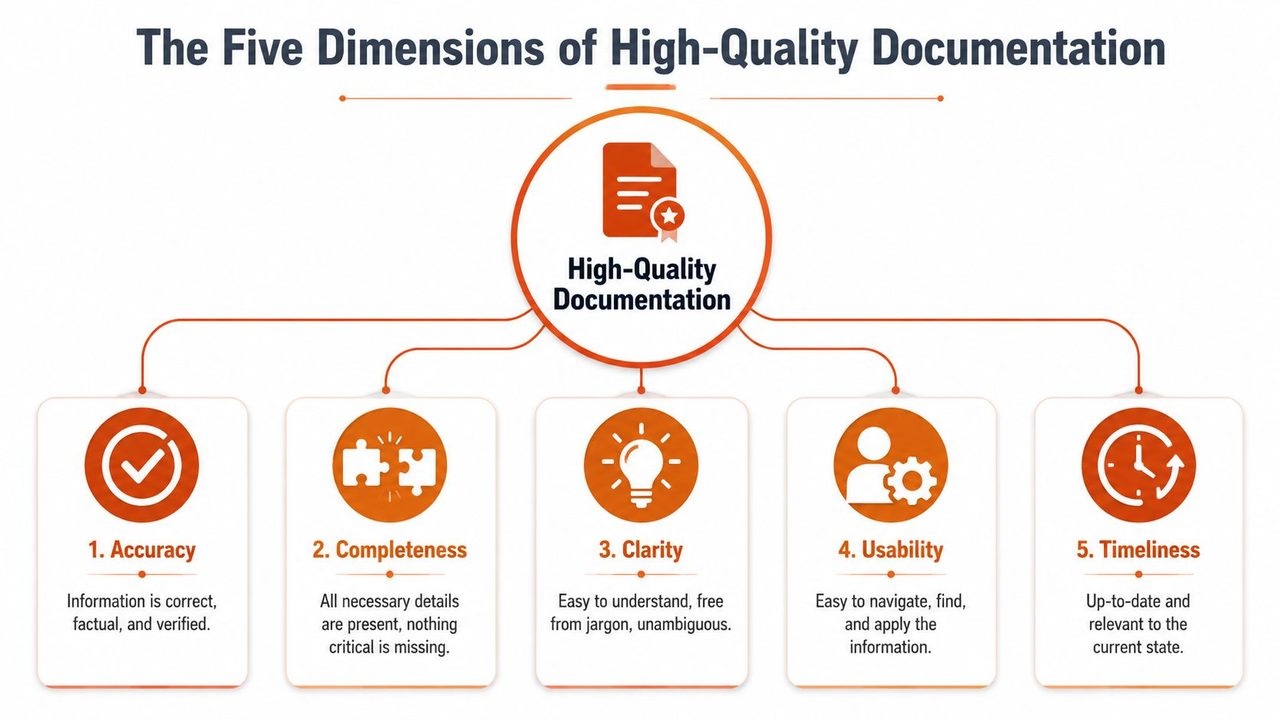
That is why documentation quality needs dimensions a team can review, score, and improve. Earlier, the article established four durable foundations from regulated data practice: accuracy, completeness, timeliness, and consistency. For documentation teams, a fifth dimension belongs in the operating model: usability. Together, these five dimensions connect editorial quality to measurable outcomes such as task success, support deflection, and update speed.
Accuracy
Accuracy means the content matches the current product, system, or process. In practice, this is more than factual correctness. It includes endpoint names, parameter behavior, permission requirements, UI labels, sample payloads, screenshots, and the order in which a user must do things.
Accurate documentation is specific. It names the exact condition, version, role, or dependency that changes the instruction. It also records exceptions instead of forcing readers to discover them through failure.
Good: “Use OAuth app credentials for server-to-server requests.”
Bad: “Authenticate with your account.”
A useful review question is simple: can someone follow this page exactly as written, without relying on tribal knowledge?
Completeness
Completeness means the page contains enough information for the target reader to finish the task and recover if something goes wrong. It does not mean dumping every related detail onto one page.
Teams usually miss completeness in two ways:
- Shallow completeness: the doc gets a user started but does not cover prerequisites, permissions, failure states, or verification
- Excess completeness: the page includes long background sections while skipping the decision points needed to act
A setup guide should usually answer five questions: What do I need before I start? What exact steps do I take? What should I see after each major step? What can fail? What do I do next if it fails?
That checklist scales well across product docs, internal SOPs, and API guides.
Consistency
Consistency keeps documentation predictable across pages and over time. Terms mean the same thing everywhere. The same action uses the same label. Similar tasks follow a similar structure. Readers do not have to relearn how the docs work every time they open a new page.
This dimension often gets ignored because inconsistency rarely looks dramatic in a content review. Readers feel it as friction. Search results become noisy. Cross-references conflict. One guide says “workspace admin,” another says “organization owner,” and support has to explain that both refer to the same role.
Consistency usually comes from systems, not writer effort alone. Controlled vocabulary, page templates, API style rules, and review checklists do more than asking contributors to “write clearly.”
Usability
Usability determines whether readers can find the answer, scan it fast, and apply it under time pressure. A correct page still creates support load if the heading structure hides the relevant step or the key warning sits inside a long paragraph.
The strongest usability improvements are often structural:
- headings that match user intent
- short sections built around tasks
- tables for comparisons and decision points
- code blocks and copyable commands where readers need exact syntax
- callouts used sparingly for irreversible actions, limits, or risks
I usually treat usability as the bridge between content quality and operational results. If readers cannot locate or use the answer quickly, the page does not perform, even if the prose is technically sound.
Timeliness
Timeliness means the content stays aligned with product releases, policy changes, and process updates closely enough to remain safe to use. Stale documentation is expensive because it often looks trustworthy right up until the reader hits the wrong button or follows a retired flow.
This dimension is less about writing skill and more about workflow. Strong teams tie documentation updates to release management, assign owners, and make review dates visible. High-velocity teams also reduce draft friction. One practical way to do that is AI dictation for first-pass drafting, which helps subject-matter experts capture steps and edge cases quickly enough for writers to refine them before the product changes again.
Use this table as a working review tool:
| Dimension | What good looks like | What usually fails |
|---|---|---|
| Accuracy | Steps, labels, examples, and prerequisites match the live system | Instructions reflect an older UI, workflow, or API behavior |
| Completeness | Readers can start, finish, verify, and recover from common failures | The happy path is documented, but blockers and edge cases are missing |
| Consistency | Terms, structure, and labels stay stable across related pages | Similar concepts are named differently or explained in conflicting ways |
| Usability | Readers find the right section fast and can act without rereading | Correct information exists, but it is buried, fragmented, or hard to scan |
| Timeliness | Pages are reviewed and updated as changes ship | Content remains published after the underlying process has changed |
If a team wants a practical standard, start here. Score each dimension page by page, then connect weak scores to fixes in templates, review steps, ownership, and tooling. That is the main advantage of a full-stack documentation model. It turns vague advice about “better docs” into work a team can assign, measure, and improve.
How to Assess Your Current Documentation Quality
Most documentation audits fail because they only count what exists. They answer “do we have a page for this?” instead of “can someone succeed with this page?” That's too shallow.
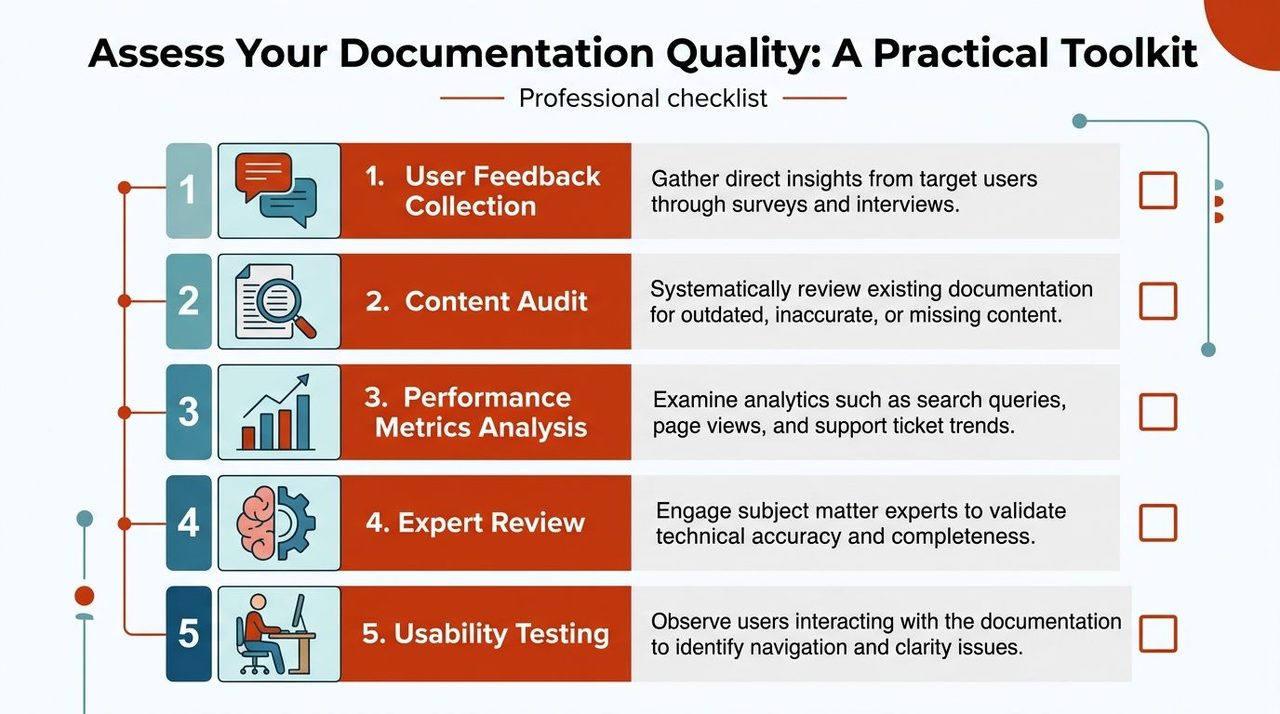
Strong assessment combines content review, user observation, and downstream outcomes. In clinical documentation programs, more mature measurement ties quality to operational results like denial rates, length of stay, and patient-safety indicators, not just whether a form was completed, as discussed in this CDI measurement article. The same logic applies to product and technical docs. Don't stop at content presence. Measure consequence.
Run a task-based audit
Pick a high-value workflow. Good candidates are first API call, feature configuration, incident escalation, refund handling, or a common intake process. Ask someone who didn't write the docs to complete the task using only the documentation.
Watch for these signals:
- Search failure: They can't find the right page.
- Interpretation failure: They find it but don't know what the instructions mean.
- Execution failure: They follow the steps and still get stuck.
- Recovery failure: They hit an error and the docs don't help.
This gives you more truth than a passive review ever will.
Use a copy-paste checklist
Score each document as pass, needs work, or fail.
- Purpose match: Does the page clearly state who it's for and what task it supports?
- Accuracy check: Are commands, fields, examples, screenshots, and references current?
- Completeness check: Are prerequisites, steps, exceptions, and next actions included?
- Clarity check: Are terms stable, instructions specific, and ambiguous phrases removed?
- Usability check: Can a user scan headings, locate examples, and spot troubleshooting quickly?
- Timeliness check: Is there a visible owner and review trigger tied to a release or process change?
- Integrity check: Is authorship clear, and are corrections or updates traceable?
Audit prompt: “Would a new team member succeed with this page at 4 p.m. on a Friday?”
Connect the audit to business outcomes
Don't treat scores as the outcome. Treat them as a diagnostic layer.
For each critical document, connect quality issues to one operational consequence:
| Document type | Better metric than “page exists” |
|---|---|
| API guide | Fewer setup-related support tickets |
| Product spec | Fewer implementation clarifications |
| Support playbook | More consistent case handling |
| Runbook | Faster issue resolution with fewer escalations |
You don't need a complicated analytics stack to start. A shared spreadsheet with audit findings, owner, severity, and observed impact is enough. What matters is that the team can see which defects create the most friction.
A Framework for Improving Documentation Quality
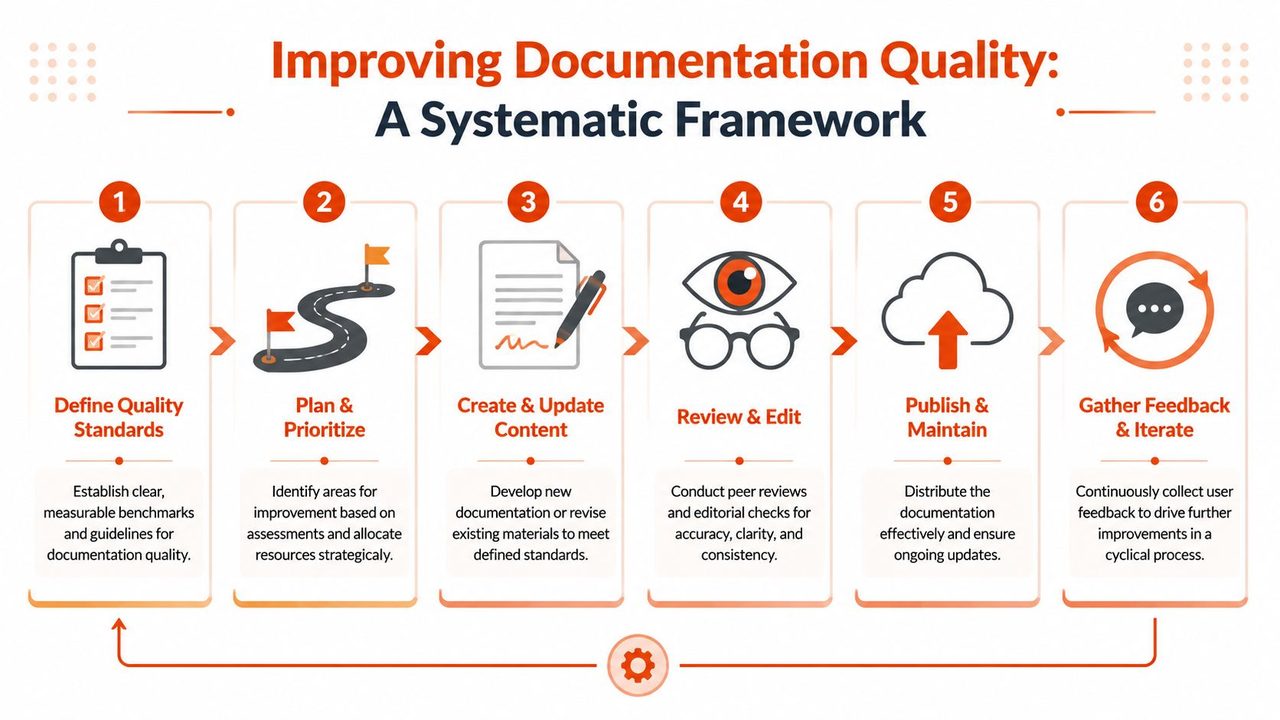
If assessment tells you where quality is weak, improvement needs to answer a different question: how do we make better documentation the default outcome? The answer is system design.
Structured documentation works because it reduces variation at the point of creation. In one healthcare study, introducing structured and standardized documentation raised the mean documentation quality score from 64.35 to 77.2, a gain of 12.8 points with p < 0.001 across 144 EHR notes before and after implementation, reported in this study on standardized note quality. This offers the strongest practical lesson. Don't start with a plea for better writing. Start with better structure.
Standardize the shape of the work
Templates do more than save time. They force contributors to answer the questions readers need answered.
A product spec template might require:
- Problem statement
- User impact
- Scope and non-scope
- Edge cases
- Dependencies
- Launch risks
- Owner and decision date
A runbook template might require trigger conditions, pre-checks, step order, rollback, and escalation criteria. If your team writes requirements often, a practical starting point is a disciplined approach to specification writing workflows.
Build review into the workflow
Quality review should happen before publication and after use.
Use different review modes for different risks:
| Review type | Best for | What it catches |
|---|---|---|
| Peer review | Internal docs and specs | Gaps, ambiguity, missing assumptions |
| SME review | Technical and regulated content | Factual errors and invalid steps |
| User test | External docs and onboarding | Findability and task failure |
| Maintenance review | Living documents | Staleness after product or process change |
One common mistake is using only editorial review. Grammar review won't catch a broken process.
Assign ownership that survives reorgs
Shared ownership usually means no ownership. Every critical document needs one accountable owner, even if many people contribute.
That owner is responsible for four things:
- Keeping the page current
- Routing reviews when upstream changes happen
- Closing feedback loops from users and support
- Archiving or replacing obsolete content
If a document can outlive a role or team, store ownership in the document metadata, not in someone's memory.
Good documentation systems don't depend on motivated individuals remembering to be careful.
Train contributors on contribution, not prose alone
Most contributors aren't professional writers. That's fine. They don't need to be. They need training on the recurring failure points in your environment.
Teach contributors how to:
- define audience and task
- write stable headings
- capture prerequisites and edge cases
- show expected results
- note correction history
- update examples when the product changes
That training is usually more effective than broad style lectures because it ties directly to real documents and real defects.
The Modern Toolkit for High-Velocity Documentation
The biggest documentation bottleneck usually appears before review. It's the first draft. Engineers leave a meeting with rough decisions in their heads. PMs have a strong verbal explanation but no written spec. Clinicians and operators know what happened but don't want to type a long note from scratch.
That's where the toolchain matters. You need tools for capture, structuring, review, publishing, and maintenance. If the capture step is slow, everything downstream suffers.
Match tools to the failure point
A practical stack often looks like this:
- Capture tools: voice dictation, meeting transcription, quick note capture
- Authoring tools: Markdown editors, Google Docs, Notion, Confluence, docs-as-code systems
- Review tools: pull requests, comments, assigned approvers, issue tracking
- Maintenance tools: content inventories, review reminders, version history
The wrong move is expecting one platform to solve every quality problem. Search issues, stale content, poor structure, and weak first drafts are different problems.
AI dictation helps at the draft stage
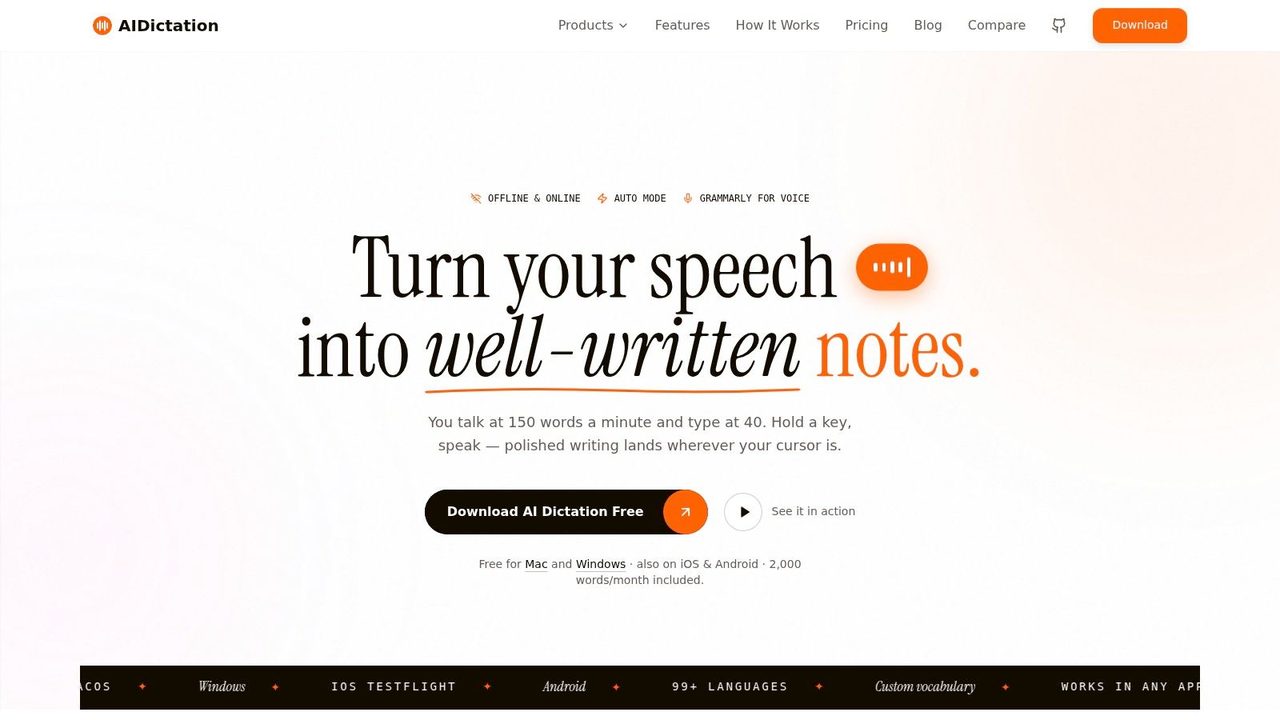
For teams that think faster than they type, AI dictation can remove the blank-page problem. A tool like AIDictation can turn spoken notes into a structured first draft on macOS, then clean grammar and punctuation, apply context-aware formatting, and use a custom dictionary for technical terms or names. That's useful when a PM needs to capture a feature brief right after a call, or when a clinician needs a readable initial note without retyping everything.
Its local processing option also matters in sensitive environments because some teams need private on-device drafting rather than cloud-first capture. If you're comparing options in this category, this roundup of voice-to-text software for 2026 is a practical place to start.
The key point isn't speed alone. It's that a better initial draft usually produces better documentation quality later because structure, terminology, and completeness degrade less when the source material is captured cleanly.
Tools still need process discipline
A faster draft won't fix unclear ownership or missing review. It will only help if the rest of the workflow is intact.
Use tools to enforce a few quality behaviors:
- Terminology control: shared glossary or custom dictionary
- Template enforcement: required sections in specs, runbooks, and KB articles
- Version visibility: clear updated date, owner, and change notes
- Feedback capture: comments tied to a page, not scattered across chat
A short product demo helps show what this drafting workflow looks like in practice:
The strongest teams treat tools as an advantage. They reduce friction at the moment people would otherwise skip documentation or leave it half-finished.
Conclusion Making Quality a Continuous Habit
Documentation quality isn't a one-time cleanup project. It's a working habit supported by standards, ownership, review, and tools that make good drafting easier. Teams that improve fastest usually don't start by rewriting the whole knowledge base. They start by fixing one critical workflow, one template, or one review gap.
The useful mental model is simple. Define quality in practical terms. Assess it through real tasks, not vanity checks. Improve the system that produces the docs, not just the wording on the page. Then give contributors tools that help them capture clean first drafts before details disappear.
Small improvements compound. A clearer runbook reduces escalation. A stronger spec prevents rework. A current support article saves dozens of repeated explanations over time.
Pick one document your team depends on this week. Run the checklist from the assessment section. Mark one failure in accuracy, completeness, clarity, usability, timeliness, or integrity. Then fix that single issue before Friday.
If drafting is where your documentation process stalls, AIDictation is worth a look. It helps turn spoken notes into structured text on macOS, which is useful for specs, support drafts, technical notes, and clinical documentation where the first draft is often the hardest part.
Frequently Asked Questions
What does Improve Documentation Quality: A 2026 Guide cover?
A developer opens your API reference, copies the sample request, and gets an error. The parameter name changed in the last release, the auth flow in the guide is half-right, and the troubleshooting section still refers to a deprecated endpoint.
Who should read Improve Documentation Quality: A 2026 Guide?
Improve Documentation Quality: A 2026 Guide is most useful for readers who want clear, practical guidance and a faster path to the main takeaways without guessing what matters most.
What are the main takeaways from Improve Documentation Quality: A 2026 Guide?
Key topics include Table of Contents, Introduction Why Documentation Quality Matters More Than Ever, What bad documentation actually costs.
Ready to try AI Dictation?
Experience fast voice-to-text on your device. Free to download.
Download FreeRelated Posts
Software Code Documentation: The Practical Developer Guide
Master software code documentation with expert best practices for API docs, inline comments, and READMEs. Boost team velocity with proven workflows.
8 Agile Documentation Best Practices for 2026
Explore agile documentation best practices for product managers, developers, and knowledge workers, with practical templates, workflows, and AIDictation tips.
Onboarding Documentation: Types, Examples, and Tools
Learn what effective onboarding documentation looks like with real examples, types, and tools to streamline employee training and retention.