Technical Documentation Medical Device in 2026
Notified bodies issued 16,453 MDR and IVDR certificates in 2025, a 45% increase from 11,292 in 2024, according to Team-NB, as reported by Regulatory Affairs Professionals Society. Behind that review activity lies a practical documentation problem: manufacturers must show which device configuration their evidence supports, then keep that evidence aligned as the product changes. A polished submission isn't enough if the technical file, labeling, quality records, and registration data describe different devices.
Table of Contents
- What a Medical Device Technical File Actually Is
- The Records Every Technical File Must Hold
- One Source of Truth Across the Device Lifecycle
- Regulatory Dates That Reset the File in 2026
- Usability Evidence When the Device Works but Users Err
- Cybersecurity Evidence Beyond a Software Bill of Materials
- Approve the Record Before the Next Change Ships
What a Medical Device Technical File Actually Is
The documentation workload extends beyond Europe. The FDA received more than 3,000 traditional, special, and abbreviated 510(k) submissions in 2024, according to Medical News Bulletin's overview of FDA submission documentation. These are different regulatory pathways, not interchangeable dossiers, but both require reviewers to understand the relationship between a device, its claims, and its supporting evidence.
Say a manufacturer supplies a surgical instrument with a replaceable component and companion software. Its documentation must establish which component, software build, intended purpose, and manufacturing configuration the evidence covers. A successful test on an earlier design doesn't automatically support a modified product.
Technical documentation is the controlled evidence behind a device's safety and performance claims. It's not a description of what the product does.
Separate the operating instructions from the evidence
Readers often mix up these artifacts:
- Instructions for use: Tell the clinician or patient how to operate the device safely.
- Quality manual: Describes how the manufacturer organizes and controls its quality-management system.
- Technical documentation: Shows why the identified device configuration meets applicable safety and performance requirements.
The instructions are like a car's dashboard and operating guide. The technical file is closer to the crash-test evidence, engineering rationale, and service history for a particular model and build.
Manufacturing choices make that distinction concrete. For teams considering additive manufacturing, American Additive Manufacturing's resource on 3D printed surgical device components provides useful process context. The manufacturer still needs device-specific evidence connecting the selected material, geometry, production process, and finished component to its requirements.
Start with identity: Name the market, device configuration, and claim before deciding which documents belong in the file.
A folder labeled final doesn't establish any of those facts. A controlled device description, supported by an evidence map and approved configuration identifiers, gives reviewers somewhere reliable to begin.
The Records Every Technical File Must Hold
Use the record map below as an audit starting point. The primary-home column identifies where evidence is organized or connected, not a requirement to duplicate every record in separate folders.
Technical file records and when they change
| Record | What it proves | Primary home | Update when |
|---|---|---|---|
| Device description and intended purpose | Identity, variants, accessories, and classification basis | MDR Annex II | Intended use, variant, or accessory changes |
| Design and manufacturing information | How this configuration is designed and produced | MDR Annex II | Process, site, or supplier change |
| Risk-management file | Hazards, controls, benefit-risk, and residual risk | Annex II with ISO 14971 | New hazard, control, or residual-risk judgment |
| Clinical or performance evaluation | Evidence that claimed performance is achieved | MDR Annex II | New data, claim, or population |
| Verification and validation | Design outputs meet specified requirements | MDR Annex II | Specification or design change |
| Labeling and instructions for use | On-market claims match approved evidence | Annex II labeling set | Claim, warning, UDI, or IFU change |
| PMS plan, PMS report or PSUR, and PMCF | Safety is watched after launch | MDR Annex III | New signal, complaint trend, or scheduled report |
| Usability engineering file | Use-related risks are controlled | Risk file plus IEC 62366-1 | UI, IFU, training, or failed validation change |
Under the MDR, the file demonstrates conformity with applicable General Safety and Performance Requirements, rather than merely describing the product. VDE's guide to MDR technical documentation explains the connection between Annex II device evidence and Annex III post-market surveillance documentation, including the applicable PMS report or Periodic Safety Update Report and post-market clinical follow-up.
Read the map from a change outward
Suppose engineering replaces a material in a patient-contacting component. Start with the design and manufacturing row, then ask which assumptions relied on the original material. Risk analysis, verification, clinical evaluation, labeling, and supplier controls may all need review, even if the device's commercial name stays unchanged.
The important distinction is review versus revision. A change-impact assessment may conclude that an existing evaluation remains applicable. Record that rationale and its approval rather than leaving the document untouched.
Every labeling or conformity claim should have a retrievable path:
Claim → requirement → risk control → test or clinical evidence → applicable configuration.
For example, a claim about an accessory's compatibility shouldn't terminate at a general product brochure. It should lead to the compatibility requirement, relevant hazards, acceptance criteria, test result, and accessory version tested.
Control the evidence, not just the filenames
Use a record index with identifiers, revision status, owners, approval status, and links to supporting evidence. Protect records from unintended alteration, establish retention rules, and prevent obsolete versions from remaining available as current working instructions.
A broader technical documentation requirements checklist can help organize document-level checks, but the medical-device review must also establish the evidence relationships above.
Mark the rows affected by your last design change. Then identify any row without a named owner, because an unowned record is difficult to keep current when engineering, clinical, and quality teams work on different schedules.
One Source of Truth Across the Device Lifecycle
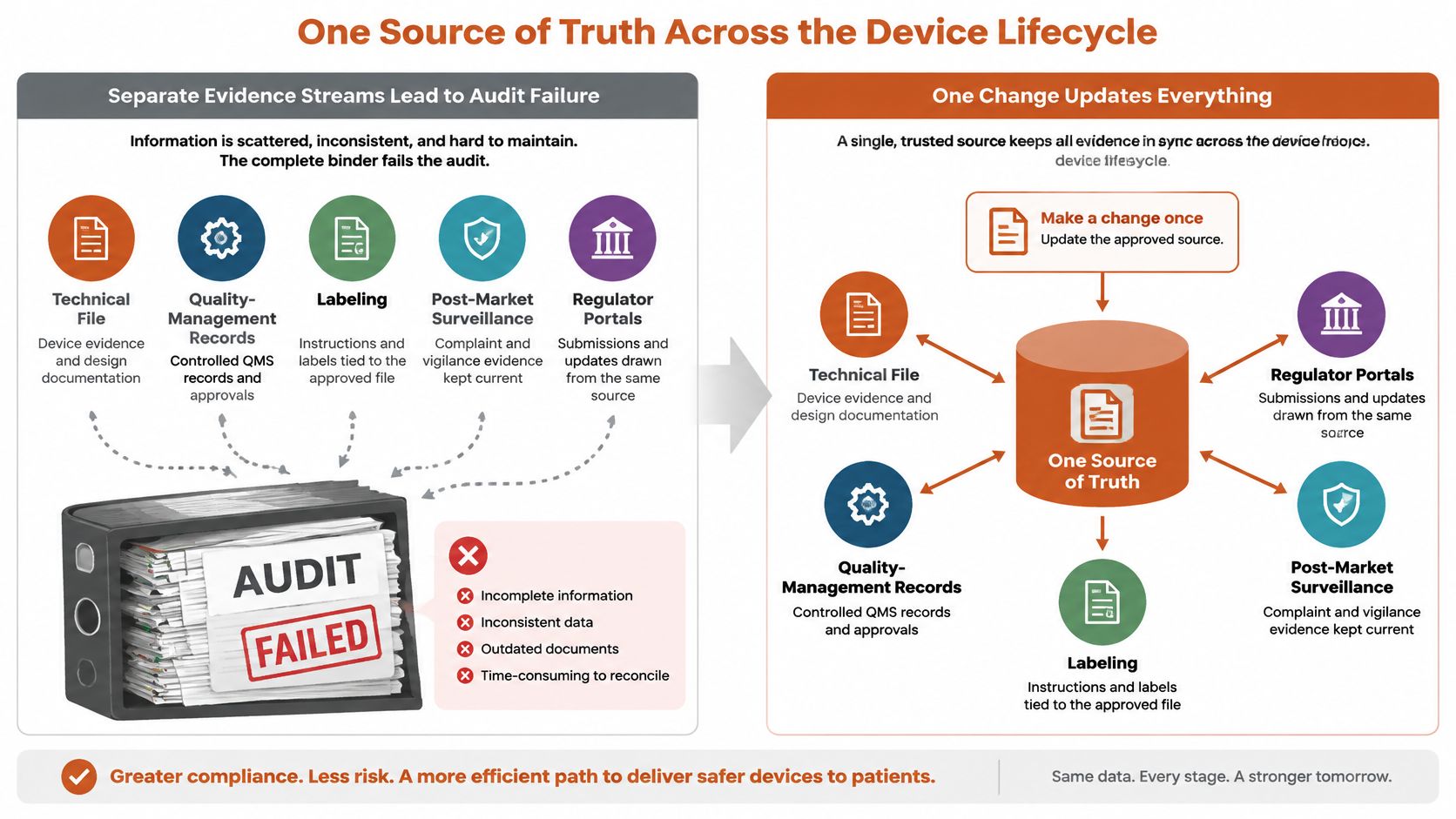
A complete binder can still fail an audit. Engineering may have released a patch, quality may have approved the change request, and regulatory affairs may still be maintaining registration data for the previous configuration.
The problem isn't missing prose. It's inconsistent facts across controlled systems.
The lifecycle diagram shows how separate evidence streams should draw from a shared, approved configuration.
Follow a displayed-result change
Consider a software patch that changes how a measured result appears on screen. The algorithm hasn't changed, but the display now rounds values differently. Engineering shouldn't conclude that the change is documentation-only without examining how clinicians interpret the result.
The change owner assesses whether the new display affects safety, performance, or regulatory status. The reviewer then checks the display requirement, associated risk control, verification protocol, screenshots, instructions, and any relevant usability evidence. Regulatory affairs determines whether device-registration information or the basis for an identifier needs updating, rather than assuming every patch requires a new UDI.
Post-market staff also need usable configuration information. If complaint intake can't distinguish the old display from the patched display, investigators may group unlike events together.
Put reconciliation under change control
Use these controls to prevent disagreement:
- Document-to-data map: Identify where shared fields appear, including intended purpose, model identifiers, software versions, warnings, and registration attributes.
- Named record owners: Assign responsibility for each destination, not just the engineering change request.
- Approval audit trail: Preserve who approved which revision, against which evidence, and for which configuration.
- Release reconciliation: Compare the release package with affected labeling, certificate information, registration records, and post-market coding before distribution.
These controls matter even when a manufacturer meets a quality-system standard. AskDona's medical-device documentation overview identifies 2 February 2026 as the FDA QMSR effective date and 28 May 2026 as the mandatory date for core EUDAMED modules, while emphasizing the operational gap between quality-system compliance and synchronized regulatory records.
A single source of truth doesn't require a single application. It requires an authoritative owner, controlled values, and a reliable way to reconcile every destination.
For a small manufacturer, that might start with a controlled register and explicit release checks. A larger organization may use connected quality, product-lifecycle, and regulatory systems. Either way, a voice-drafted sentence remains unapproved draft content until a qualified reviewer verifies its evidence and approves the controlled record.
Regulatory Dates That Reset the File in 2026
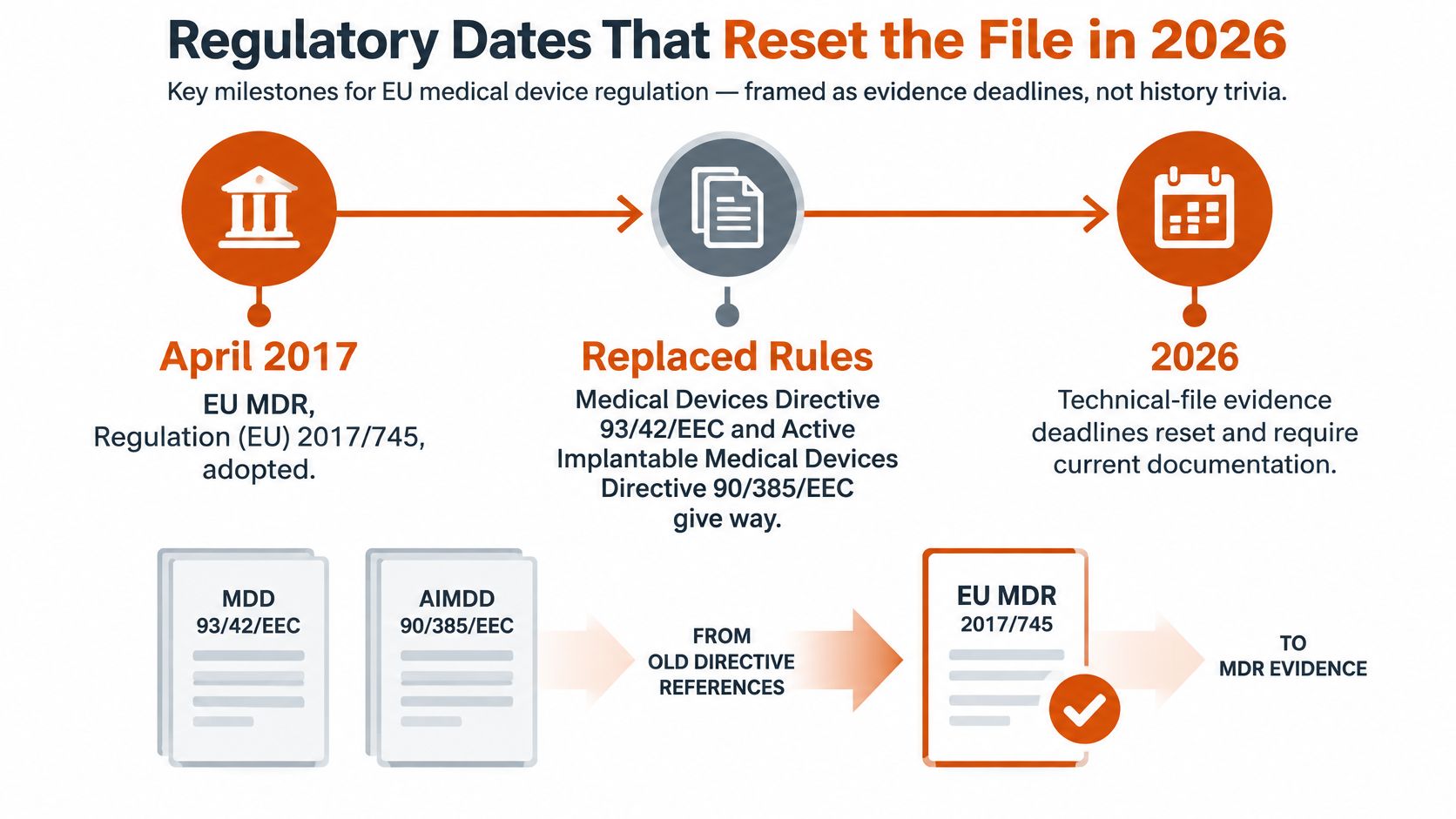
Three regulatory dates shape how manufacturers should review their records: the FDA QMSR takes effect on 2 February 2026, core EUDAMED modules become mandatory on 28 May 2026, and MDR legacy-device transition endpoints fall on 31 December 2027 or 31 December 2028, depending on conditions. The European Commission's MDR transition material sets out the regulation's adoption in April 2017, application from 26 May 2021, and conditional transition dates under Regulation (EU) 2023/607.
A date changes the review schedule, not the evidence standard. The MDR replaced the earlier medical-device and active-implantable-device directives with a more detailed lifecycle framework. A legacy-device transition does not remove the need to assess changes, keep evidence current, and monitor the device on the market.
The graphic shows the shift from the earlier directives to the MDR.
Match the clock to your device
Documentation clocks by market
| Milestone | Date | Where | What the file must match |
|---|---|---|---|
| MDR applicable | 26 May 2021 | European Union | Lifecycle evidence for GSPRs, not a one-time dossier |
| Legacy-device transition end | 31 December 2027 or 31 December 2028 | European Union | Class and other conditions under Regulation (EU) 2023/607 |
| FDA QMSR effective | 2 February 2026 | United States | ISO 13485 alignment plus US labeling, complaint, and servicing records |
| EUDAMED core modules mandatory | 28 May 2026 | European Union | Actor registration, UDI, certificates, and market surveillance |
| IMDRF SaMD document set complete | 2017, after a 2013 concept and 2014 risk framework | International | Intended purpose and risk by information significance and condition seriousness |
The IMDRF Software as a Medical Device working group developed its document set over several years: the SaMD concept appeared in 2013, risk categorization followed in 2014, and the technical-document series was completed in 2017. Its framework considers both the significance of the information software provides and the seriousness of the healthcare situation or condition.
That distinction helps prevent a classification error. A shared delivery format does not make software equivalent. The intended purpose and risk argument should distinguish software that informs a clinical decision from software used in a more consequential clinical situation.
Turn dates into readiness decisions
For each applicable milestone, record the market, device class, transition basis, responsible person, and outstanding evidence. A transition endpoint is conditional, so confirm that the device meets the associated requirements before relying on it.
Review the records together:
- Device scope: Intended purpose, variants, accessories, and released software configuration.
- External representations: Certificate scope and applicable registration information.
- Current evidence: Risk conclusions, clinical evaluation, labeling, and post-market findings.
A useful comparison is how keeping laser treatment records audit-ready concerns clinic-level treatment records, while a manufacturer's conformity file must support its own regulatory claims. Keep those record types distinct.
The embedded video provides additional context on regulatory dates and their implications for documentation reviews. Watch it alongside the device-specific check, not as a substitute for confirming which dates and transition conditions apply.
Select the table rows that apply to the product, then reconcile the technical documentation, certificate information, and UDI entry. Each should identify the same device and reflect the same approved configuration.
Usability Evidence When the Device Works but Users Err
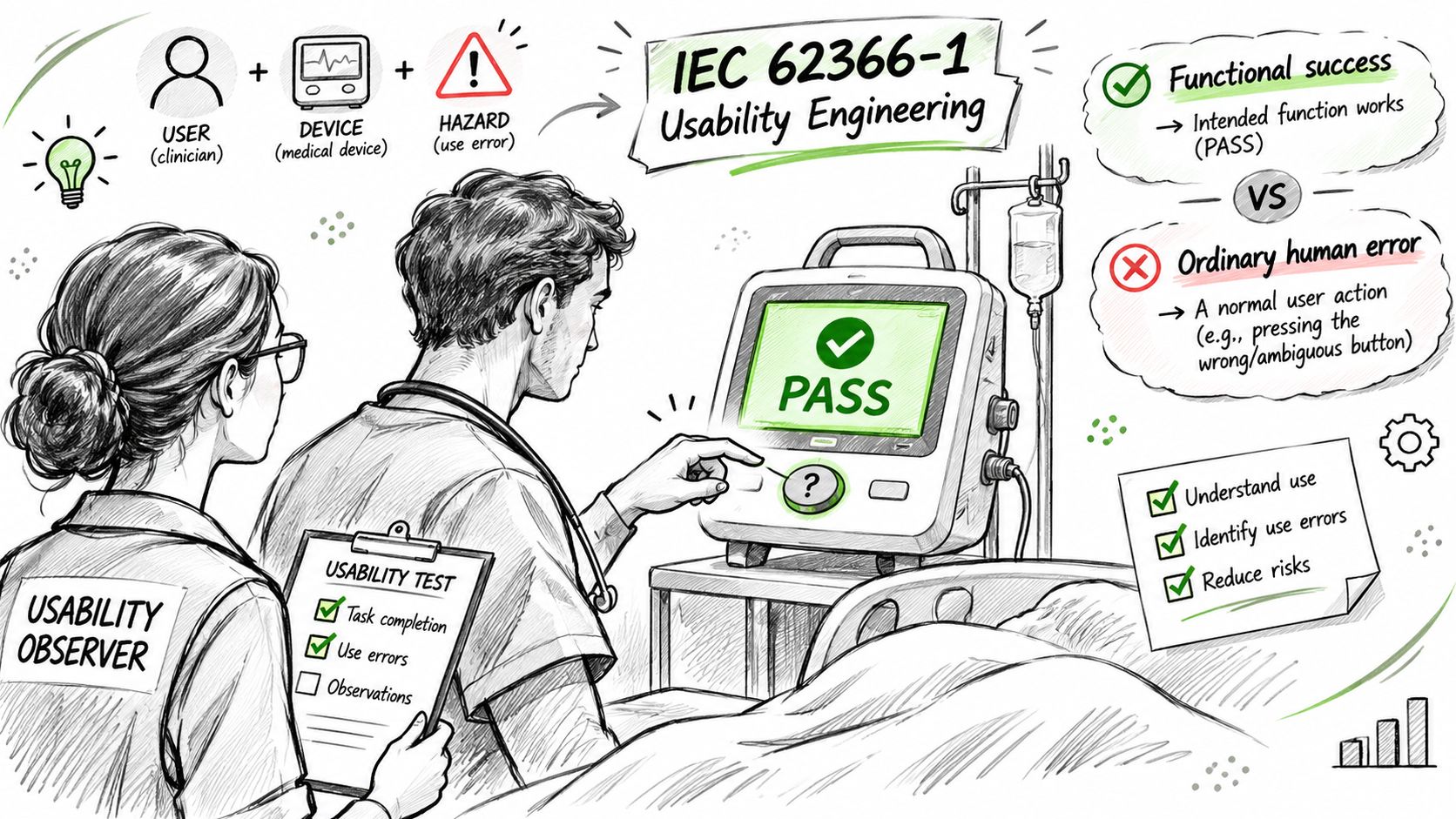
A device can meet its functional specification and still expose users to avoidable harm. A confirmation button may work perfectly while its placement encourages a clinician to accept the wrong value.
The FDA's recognition entry for IEC 62366-1 identifies the usability-engineering standard supporting analysis, specification, design, verification, and validation of usability-related safety. The relevant question isn't merely whether the interface operates, but whether intended users can complete safety-critical tasks under representative conditions.
The illustration places that evaluation in a clinical-use setting.
Define the task before designing the test
Begin with intended users and use environments. A trained specialist in a quiet room and a rotating clinical team handling interruptions may interact with the same interface differently.
Document the critical task, foreseeable use error, hazardous situation, and user-interface requirement. Then identify the control and the evidence needed to show that it works.
For medical documentation software, test workflows such as:
- Medication correction: Can the user detect and correct a plausible but incorrect drug name?
- Negation handling: Does the user notice when the draft reverses a statement such as no known allergy?
- Speaker attribution: Can users distinguish the clinician's words from the patient's report?
- Structured-field confirmation: Can the user verify the destination field before information enters the patient record?
These are safety scenarios, not merely transcription-accuracy checks.
Trace a medication-name hazard to validation
Suppose dictated text contains the wrong medication name. The hazardous situation is a clinician relying on that incorrect entry; the proposed control is a confirmation step that makes the medication and destination visible before acceptance.
Formative evaluation helps the design team discover whether users understand the confirmation screen and notice the error. Summative validation, where necessary, evaluates the final interface against predefined acceptance criteria with representative users and tasks.
Set the criterion before observing the result. Specify the required task outcome, what counts as a use error, how assistance is handled, and what findings require investigation or redesign.
A completed test session isn't automatically a successful validation. The observed result must support the safety conclusion.
If users miss the wrong name, investigate the interface, terminology, workflow, instructions, or training. Don't close the issue by recording that participants made mistakes.
Choose a critical task in your own device workflow. Write the acceptance criterion that would demonstrate users can perform it safely, then identify the approved protocol and result that support that conclusion.
Cybersecurity Evidence Beyond a Software Bill of Materials
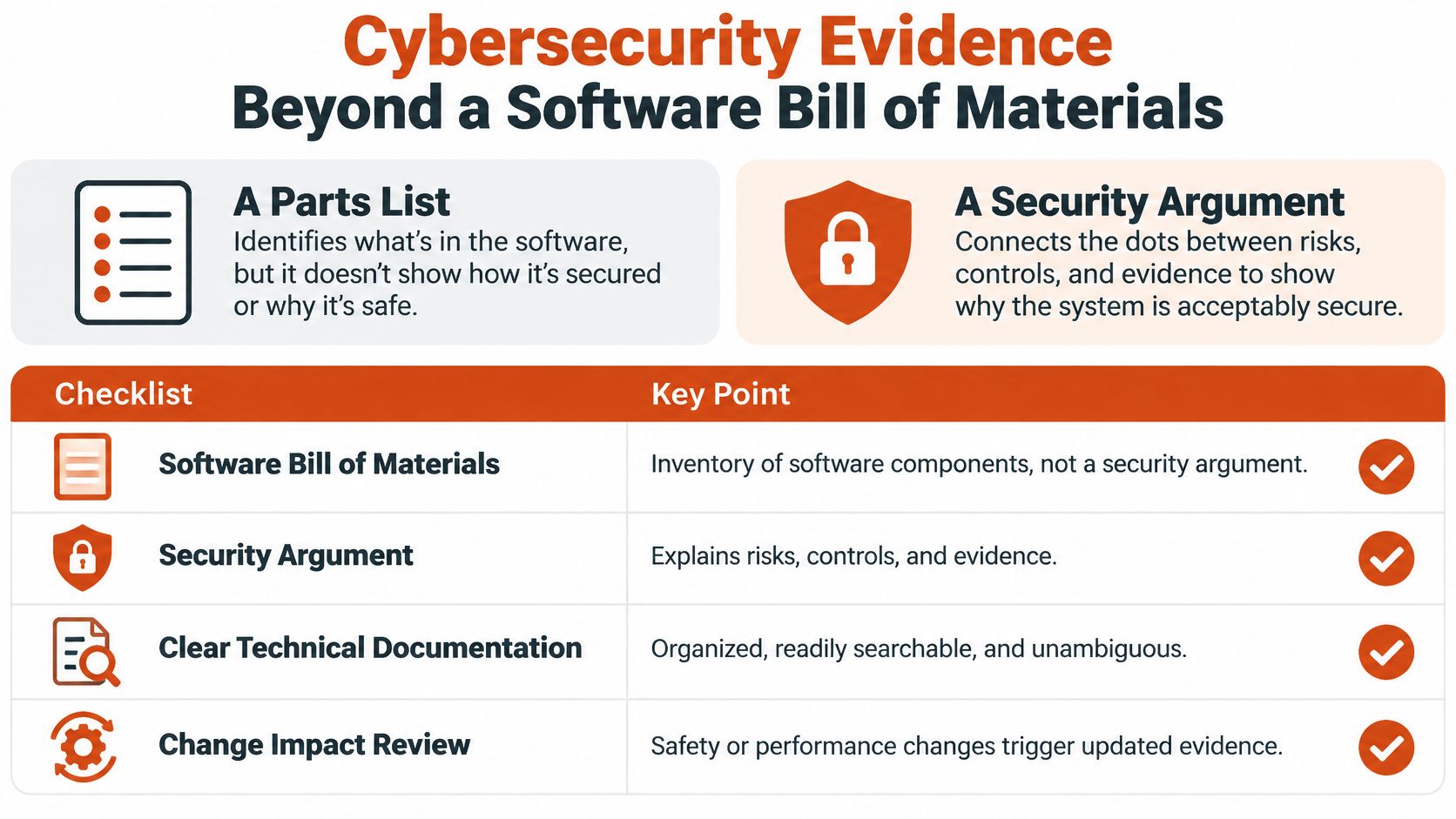
A software bill of materials, or SBOM, names the software components in a device. On its own, it does not show whether a vulnerability can be exploited in the device, what harm could result, or whether the risk controls are effective. The technical file should connect each relevant component to the product's architecture, risk assessment, mitigations, testing, and monitoring. That creates a security argument reviewers can follow rather than leaving them to piece together separate records.
The EU MDR text calls for technical documentation that is clear, organized, readily searchable, and unambiguous. Apply that principle to cybersecurity evidence: each conclusion should lead to the supporting record, and each record should identify the device or software configuration it covers.
The checklist below separates evidence planning from legal applicability.
Separate evidence planning from legal conclusions
Cyber evidence by certainty and device age
| Status | Evidence | New connected device | Legacy device |
|---|---|---|---|
| Expected now | Architecture, interfaces, threat model, risk controls, test evidence, and monitoring plan | Complete and traceable to residual risk | Proportionate to remaining connectivity and support |
| US cyber-device provisions and guidance to assess | Support and end-of-support dates, CISA KEV references, VEX, coordinated disclosure, and machine-readable SBOM | Determine which provisions apply and build relevant evidence into the lifecycle file | Assess applicable provisions and map exploitable components still in the field |
| EU cybersecurity proposals to monitor | Explicit SBOM and related EUDAMED cybersecurity proposals | Track their status; do not present proposals as current mandates | Apply the same distinction between proposals and current requirements |
Use this table to plan evidence, not to decide legal applicability. The listed US materials are not all universal legal requirements, and EU proposals may change status. Check the applicable jurisdiction and device requirements for the product.
Record the legal-status check separately. For each requirement, document the authority, the applicability decision, and the review date. A general security checklist cannot establish whether a particular provision applies to a specific device.
Follow a vulnerable component through the file
Suppose a connected device includes a communications library with a disclosed vulnerability. Identify the affected component and released builds, then assess whether the vulnerable function is reachable in the deployed configuration. A component name alone does not answer that question.
Connect the assessment to the threat model, risk control, test evidence, and residual-risk decision. If remediation is needed, record the owner and deadline, define customer communication, and track the proposed patch's approval status. Treat draft assessments and patch descriptions as unapproved until the appropriate reviewer signs the evidence.
If the vulnerability is judged not exploitable, document the rationale rather than relying on a status label. A patch that could affect safety or performance also needs change-impact review, including whether notified-body approval may be necessary.
Teams handling sensitive information can consult guidance on healthcare data security practices. Device cybersecurity evidence must also address the product's clinical function and support life, because a security decision can affect whether the device remains safe and usable.
For each open vulnerability, classify the associated obligation as required now, emerging, or not applicable, and record the reason. Then trace the decision across the technical file, quality records, labeling, UDI, and post-market data. Keeping those records synchronized is harder than producing an SBOM, but it gives reviewers one consistent account of the device and its security status.
Approve the Record Before the Next Change Ships
Run the next release review against the actual configuration being shipped, not the most recently assembled presentation. The goal is an approval package that another qualified person can reconstruct without relying on the author's memory.
Use this sequence as a release gate.
Check the configuration and evidence
- Name the configuration. Record the device identifier, software build, accessories, and intended purpose. Identify the manufacturing configuration when it affects the evidence.
- Mark affected records. Review risk, verification, clinical evidence, usability, labeling, UDI data, and post-market documentation. Record why apparently unaffected records remain applicable.
- Decide the regulatory impact. Determine whether safety, performance, or regulatory status changes. Resolve whether the notified body or another authority needs to review the change before implementation.
- Repair the trace. Confirm that each affected claim still reaches its requirement, control, acceptance criterion, and approved result.
- Reconcile external information. Compare the release package with applicable certificate data, registration entries, and post-market reporting configurations.
- Approve and preserve. Have a qualified person approve the controlled records, retain the audit trail, and remove superseded versions from current points of use.
A practical guide to writing technical documentation can support clearer drafting. It can't replace the technical judgment behind those approvals.
Keep drafting assistance outside the approval boundary
Dictated or generated prose is not the approved record. A fluent sentence can still contain an incorrect identifier, unsupported conclusion, or missing qualification.
With AIDictation, our Local Mode runs transcription on-device, so users can dictate offline and keep sensitive audio on their machine. We can also help expand sparse bullet points into readable documentation for teammates to review and comment on. That drafting role has firm limits: we have no SOC 2 or HIPAA compliance and no invoicing or procurement paperwork, and the app must not serve as the repository for your approved technical file.
Use only content permitted by your organization's policies, then move reviewed text into the controlled system. Assign an owner and a due date to the out-of-date record most likely to undermine your next release, and make its approval a visible release condition.
AIDictation offers voice-to-text drafting and expansion of sparse notes into documentation your teammates can review. Visit AIDictation to prepare a non-sensitive change-summary draft, then verify its claims and route the finished record through your quality-system approval process.
Frequently Asked Questions
What does Technical Documentation Medical Device in 2026 cover?
Notified bodies issued 16,453 MDR and IVDR certificates in 2025, a 45% increase from 11,292 in 2024, according to Team-NB, as reported by Regulatory Affairs Professionals Society. Behind that review activity lies a practical documentation problem: manufacturers must show which device configuration their evidence supports, then keep that evidence aligned as the product changes.
Who should read Technical Documentation Medical Device in 2026?
Technical Documentation Medical Device in 2026 is most useful for readers who want clear, practical guidance and a faster path to the main takeaways without guessing what matters most.
What are the main takeaways from Technical Documentation Medical Device in 2026?
Key topics include Table of Contents, What a Medical Device Technical File Actually Is, Separate the operating instructions from the evidence.
Ready to try AI Dictation?
Experience fast voice-to-text on your device. Free to download.
Download Free