Intellectual Property Notes Made Simple
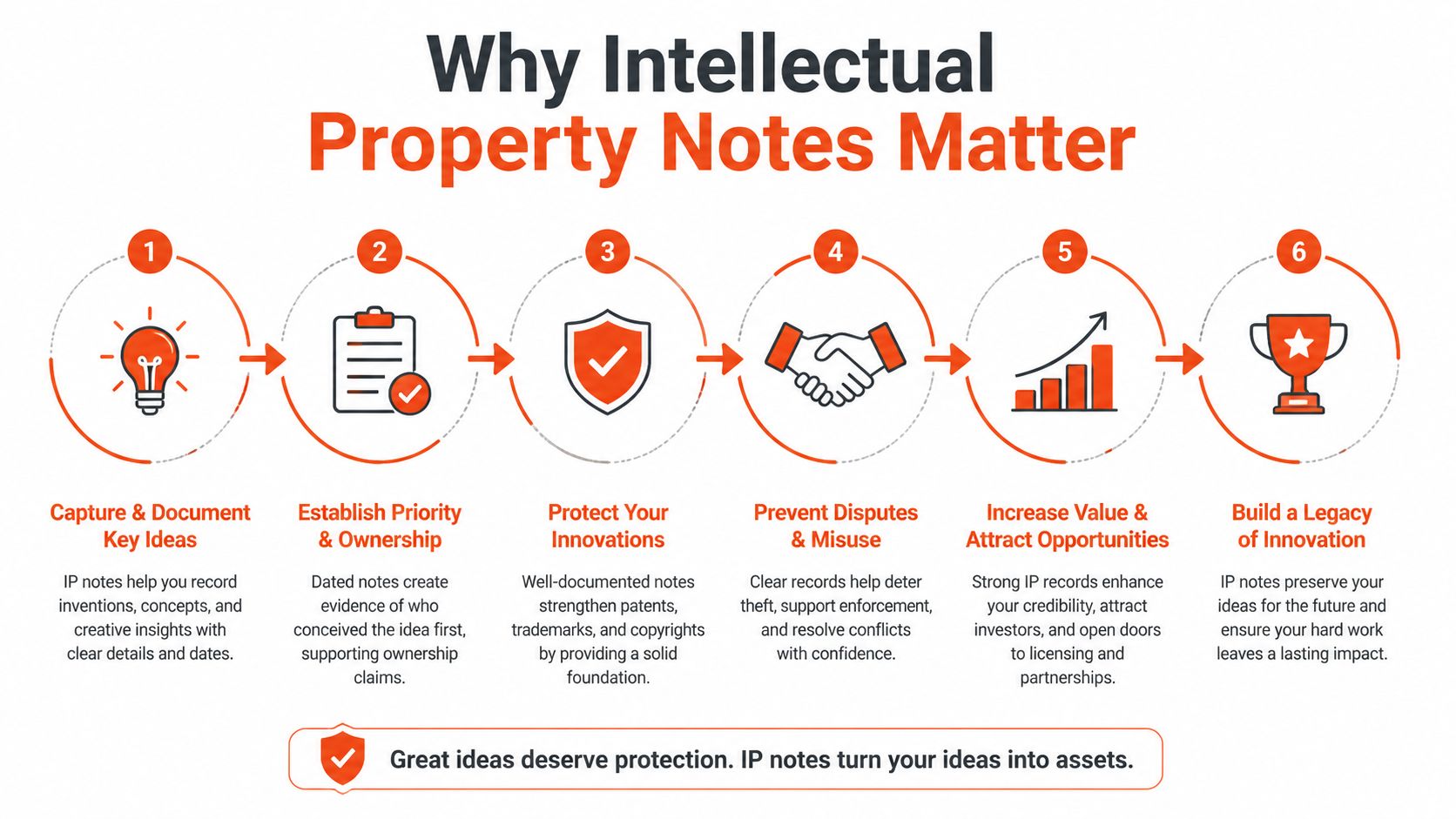
You dictate a product idea into your phone on the way to work. A transcription service turns the recording into clean notes, an AI tool removes filler words, and you send the draft to a designer, engineer, and overseas partner. The document looks ordinary, but it may contain creative expression, a functional invention, a potential brand name, and confidential business knowledge at the same time.
That's why intellectual property notes need more care than ordinary reminders. Good notes don't automatically create ownership or legal protection, but they can help you identify what matters, preserve evidence, control disclosure, and decide whether a draft is ready to share, publish, license, or submit for professional review.
Table of Contents
- Why Intellectual Property Notes Matter
- Understanding the Four Core IP Categories
- Key Principles and Exceptions
- How the Categories Apply in Practice
- Templates and Shorthand for Better Notes
- Sample Summaries for Quick Review
- Recording and Organizing Notes Safely
Why Intellectual Property Notes Matter
A founder records a rough explanation of a proposed healthcare device. The first audio file captures the founder's own words. A speech-to-text system converts those words into a draft. An AI assistant reorganizes the explanation into headings and removes repetitions. A contractor adds a diagram, and a colleague suggests a memorable product name.
One working document now contains several different IP questions. The founder's original explanation and the contractor's diagram may involve copyrightable expression. The device's technical mechanism may be relevant to patent analysis. The suggested name could become a trademark candidate. The details about the manufacturing method may be valuable confidential know-how.
The words alone don't answer every legal question. Context matters. Who created each part? What agreement governed the contractor's work? Did anyone disclose the technical idea publicly? Has the proposed name been used to identify goods or services? Which countries are involved? A note that seems harmless in a private workspace can become significant once it's emailed to a supplier or uploaded to a shared platform.
Practical rule: Label the possible asset before you decide how widely to share the note.
The global IP system makes this classification increasingly important. WIPO's IP Statistics Data Center covers patents, trademarks, industrial designs, utility models, and international filing systems, with long-running historical series that help governments, researchers, and businesses compare activity across countries and time. IP is therefore more than an abstract legal idea. It's a structured system that organizations document, manage, and evaluate.

For practical research and documentation habits, this guide to research documentation offers a useful model: capture the source, preserve the context, and make later review easier. Apply the same discipline to IP-related notes by keeping the original recording, the edited transcript, contributor details, access history, and a clear statement of what the note is meant to support.
AI-assisted drafting adds another layer. A person may supply the ideas and raw language, while software performs transcription, cleanup, translation, or organization. The U.S. Copyright Office's 2025 AI report is relevant to this uncertainty because human authorship remains central to copyrightability. The practical question isn't whether an AI-assisted note is “owned.” It's whether your records show who contributed creative expression, what the software changed, and what permissions apply to later reuse.
Understanding the Four Core IP Categories
A notebook analogy makes the four main categories easier to separate. Think of the notebook as a project that moves from raw thought to usable business asset.
Copyright protects the way an idea is expressed
Your written explanation, interview transcript, original diagram, or carefully structured report may contain copyrightable expression. Copyright generally focuses on the form of communication, not the underlying fact, method, or broad idea.
If your note says, “The app lets a clinician summarize a consultation by speaking naturally,” that sentence may be ordinary language. A distinctive, developed article explaining the workflow is a different matter. The underlying concept of summarizing a consultation isn't automatically protected merely because you wrote it down.
The trigger usually involves original expression fixed in a recorded form. A voice recording, transcript, or document can help show what was created and when, but a timestamp alone doesn't guarantee protection.
Patents protect qualifying inventions
A patent is closer to a recipe for a new technical result than to a page of prose. Your notes may describe a device, process, or technical improvement, but the notes themselves aren't the patent. Patent analysis normally asks whether the invention meets requirements such as novelty and non-obviousness, along with other jurisdiction-specific rules.
A sketch showing a new sensor arrangement and notes explaining how the arrangement solves a technical problem may support an invention disclosure. Public disclosure can affect patent strategy, so invention notes should be handled more cautiously than a routine brainstorming list.
Trademarks identify commercial source
A brand name, logo, slogan, or other sign can help customers recognize the source of goods or services. In the notebook analogy, a trademark is a signpost. It points customers toward a particular commercial identity.
A memorable phrase in a meeting transcript isn't automatically a trademark. Its role depends on how it's used. A phrase placed on products, websites, or service materials may function as a mark, while the same phrase in an internal note may be only an idea awaiting review.
For a plain-language overview of these distinctions, Kons Law's trademark and copyright guide provides useful background, though specific outcomes still depend on the relevant jurisdiction and facts.
Trade secrets protect valuable confidential information
A private formula, supplier process, pricing method, or technical workflow may be treated as confidential know-how or trade secret material when it has value because it isn't generally known and the owner takes reasonable steps to keep it secret.
A note stored in an open team channel may be difficult to characterize as carefully protected confidential information. A restricted document with permission controls, confidentiality terms, and an access history tells a stronger operational story.

A single project can involve all four categories. The technical product may raise patent issues, the user manual may contain copyrightable expression, the product name may require trademark review, and the manufacturing process may need secrecy controls.
Key Principles and Exceptions
Protection depends on more than putting words into a document. Each IP category has a different central question, and the same raw note can produce different results depending on its purpose, surrounding facts, and jurisdiction.
| Category | Core Requirement | Key Boundary | Common Exception |
|---|---|---|---|
| Copyright | Original expression fixed in a recorded form | Facts, ideas, methods, and short commonplace language may fall outside protection | Fair use or another local limitation may apply, depending on purpose and context |
| Patent | A qualifying invention that satisfies applicable legal requirements | A description alone doesn't guarantee patent rights, and prior art can affect eligibility | Prior art may prevent protection, while narrow jurisdiction-specific exceptions may affect disclosure consequences |
| Trademark | A distinctive sign used or intended to identify commercial source | A phrase in private notes isn't necessarily trademark use | Descriptive or otherwise fair use may be permitted in some circumstances |
| Trade secret | Valuable information kept secret through reasonable measures | Disclosure, weak controls, or public availability can undermine secrecy | Independent development or lawful reverse engineering may be permitted in some jurisdictions |
Originality and fixation
Copyright analysis separates expression from information. A verbatim interview transcript may record another person's words, raising authorship and permission questions. Your original editorial arrangement, commentary, or selection may involve a different analysis.
Fixation matters because a recording, transcript, or saved draft gives the work a stable form. Keep the raw version when possible, especially if later edits, translation, or AI cleanup could make the final wording look more independent than it really is.
Novelty and non-obviousness
Patent notes should describe the technical problem, proposed solution, contributors, tests, drawings, and public disclosures. A brilliant idea can still face prior-art problems if similar information was already available. A private note can support chronology, but it doesn't replace professional patent analysis or filing strategy.
Distinctiveness and use
A proposed brand name must be assessed as a source identifier, not merely as a pleasant phrase. A descriptive term may communicate what a product does without distinguishing who provides it. A name that looks strong in a brainstorming note may become weaker after a clearance search or broader market review.
Secrecy and reasonable measures
Trade secret protection depends on conduct as well as content. Access permissions, confidentiality agreements, restricted folders, careful sharing, and clear labels can help demonstrate that the organization treated information as confidential. They don't turn every internal note into a trade secret.
Ownership also requires attention. Employment terms, contractor agreements, joint projects, licenses, and collaboration rules can determine who may use or transfer the resulting material. Jurisdiction affects registration, duration, exceptions, and enforcement, so avoid treating a general note-taking rule as universal legal advice.
How the Categories Apply in Practice
The practical difference becomes clearer when the same note-taking habit is placed beside a specific project.
| IP Category | Typical Note Situation | What to Watch For | First Protective Step |
|---|---|---|---|
| Copyright | Drafting a blog post, training guide, or interview transcript | Original wording, contributor rights, permissions, edits, and later reuse | Preserve drafts, identify contributors, and record permissions |
| Patent | Sketching a device improvement or technical process | Novelty, contributors, testing, public disclosure, and invention chronology | Create a restricted invention disclosure record before broad circulation |
| Trademark | Brainstorming a product name or slogan | Distinctiveness, commercial use, confusingly similar marks, and market scope | Mark the idea as uncleared and record intended goods or services |
| Trade secret | Documenting a vendor process, formula, or internal method | Confidentiality, access, sharing, copying, and retention | Restrict access and record why the information has commercial value |
Consider a software company developing a tool that converts spoken clinical observations into structured documentation. A product manager dictates the workflow, an engineer describes the processing method, a designer drafts the interface, and a marketing lead suggests a name.
The product manager's written explanation may involve copyrightable expression. The engineer's technical method may need patent review. The interface name may raise trademark questions. Internal information about model configuration, vendor terms, or deployment practices may be confidential know-how.
The note-taking channel changes the risk. A private invention record, a public blog draft, and a partner-facing product brief should not share identical access settings. The raw content may overlap, but the intended audience, purpose, and disclosure level differ.
A useful classification question: Is this line communicating expression, describing function, identifying source, or revealing confidential value?
For business teams, the inventory should be more than a folder full of documents. Questel's guidance on maintaining intellectual property records recommends tracking fields such as IP type, application or registration number, owner names, filing date, classes, renewal deadlines, and evidence of first use. That metadata turns scattered notes into an actionable record.
Templates and Shorthand for Better Notes
A template helps people ask the right questions before a note disappears into a general project folder. It doesn't create ownership by itself. Rights arise from applicable law, contracts, registration systems, or confidential relationships, not from labels alone.
General IP note template
Use this structure for a product idea, research record, marketing concept, or internal document:
- SUBJECT: What does the note describe?
- IP TYPE: Copyright, patent, trademark, trade secret, mixed, or undecided.
- OWNER: Individual, employer, client, joint team, or unknown.
- CREATORS: Who supplied words, ideas, drawings, recordings, or edits?
- DATE: When was the material captured and when was it revised?
- EVIDENCE: Audio, transcript, sketches, screenshots, drafts, test files, or source documents.
- USE: Internal review, publication, filing preparation, training, licensing, or other purpose.
- ACCESS: Who may view, edit, export, or share it?
- RESTRICTIONS: Confidentiality terms, permission limits, personal data, or disclosure concerns.
- NEXT: Clearance search, legal review, filing discussion, redaction, approval, or archive.
For rapid capture, shorthand keeps the minimum context visible:
OWN: responsible owner
EVID: supporting file or recording
USE: intended use
EXPIRE: renewal or review date
NEXT: next action
A short note such as EVID: phone audio, draft 2 is more useful than an unexplained timestamp because it points a reviewer toward the underlying record.
Invention disclosure template
For a technical concept, add fields that focus on chronology and disclosure:
- PROBLEM: What technical problem exists?
- SOLUTION: What does the proposed system do differently?
- CONTRIBUTORS: Who contributed to the inventive concept?
- DRAWINGS: Which sketches or diagrams explain the mechanism?
- TESTS: What has been built, tested, or simulated?
- PUBLIC DISCLOSURE: Has anyone presented, posted, sold, demonstrated, or shared it externally?
- RELATED WORK: What earlier products, publications, or internal projects should be reviewed?
- CONFIDENTIALITY: Which agreement or access rule applies?
- REVIEW: Who will assess filing strategy?
The value of this format is traceability. Research documentation guidance can help teams organize long-form material, but IP notes also need ownership, evidence, restrictions, and next actions.
Adapt the fields for your setting:
- Coursework: Record the source, quotation permissions, original analysis, and submission restrictions.
- Client work: Separate client-owned content from your templates, tools, and pre-existing materials.
- Personal projects: Identify collaborators, retain original files, and note what you've shared publicly.
Sample Summaries for Quick Review
Short summaries work as review anchors. They help you notice whether a note requires a copyright, patent, trademark, or confidentiality question before you publish or share it.
Software idea
SUBJECT: Voice workflow that converts a spoken clinical observation into structured fields.
IP TYPE: Mixed, possible patent and copyright issues.
OWN: Product team, subject to employment and contractor agreements.
EVID: Original audio, raw transcript, edited specification, workflow sketch.
USE: Internal product review.
RESTRICTIONS: Do not circulate outside the product group until disclosure is reviewed.
NEXT: Identify contributors and ask qualified counsel to assess patent and confidentiality strategy.
Risk note: The workflow description may contain written expression, while the technical mechanism requires a separate functional analysis.
Product name
SUBJECT: “ClearNote” proposed name for a documentation tool.
IP TYPE: Potential trademark.
OWN: Business, subject to clearance and ownership review.
EVID: Brainstorm record, naming brief, proposed goods and services, search results.
USE: Internal naming discussion.
RESTRICTIONS: Do not announce publicly before clearance.
NEXT: Conduct a jurisdiction-specific trademark search.
Risk note: A memorable phrase becomes relevant as a trademark when it functions as a commercial identifier. Its presence in a notebook doesn't establish that function.
Interview transcript
SUBJECT: Interview with a developer about documentation practices.
IP TYPE: Copyright and permission questions.
OWN: Confirm interviewee rights, interviewer contributions, and publication terms.
EVID: Consent record, audio, transcript, edited article, translation draft.
USE: Research article and possible public publication.
RESTRICTIONS: Remove confidential details and honor agreed limitations.
NEXT: Verify attribution and publication permission.
Risk note: The transcript contains the speaker's expression. Your selection, arrangement, edits, and commentary may raise separate authorship issues.
Confidential know-how
SUBJECT: Vendor process for reducing defects during a specialized production stage.
IP TYPE: Trade secret or confidential know-how.
OWN: Company, subject to vendor agreement.
EVID: Restricted procedure note, process diagram, agreement, access log.
USE: Internal training for approved staff.
RESTRICTIONS: No external sharing or personal-device export.
NEXT: Review access list and retention schedule.
Risk note: The commercial value may depend more on secrecy than on expressive wording. A polished summary should still receive the same access controls as the underlying process.
Recording and Organizing Notes Safely
A safe workflow starts before transcription. When someone dictates an idea, preserve the original audio, record the speaker, device, date, and project, and enable timestamps when the tool supports them. Then create a transcript while keeping the raw recording separate from the cleaned version.
Contemporaneous records are generally stronger than reconstructed accounts. Forensic note-taking guidance emphasizes records made at or near the event, along with timestamped observations, drafts, sketches, and research notes. Digital audit trails can add useful context when they show who edited, viewed, exported, or signed a record.
A practical capture sequence
- Capture the source. Save the original audio, handwritten page, sketch, or source file.
- Timestamp the event. Keep the capture time and revision history visible.
- Label the people. Identify the speaker, writer, editor, AI tool, contractor, and reviewer.
- Separate versions. Store raw transcription, human edits, AI-assisted cleanup, and approved output as distinct records.
- Classify the content. Mark possible expression, invention, brand, confidential information, personal data, or mixed material.
- Control access. Use workspace permissions based on need, not convenience.
- Record disclosure. Note who received the material, why, under what agreement, and whether the sharing was internal or external.
- Archive deliberately. Keep supporting evidence with the relevant asset record and apply a retention policy.
The same note can serve different evidentiary purposes. A sequence of drafts can show how a person developed written expression. A technical record can preserve conception, contributors, testing, and later development. A screenshot can document use of a mark in commerce. A restricted procedure file can support the organization's effort to preserve confidentiality.
AI creates a need for more precise labeling, not less. Record whether the system transcribed speech, translated it, removed filler words, reorganized sections, generated new language, or summarized another person's words. Human review should identify errors, unsupported additions, private data, and material that the team lacks permission to reuse.
Cloud storage also requires operational judgment. Review encryption, workspace permissions, vendor terms, retention settings, deletion processes, cross-border transfers, and the lawful basis for processing personal information. Data security best practices for dictation workflows can help teams build a broader review checklist.
Cross-border work makes labels and permissions even more important. A partner in another country may receive a different version, under different contractual terms, and subject to different rules about privacy, copyright, patent disclosure, or trade secrets. Treat the record as an evidence and governance system, not as a passive pile of notes.
Good organization preserves context, but it doesn't create rights. Review important records periodically, redact material that no longer needs broad access, and seek jurisdiction-specific advice before filing, publishing, or transferring valuable IP.
AIDictation turns spoken ideas into clean, ready-to-send writing while supporting workflows such as research documentation, technical notes, interviews, and meeting records. Try AIDictation to capture source audio and transform speech into organized drafts, then apply the ownership, evidence, access, and retention practices described above.
Frequently Asked Questions
What does Intellectual Property Notes Made Simple cover?
You dictate a product idea into your phone on the way to work. A transcription service turns the recording into clean notes, an AI tool removes filler words, and you send the draft to a designer, engineer, and overseas partner.
Who should read Intellectual Property Notes Made Simple?
Intellectual Property Notes Made Simple is most useful for readers who want clear, practical guidance and a faster path to the main takeaways without guessing what matters most.
What are the main takeaways from Intellectual Property Notes Made Simple?
Key topics include Table of Contents, Why Intellectual Property Notes Matter, Understanding the Four Core IP Categories.
Ready to try AI Dictation?
Experience fast voice-to-text on your device. Free to download.
Download Free