How Much Is 1000 Words? a 2026 Pricing Guide
A 1,000-word piece can cost anywhere from $50 to over $2,000. That's a wide spread, but it's the honest answer if you're budgeting for a blog post, article, or report and trying to figure out what you'll get for the money.
This question commonly arises when staring at a content plan, a freelance quote, or a blank calendar and trying to turn “we need more content” into a real budget. The problem is that word count sounds precise, while pricing rarely is. Two 1,000-word articles can have the same length and completely different workloads.
That's why “how much is 1000 words” isn't really a word-count question. It's a scope question. It's also a time question. If you hire someone, you're paying for their time, process, and judgment. If you write it yourself, you're still paying, just with your own hours instead of cash.
Table of Contents
- The Real Cost of 1000 Words in 2026
- Who You Hire Determines What You Pay
- What Drives the Price of Writing Up or Down
- Beyond Dollars The Time Investment for 1000 Words
- Smart Strategies to Lower Your Content Costs
- Frequently Asked Questions About Content Pricing
The Real Cost of 1000 Words in 2026
A 1,000-word budget gets easier to judge once you understand what 1,000 words is. In standard business or academic formatting, 1,000 words is about 2 pages single-spaced or about 4 pages double-spaced, though font, margins, and spacing change the exact length, as noted in Grammarly's page-length guide.
That matters because clients often treat 1,000 words like a small task. It usually isn't. It's long enough to require structure, transitions, examples, and an editor's eye. It's short enough that every weak sentence shows.
Practical rule: You're not buying “1000 words.” You're buying a finished deliverable that happens to be 1000 words long.
When someone quotes a low price, ask what's inside that number. Are they writing from your outline, or creating the angle? Are they doing research, or paraphrasing what's already ranking? Are revisions included? Will they format it for publishing?
Those details drive cost far more than the raw word count.
For planning, I tell clients to separate content length from content responsibility. Length tells you the output size. Responsibility tells you who owns strategy, sourcing, interviewing, structure, editing, formatting, and publishing prep. That second list is where budgets expand fast.
If you're building your first content budget, it also helps to understand prompt platform pricing and other production inputs around the writing itself. Content costs rarely live in one line item anymore. Teams now mix writers, editors, AI tools, research support, and workflow software. The article cost is only one piece of the system.
Who You Hire Determines What You Pay
The biggest pricing variable isn't the word count. It's the provider.
A novice freelancer, a proven specialist, and a content agency can all deliver a 1,000-word article. They are not selling the same thing, even when the final file looks similar on the surface.
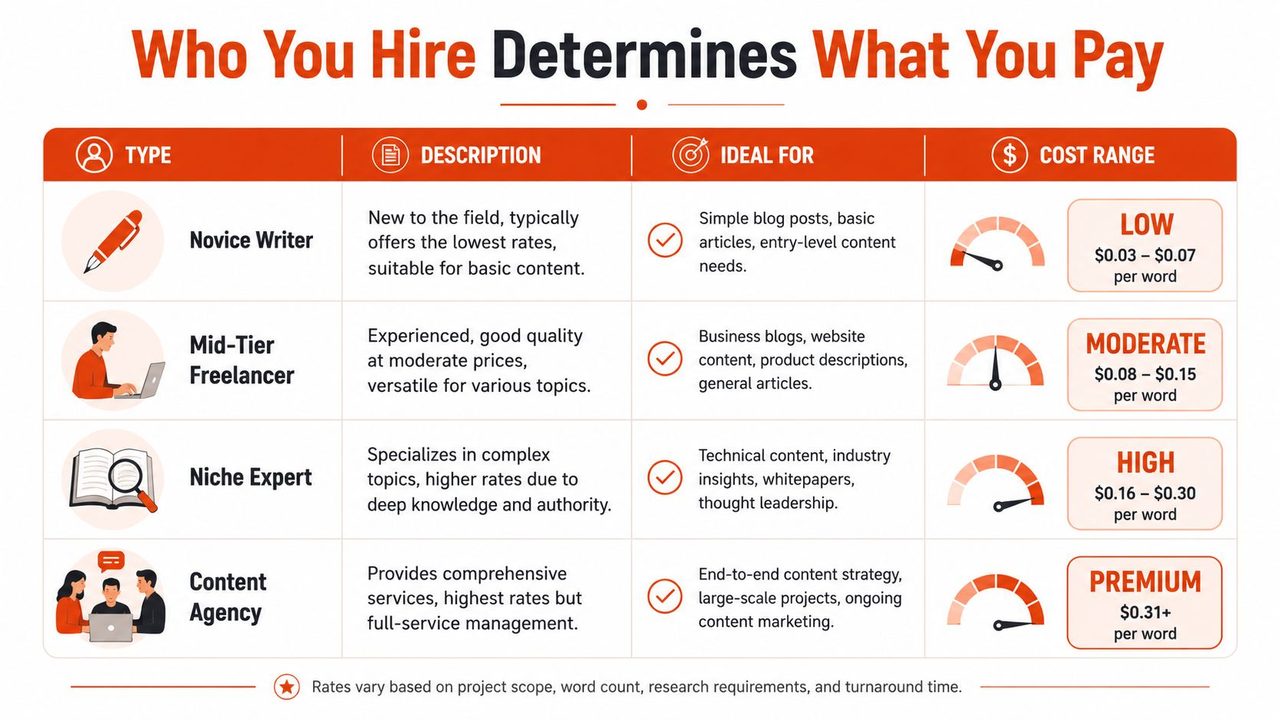
1000-word content cost by provider type
| Provider Type | Typical Cost for 1000 Words | Best For | Key Trade-off |
|---|---|---|---|
| Novice Writer | $50 to $150 | Simple topics, low-stakes drafts, content volume | Lower rates often mean heavier editing and weaker strategy |
| Mid-Tier Freelancer | $150 to $500 | Most business blogs, practical articles, regular publishing | Quality varies by niche and briefing quality |
| Niche Expert | $500 to $1,500 | Technical, regulated, or credibility-sensitive topics | Higher upfront cost, better judgment and cleaner drafts |
| Content Agency | $800 to over $2,000 | Teams that need strategy, editorial process, and management | You pay for coordination and overhead, not just writing |
The ranges above are practical market framing, not a universal rate card. They reflect what buyers commonly run into when comparing vendors. The reason the spread is so wide is simple. Some providers sell words. Others sell outcomes, process, and risk reduction.
What the trade-off actually looks like
A novice writer can be useful when you already have a tight outline and the topic is straightforward. If the piece is internal, low-risk, or mainly a first draft for someone else to refine, low-cost help can make sense.
A mid-tier freelancer is where many companies get the best balance. This is usually the sweet spot for standard blog content, thought leadership support, and SEO articles that need clarity but not deep subject-matter authority.
A niche expert becomes worth the money when mistakes are expensive. Software architecture, healthcare, finance, legal-adjacent topics, and technical B2B categories often need a writer who already understands the language and can ask smart questions.
Cheap content gets expensive when your team has to rewrite it.
An agency makes sense when you're not just buying one article. You're buying project management, editorial standards, workflow, and often strategy. That's useful if your internal team is thin or your publishing process is messy.
If you're comparing freelancers who write inside shared workflows, it helps to look at practical setup guides like using voice recognition in Google Docs. Tools like that don't replace writers, but they do affect delivery speed, revision flow, and who can participate in drafting.
Here's the blunt version of the buying decision:
- Choose low-cost help when the topic is simple and your team can edit.
- Choose a solid freelancer when you need dependable output without agency overhead.
- Choose a specialist when accuracy, authority, or nuance matter.
- Choose an agency when coordination is the bigger problem than writing.
What Drives the Price of Writing Up or Down
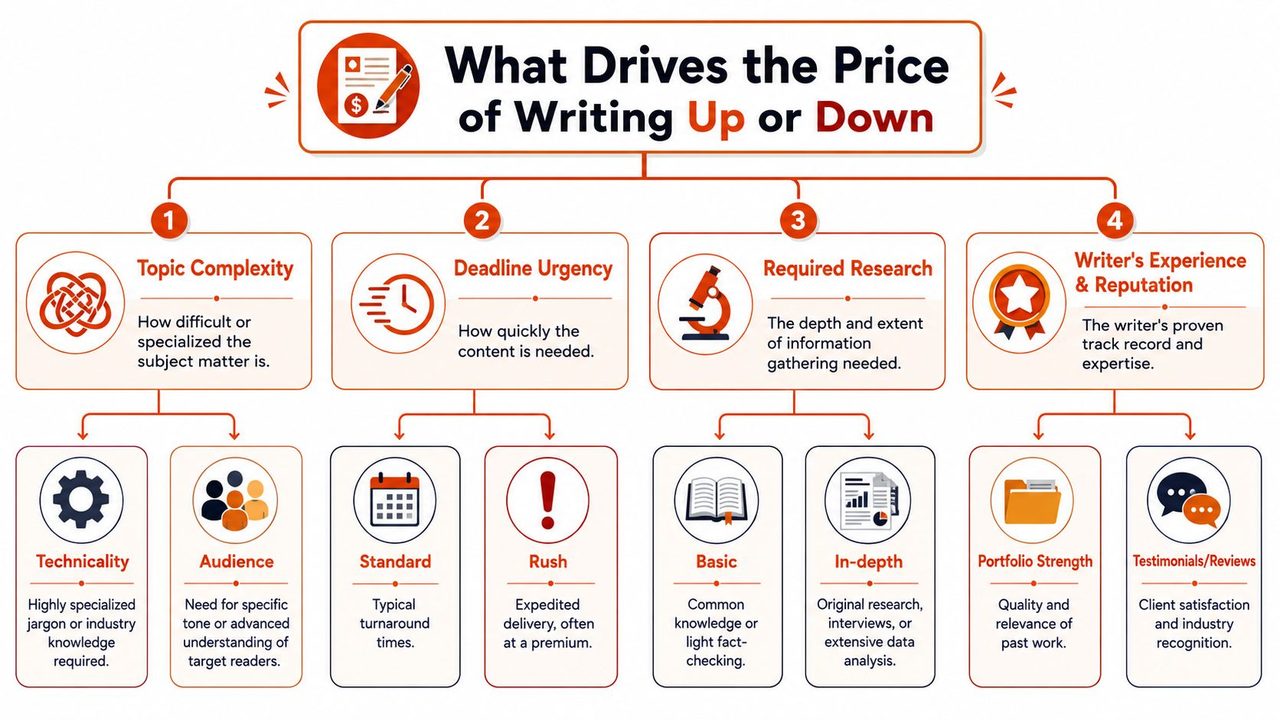
The quote on your screen is usually a bundle of hidden decisions. A writer isn't only pricing words. They're pricing uncertainty, research load, deadline pressure, and how much cleanup your team will require after delivery.
Complexity changes everything
A 1,000-word article on a familiar marketing topic is one thing. A 1,000-word explainer for technical buyers is something else entirely.
Writers charge more when they need to:
- Learn a specialized subject and avoid basic mistakes
- Translate jargon for a mixed audience without oversimplifying
- Review source material carefully before making a claim
- Match a demanding brand voice that has little room for improvisation
Urgency also changes pricing fast. A standard timeline lets the writer fit your job into a normal queue. A rushed deadline forces them to reshuffle other work, compress review time, and deliver with less scheduling flexibility.
The brief can save or waste money
The cheapest way to lower a content quote is to reduce ambiguity before the writer starts.
A strong brief includes the audience, the goal, the angle, required points, internal references, and examples of tone. A weak brief says, “We need a blog post about this topic by Friday.” One creates momentum. The other creates rounds of revision.
If a writer has to discover the strategy while drafting, you'll pay for strategy whether it appears on the invoice or not.
Revision scope matters too. One tidy round of edits is normal. Repeated changes caused by unclear direction, stakeholder disagreements, or late-added requirements often turn a modest project into an expensive one.
The same goes for SEO work. Some writers include search intent, outline planning, title options, and internal-link suggestions. Others deliver clean copy only. Neither approach is wrong, but they're different products. Pricing follows scope.
Beyond Dollars The Time Investment for 1000 Words
A founder blocks off Friday afternoon to write a blog post instead of reviewing pipeline, answering customer questions, or fixing a launch problem. The invoice for that article might be zero. The cost is still there, and it usually shows up in slower work somewhere else.

Typing speed is only a small part of the equation. One source estimates it takes about 25 minutes to type 1,000 words at 40 words per minute, but drafting a useful 1,000-word article usually takes 1 to 2 hours, and a solid piece with editing can take 4 to 6 hours, as explained in Ali Abdaal's writing-time breakdown.
Typing is rarely the primary bottleneck
If the ideas are clear, 1,000 words can come out fast. Business content usually slows down earlier than that. The time goes into deciding the angle, pulling examples, checking claims, organizing the draft, and cutting weak sections before anyone hits publish.
That matters for budgeting. A 1,000-word post is not just a word-count purchase. It is a block of focused work, and someone has to absorb that time cost, whether that person is a freelancer, a staff marketer, a founder, or a subject-matter expert.
Experienced writers sometimes draft at around 1,000 words per hour, according to this practical writing-speed analysis. In technical or high-stakes content, research, synthesis, and fact-checking often take longer than drafting.
A practical fix is to reduce blank-page time before the draft starts. Dictation, recorded voice notes, and AI-assisted outlining help teams turn rough expertise into a workable first draft faster. If you want a simple process for that, this guide on how to write faster and neater focuses on getting ideas out quickly without making the draft messier.
DIY content still has a price
In-house writing can be the right call. A product manager may produce the most accurate draft. A founder may be the only person who can nail the point of view. The trade-off is opportunity cost.
The better question is not, “Can someone on the team write 1,000 words?” It is, “Whose time is cheapest to use here, and whose time is too expensive to spend on first-draft labor?”
That is where modern workflows help. I often advise teams to have the expert talk first, then shape the material later. A 15-minute spoken brain dump can replace an hour of staring at the cursor. AI can then organize notes, suggest structure, and surface gaps for a human editor to fix. Used well, it cuts production time without handing quality control to a machine.
The same input can also do more than one job. A customer call, webinar transcript, founder memo, or internal training session can become a blog post, email, social thread, and sales asset. If you want to stretch one source into multiple pieces, review this guide on how to repurpose content.
The video below is a useful reminder that writing speed starts with capture and workflow, not just keyboard speed.
Smart Strategies to Lower Your Content Costs
You usually can't force content to become cheap without making it worse. You can, however, make it more efficient.
That starts with a simple shift in thinking. Cost isn't only the invoice. Cost is also the number of hours your team burns getting from idea to publishable draft.
If you hire writers
The best clients often get better value, even when rates don't change.
Use these habits:
- Send a real brief: Include audience, purpose, examples, must-cover points, and what success looks like.
- Batch related assignments: Writers get faster when they stay inside one subject area, voice, and workflow.
- Reduce stakeholder chaos: Pick one decision-maker. Conflicting feedback is one of the fastest ways to waste budget.
- Build continuity: A writer who knows your product, buyer, and style guide usually needs less ramp-up on the next piece.
Another overlooked lever is reuse. A good source interview, webinar transcript, meeting summary, or product memo can feed multiple assets. If you need ideas for extending the value of one draft, this resource on how to repurpose content is worth reviewing before you commission net-new work.
If you write in-house
Modern dictation and AI-assisted cleanup can alter the math.
The old model was simple but slow. Think, type, backspace, rephrase, reorganize, repeat. That works, but it turns drafting into editing too early. A faster model is to speak the messy first version, then clean structure and wording afterward.
That's where tools can reduce the time component of content cost. For example, AIDictation is a macOS voice-to-text app that turns speech into written text and can clean up grammar, punctuation, and formatting after dictation. Used well, that helps teams get from rough ideas to usable draft faster, especially for outlines, explainers, notes, and first passes.
The cheapest draft is often the one you can create quickly, then refine with judgment.
This works best when you don't start from zero. Keep a running topic list, collect source notes in one place, and plan publishing ahead of time. If your workflow is reactive, every draft feels expensive. If your workflow is scheduled, the same team produces more with less friction. A simple content calendar workflow often saves more money than haggling over rates.
Frequently Asked Questions About Content Pricing
A lot of budget problems start with a simple handoff issue. A client expects a publish-ready article. The writer thinks they were hired to deliver a clean draft in Google Docs. Both sides feel reasonable, and the mismatch still costs time, money, and patience.
Do writing fees usually include images formatting and uploading
Usually not.
Writers often price for words, research, and editing. Formatting, image sourcing, screenshot capture, alt text, CMS entry, metadata, and final pre-publish checks are often separate tasks, even when they look minor on paper. I've seen teams spend more fixing that assumption after delivery than they would have spent clarifying scope at the start.
Ask for these items in plain language:
- Formatting: Headings, bullets, links, tables, and callouts
- Images: Selection, sourcing, screenshots, alt text, and licensing
- Uploading: WordPress or CMS entry, category tags, metadata, and final QA
If it is not listed in the proposal, treat it as extra work.
How do revisions usually work
A professional revision policy ties changes to the approved brief. That protects both sides.
If the feedback is “tighten the intro,” “adjust the tone,” or “add the missing point from the brief,” that is a revision. If the feedback is “we changed the audience,” “we want a different angle,” or “add fresh interviews and new research,” that is new scope and should be priced that way.
Good contracts spell this out. For example: One round of revisions is included to address feedback on tone, clarity, and accuracy based on the approved brief. That sentence prevents a lot of unnecessary debate.
One more rule matters: one person should collect feedback before it reaches the writer. Five stakeholders giving separate notes can turn a 1000-word article into a stop-start editing cycle that costs more in time than in writing fees.
Which pricing model is better
Use the model that fits the assignment.
Per-word pricing works for straightforward articles with a stable brief. It makes comparison easy, but it can hide major differences in research depth, subject knowledge, and editorial cleanup.
Hourly pricing fits projects where scope may shift, such as thought leadership, interview-based pieces, or technical topics that need back-and-forth with internal experts. The trade-off is less budget certainty.
Flat project pricing is usually the easiest option for a client building a content budget. You know the expected output, the writer knows what is included, and both sides have fewer surprises if the brief is clear.
If your team also cares about post-publication improvements, review resources like MyMentions' AI content insights. It helps separate writing costs from optimization work, which are often bundled together when they should be scoped separately.
The safest approach is to define the deliverable, revision rules, and ownership plainly before work starts. Also define who is responsible for the final publish-ready version. That one line saves a lot of back-and-forth later.
If you write your own content and want to lower the time cost without turning every draft into a typing session, AIDictation is worth a look. It gives macOS users a practical way to dictate first drafts, notes, emails, and documents, then clean them up into ready-to-send text.
Frequently Asked Questions
What does How Much Is 1000 Words? a 2026 Pricing Guide cover?
A 1,000-word piece can cost anywhere from $50 to over $2,000. That's a wide spread, but it's the honest answer if you're budgeting for a blog post, article, or report and trying to figure out what you'll get for the money.
Who should read How Much Is 1000 Words? a 2026 Pricing Guide?
How Much Is 1000 Words? a 2026 Pricing Guide is most useful for readers who want clear, practical guidance and a faster path to the main takeaways without guessing what matters most.
What are the main takeaways from How Much Is 1000 Words? a 2026 Pricing Guide?
Key topics include Table of Contents, The Real Cost of 1000 Words in 2026, Who You Hire Determines What You Pay.
Ready to try AI Dictation?
Experience fast voice-to-text on your device. Free to download.
Download Free