Translation to English to French: A Practical Guide
If a translation tool gives you French that no grammar checker would flag, have you finished the job? The answer may seem obvious. That assumption is where localization projects fall apart, because correct French and appropriate French are two different targets, and a tool can hit the first one while missing the second by a wide margin.
The gap isn't vocabulary. It's that English-to-French work is a rebuilding job, not a swapping job, and the decisions that matter happen before a single word gets translated: who reads this, in which French, at what level of formality, in how much space. Get those wrong and even polished output reads like a translation rather than like French.
Table of Contents
- What Good English to French Translation Requires
- Machine, Human or Hybrid Translation Compared
- Why Word for Word French Sounds Wrong
- Regional Variants and Text Length
- How to Translate English to French Step by Step
- High-Risk Content and When to Bring In a Human
- Choose Your Approach and Do the First Check
What Good English to French Translation Requires
Good English-to-French translation keeps meaning, tone, register and function intact, then rebuilds the sentence in French. Word substitution is a different operation, and it's the one many people perform when they paste English into a tool and accept whatever comes back.
The difference is remodeling versus repainting. Repainting keeps the floor plan and changes the surface. Remodeling moves walls. Swap words one by one and the English clause order stays bolted to the floor, so the French reads like furniture pushed against the wrong wall. Remodel the sentence and the building (the meaning) survives while the rooms (the clauses, the subject, the connective, the rhythm) get rearranged.
Three levers do most of that work, and they run through everything below.
- Structure. French and English package information differently, so clause openings and connectives have to move, not just the nouns.
- Register. The choice between tu and vous, and between business-formal and casual, changes verbs, pronouns and punctuation across a whole document.
- Regional variety. French is an official language in 26 independent countries and 10 territories, with roughly 300 million speakers worldwide, so terminology, legal conventions and everyday vocabulary shift between France, Canada, Belgium, Switzerland and Francophone Africa, as the Centre international de la langue française sets out.
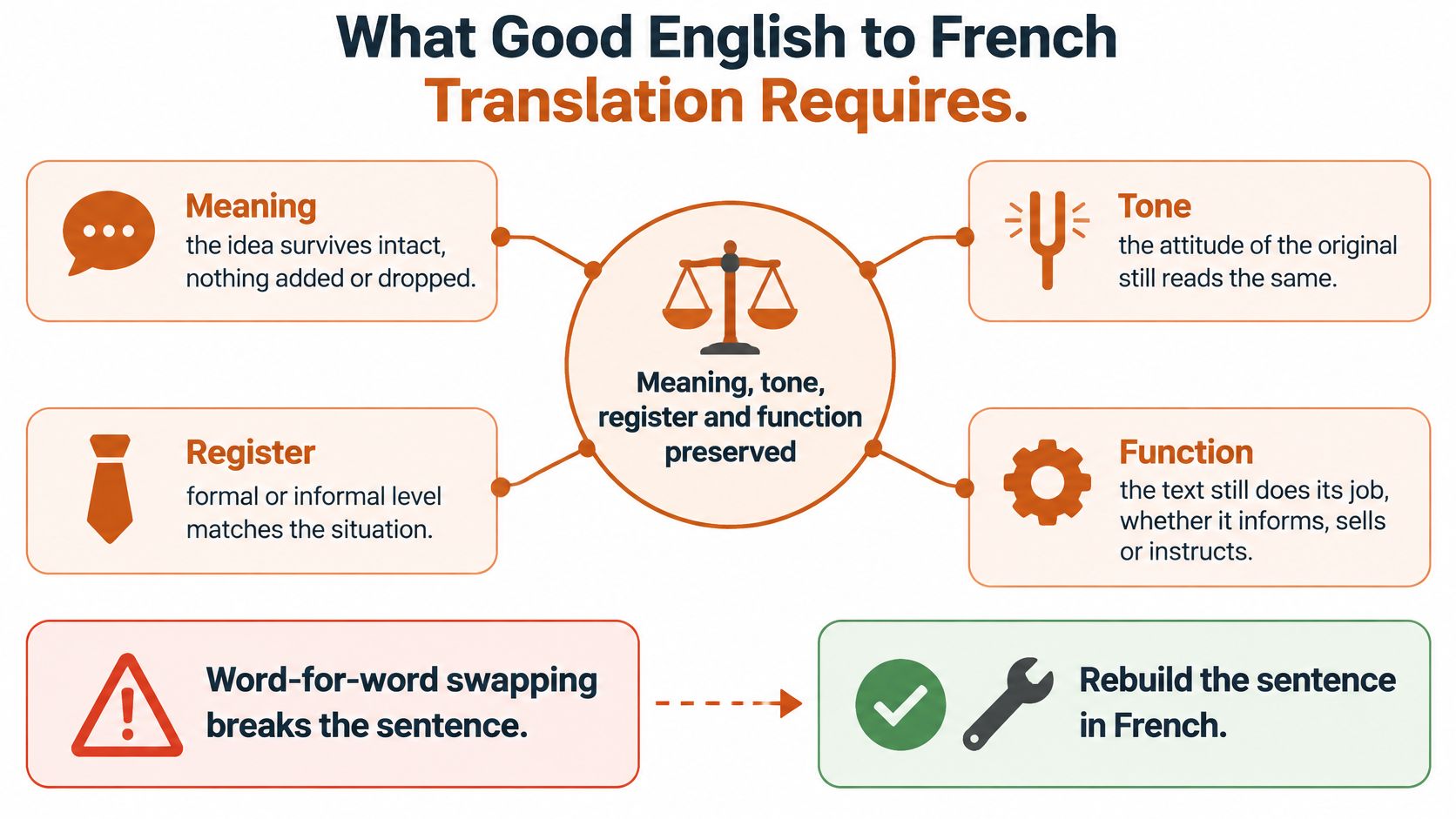
Two failures show up again and again once you start looking. The first is text that passes every grammar check and still sounds translated. The second is a French interface that fits the meaning but not the button, because the words grew. Both are covered below with the specific fixes.
If the French pages will live at their own URLs, it pays to learn how to optimize hreflang tags while the copy is being written. A localized site that search engines read as duplicate English content loses exactly the audience the translation was meant to reach.
Machine, Human or Hybrid Translation Compared
| Method | Best for | Typical speed | Typical cost | Accuracy profile | Main risk |
|---|---|---|---|---|---|
| Raw machine translation | Gisting, internal drafts, high-volume low-risk content | Seconds per page | Free to low | Fluent but prone to literal structure and terminology slips | Negation, idiom, and dosage or legal nuance errors |
| Professional human translation | Legal, clinical, marketing, brand-critical copy | Hours to days | Per word, highest | Native naturalness and terminology control | Cost and turnaround |
| Hybrid (machine plus human post-edit) | Product UI, documentation, reports, email campaigns | Hours | Mid-range | High when reviewers check structure and terminology | Reviewers only fixing words, not sentence flow |
| Speech-first workflow (dictate, translate, clean up) | Meetings, clinical notes, interviews, voice memos | Near real time | Low to mid | Good for spoken content when filler and self-corrections are removed | Losing uncertainty or roles in the cleanup |
English-French is one of the friendlier pairs for automation, because decades of parallel text make strong neural models possible. It still isn't a solved problem. A 2025 evaluation on a European Parliament parallel corpus put the best neural system at 30.8 BLEU and 60.59 METEOR, against 24.47 BLEU and 54.97 METEOR for the strongest large language model tested, as the ACL Anthology case study reports. The two metrics travel together for a reason: BLEU rewards n-gram overlap with a reference, METEOR leans semantic, and either one alone can mis-rank two systems. In practice that gap means a dedicated engine still beats a general chat model on this pair, yet neither score is close to perfect.
Read the table by risk, not by preference. Machine output earns its place on internal drafts, research summaries and anything a colleague reads once and discards. Human translation earns its place where a wrong number, a wrong negation or a wrong tone creates liability: contracts, consent forms, dosage instructions, campaign slogans.
The hybrid row is where professional work has settled. The machine draft handles volume; the human editor handles judgment. The failure mode is specific and worth naming: reviewers who treat the draft as a spelling exercise fix individual words and leave the sentence flow untouched. A good post-edit pass works in the other order. First check whether each sentence is built the way French would build it, then check terminology against the project glossary, then check negation, numbers and names word by word. Skipping the first pass is how you ship French that is correct and still sounds translated.
Rule of thumb: the higher the cost of being wrong, the further down the table you move. Cost of being wrong includes legal exposure, patient safety and brand embarrassment, not just money.
For teams running bilingual meetings and dictating notes in two languages, a bilingual AI dictation workflow shortens the distance between spoken input and a clean source text worth translating. That matters more than it seems, because every downstream row in the table inherits the quality of the source. A muddled transcript produces a muddled translation no matter which method you pick.
Why Word for Word French Sounds Wrong
There's a name for output that is grammatically valid and still sounds foreign: translationese. It happens when the translation keeps the source language's distributional habits, not just its words.
The clearest measurable example is the existential construction. English leans on "there is" and "there are"; French leans on il y a. Comparative corpus research found that English-to-French translations use il y a more often than original French does, while French-to-English translations use English "there" less often than original English does. Both directions drift toward the source, which is how you get French that a native reader recognizes as translated before they can say why, as the Intralingua corpus study documents.
The practical rewrite rule follows from that. When an English sentence opens with "there is" or "there are", don't reach for il y a automatically. Ask whether French would rather start with the subject, with the verb, or with a different discourse marker entirely. "There are three reasons this fails" often becomes Trois raisons expliquent cet échec, not Il y a trois raisons.
Beyond word order
Structure is only the first layer. Idioms fail almost every time, and cultural references that land in English can land as noise in French. Grammatical gender and agreement ripple outward from every noun, so a late change to a subject's gender can force edits across three sentences.
False friends do quiet damage: actuellement means currently, not in fact; éventuellement means possibly, not eventually. French punctuation spacing differs too, with a space before double punctuation such as the colon, question mark and exclamation point, which looks like a typo to anyone who doesn't know the convention.
Register sits on top of all of it. The wrong tu/vous choice reads as either stiff or rude, and no amount of vocabulary accuracy rescues it.
Spoken input adds one more layer. Filler words, false starts and self-corrections have to be removed before translation, because a machine will faithfully translate "so, um, what I meant was, we need, we need to ship it Friday" into equally hesitant French.
- Check clause openings: does the French sentence start where a French sentence would start?
- Check connectives: are donc, or, pourtant placed where French puts them?
- Check rhythm: read it aloud and listen for English cadence in French words.
- Check packaging: would a native writer have chosen this subject and verb at all?
Regional Variants and Text Length
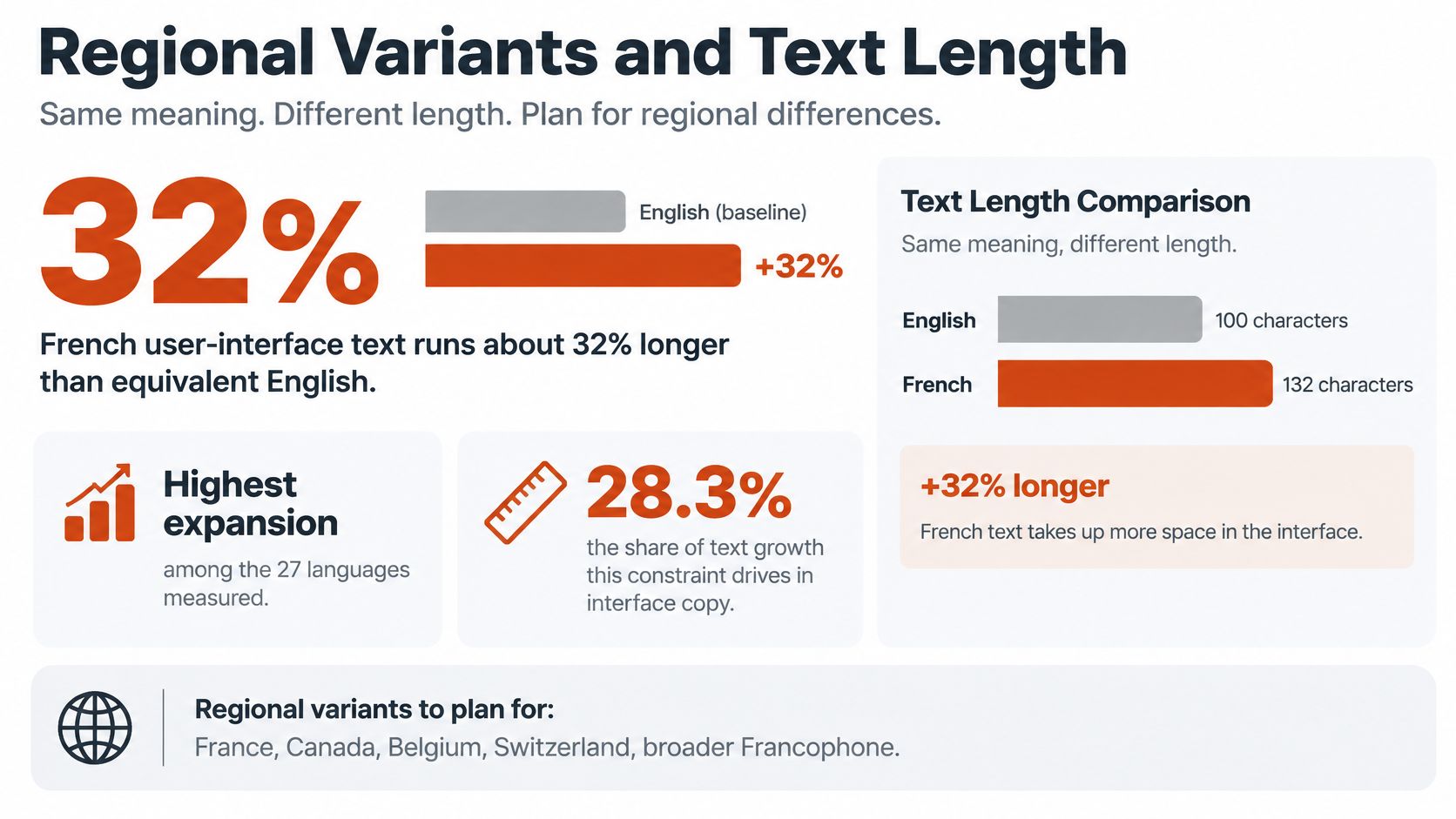
Start with the constraint you can measure before anyone argues about style. French user-interface text runs about 32% longer than the equivalent English, the highest expansion among the 27 languages measured in that analysis, and 28.3% of French strings grow by more than half, according to translation industry statistics compiled by LanguageOps.
That number breaks things. A button reading "Save changes" fits a fixed-width control in English and wraps to two lines in French, or truncates to "Enregistrer les mod…" in a menu. A tab label turns into an ellipsis, a caption overruns its safe area, and a mobile card that looked fine in the design file pushes its footer off screen.
The fixes are unglamorous and effective. Pick the shortest accurate French synonym for interface labels. Build flexible layouts that tolerate a longer string instead of pixel-perfect fixed widths. Set an explicit truncation rule so the fallback is deliberate. Then test with the longest French string in the build before release, not after.
Which French, for whom
| Variant | Typical markers | Adaptation needed |
|---|---|---|
| France French | Standard reference, formal vous in business | Default for European and international audiences |
| Canadian French | Distinct vocabulary and anglicism avoidance, stronger language rules | Local terminology and legal review |
| Belgian French | Shared core with local numbers and terms | Check numbers and administrative terms |
| Swiss French | Shared core, slower adoption of some France usage | Verify administrative and currency terms |
| Francophone Africa | Broad audience across many countries, French often a second language | Plain, clear phrasing and local context |
One French doesn't fit all of them, and the scale explains why. English is the content language of roughly 49.5% of websites whose language can be identified, against 4.6% for French, so most source text starts in English and then has to serve a widely distributed French readership. That readership is not one market.
Budget character limits separately for social posts and SMS, where the platform cap doesn't move just because French needs more room, and check subtitle reading speed rather than character count. For documentation teams working through this, these technical writing best practices apply directly to the source text you hand to a translator.
How to Translate English to French Step by Step
Here is the hybrid workflow that holds up on real projects, in the order that avoids rework.
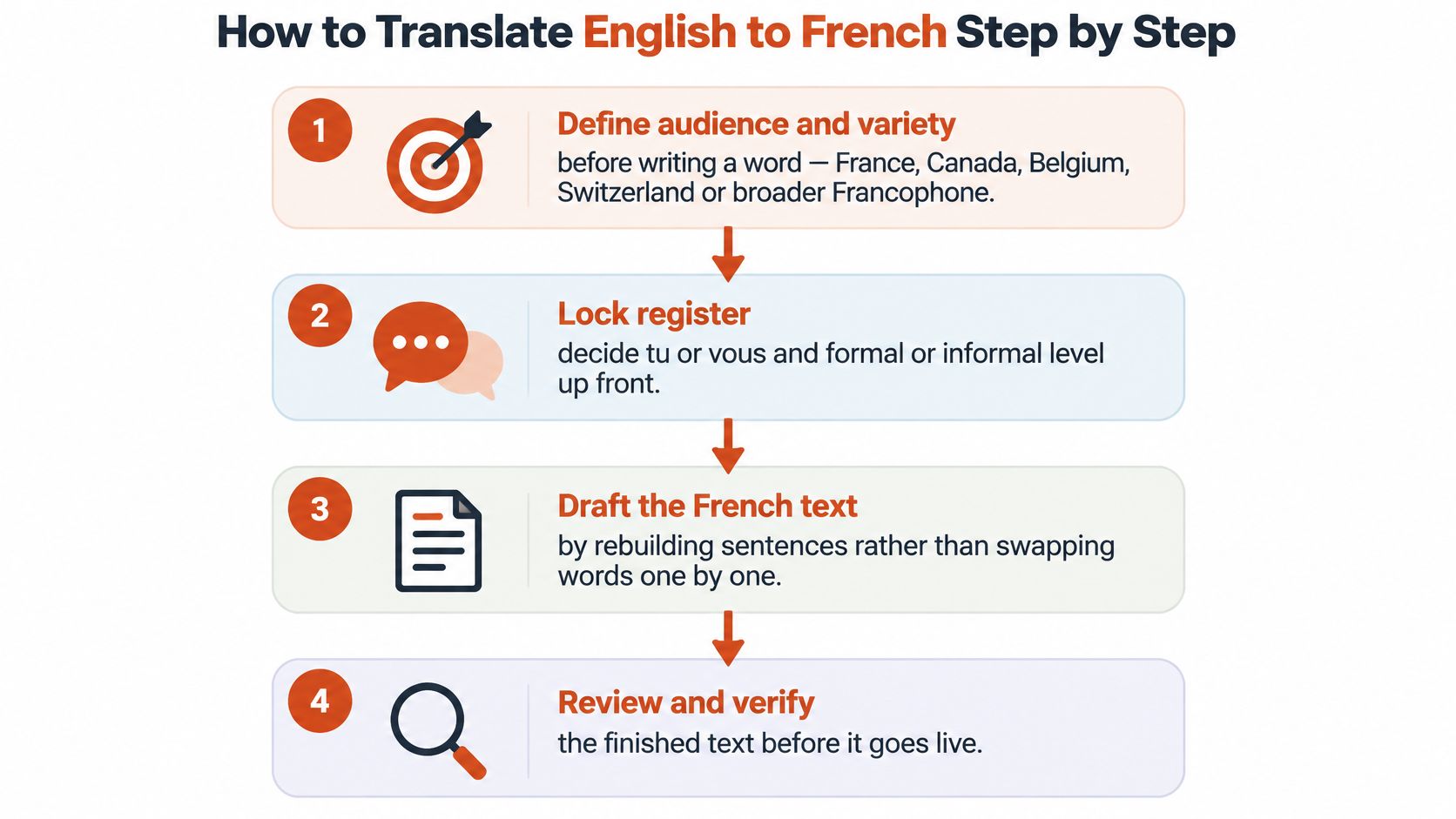
- Define the audience and the variety before you write a word. France, Canada, Belgium, Switzerland or a broader Francophone audience changes vocabulary, legal conventions and formatting. The common slip is discovering mid-review that the client needed Canadian French, which sends terminology and layout back to the start.
- Lock the register in a style line. Decide tu or vous, formal or casual, and record it where every contributor sees it. Without that line, one section says vous pouvez and the next says tu peux.
- Build a terminology list. Product names, acronyms, job titles, clinical or technical terms, plus an explicit decision about which stay in English. Skipping this is how a product name gets translated in one paragraph and preserved in the next.
- Produce the draft. Machine output or dictated speech, with the English source open beside it. Keeping the source visible is what makes step 6 possible.
- Clean spoken source before translating. Strip filler, resolve false starts, finish abandoned clauses. If you translate the hesitation, the French inherits it.
- Post-edit for structure, not just words. Rewrite clause openings, move connectives, replace literal idioms. The common slip is fixing vocabulary and leaving English sentence architecture untouched.
- Check layout and length. French runs longer than English, so buttons, tabs, captions and email subject lines need a real test rather than a glance.
- Run a second reader, then a final terminology and number pass. The second reader catches tone; the number pass catches the errors that carry liability.
A finished hybrid draft has a recognizable shape: natural clause order, one consistent register from start to finish, and a terminology log someone can hand to the next translator.
Two accuracy tactics improve every step. Prime the tool or the prompt with your terminology list and register line so the first draft starts closer to the target instead of needing a full rewrite. Then, after the final check, back-translate a handful of key sentences into English to catch meaning drift.
Back-translation confirms that the meaning survived. It says nothing about whether the French sounds natural, so it supplements the structural edit rather than replacing it. A voice to text translator helps at the front of this workflow, turning spoken English into clean written source before translation begins.
High-Risk Content and When to Bring In a Human
Fluent output is more dangerous than clunky output. Clunky output invites a second look; fluent output discourages one. That single asymmetry should decide your review gates, because the risk isn't that a machine produces nonsense, it's that it produces something that reads well enough to ship unchecked.
Clinical content makes the case. A 2025 study of a French university hospital surveyed 362 staff members and found persistent communication difficulties with patients who spoke languages other than French. A separate 2025 review of AI translation in intensive-care settings found that Google Translate and ChatGPT were not sufficiently accurate for advanced medical terminology, and identified no English/French AI translation application specifically developed and deployed for ICU communication, as reported in the PMC review.
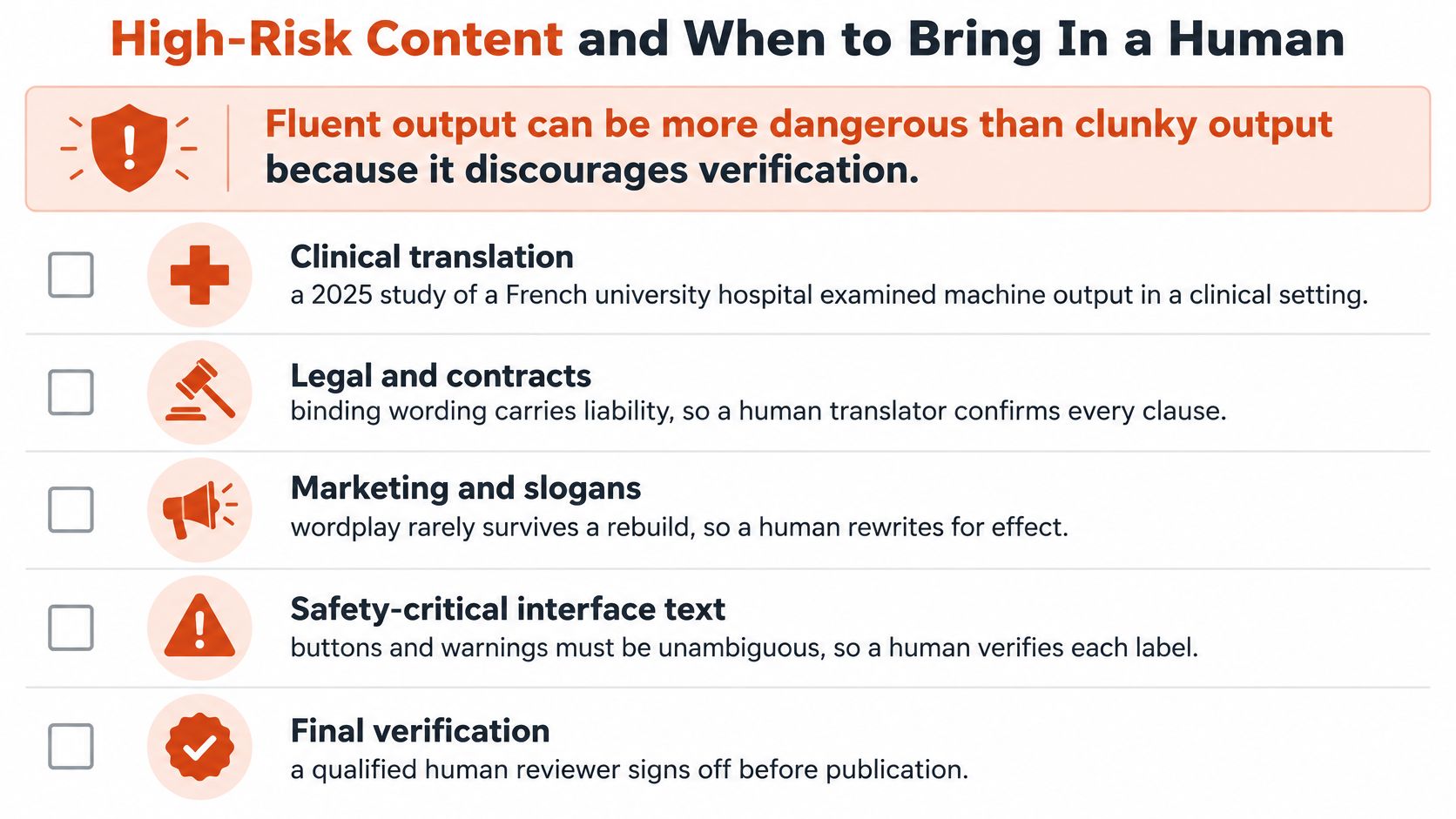
Translated into practice, that means machine output can draft a clinical note, but dosages, symptoms, consent language, uncertainty and professional roles need a clinician or a qualified reviewer before anyone acts on them. Ambiguity should be flagged in the text, not smoothed away, because a translator's guess and a clinician's decision are different things.
Legal and contractual text carries its own traps. Jurisdiction-specific terms rarely map cleanly, and false friends in a contract can shift an obligation without anyone noticing. Technical documentation needs controlled handling of acronyms, product names and interface strings, where the same term must render identically in forty places.
Marketing sits furthest from literal translation. A slogan that depends on English wordplay needs transcreation, a rewrite for effect in French, and a literal rendering of it is worse than useless because it sounds like a mistranslation.
Review gate: name the person who signs off, list the controlled terms, define how uncertainty is marked, and record the approved version so the next draft has an audit trail.
Teams scaling multilingual support operations often measure this with language coverage KPIs for enterprises, which is the right instinct: coverage without a review gate is just faster risk.
Choose Your Approach and Do the First Check
Three scenarios cover most of the decisions you'll face.
A quick internal draft. Machine translation plus a careful read. You need the gist, the reader is a colleague, and a wrong idiom costs nothing but a clarification.
A customer-facing or clinical document. The hybrid workflow with a qualified reviewer, a terminology list and a signed-off final version. Here the review gate isn't overhead, it's the product.
Spoken content such as meetings or clinical notes. A speech-first workflow that removes filler and self-corrections before translation, then hands clean written source to steps 4 through 8. Dictation fits this stage well: AI Dictation's Pro plan includes translation to English when requested along with audio and video transcription, and the app lets you switch languages mid-sentence while keeping English terms as spoken, which matters when a sentence mixes both.
The five-minute first check
Run this today, before the next project starts.
- Translate the longest English string you have and see whether the French still fits the space. That one test predicts most layout failures.
- Make one tu/vous decision and write it into a style line you can reuse.
- Confirm the regional variant with the people who will read the result, not with the person who commissioned it.
Then match method to risk, and review structure and register before you ship. Speed is a property of the draft. Accuracy is a property of the review.
Translation to English to French gets easier once the sentence stops being a container for words and starts being a structure you rebuild. AIDictation supports that work on the input side: it turns spoken English and mixed-language speech into clean, punctuated text you can hand to a translator, with translation to English available on the Pro plan when you need the meaning back in English. If your source text usually starts as a voice memo or a recorded meeting, try AIDictation and see how much of the cleanup step disappears before translation even begins.
Frequently Asked Questions
What does Translation to English to French: A Practical Guide cover?
If a translation tool gives you French that no grammar checker would flag, have you finished the job? The answer may seem obvious.
Who should read Translation to English to French: A Practical Guide?
Translation to English to French: A Practical Guide is most useful for readers who want clear, practical guidance and a faster path to the main takeaways without guessing what matters most.
What are the main takeaways from Translation to English to French: A Practical Guide?
Key topics include Table of Contents, What Good English to French Translation Requires, Machine, Human or Hybrid Translation Compared.
Ready to try AI Dictation?
Experience fast voice-to-text on your device. Free to download.
Download FreeRelated Posts
Beste Wispr-vloei-alternatiewe vir Afrikaanse diktee
Die beste Wispr Flow-alternatiewe vir Afrikaanse diktee, vergelyk volgens privaatheid, plaaslike modus, vertaling, formatering, pryse en daaglikse werk.
أفضل بدائل Wispr Flow للإملاء العربي
أفضل بدائل Wispr Flow للإملاء باللغة العربية، مقارنة بالخصوصية والوضع المحلي والترجمة والتنسيق والتسعير والعمل اليومي. Privacy, offline mode, pricing, transl...
বাংলা ডিকশনের জন্য সেরা উইসপ্র ফ্লো বিকল্প
গোপনীয়তা, স্থানীয় মোড, অনুবাদ, বিন্যাস, মূল্য নির্ধারণ এবং দৈনন্দিন কাজের তুলনায় বাংলা শ্রুতিমধুর জন্য সেরা Wispr ফ্লো বিকল্প।