8 Speech Writing Tips for Clearer, Stronger Speeches
You've got a talk Thursday morning, a blank document on your screen, and a rough sense of what you want to say. Then you start typing the way you'd write an email. The sentences get long, the point gets buried, and the draft reads fine on the page while sounding stiff in your mouth.
Your speech is written to be heard. A strong speech isn't just good writing placed on a page. It's language designed for a listener who can't reread it, a room that may be distracting, and a speaker who must make every idea feel clear and intentional. Treat these speech writing tips as a production process, not a list of abstract rules. You shape the message first, draft it in your own voice, clean it up, then rehearse it aloud until the words fit your breath and your thinking.
That order matters. Get the structure right before you polish phrasing, and get the phrasing spoken before you worry about gestures. If you're leading a team conversation rather than giving a formal address, you can also browse the conversation leadership title for a related angle. The eight techniques below move from shaping the message to polishing the draft and rehearsing the final delivery, with practical examples and dictation workflows throughout. Use them in sequence the first time, then borrow the parts you need for shorter talks.
Table of Contents
- 1. Write for the Ear, Not the Eye
- 2. Lead with Your Main Message and Signpost the Structure
- 3. Use the Rule of Three
- 4. Build a Narrative Arc Using Contrast
- 5. Use Repetition and Anaphora for Emphasis
- 6. Speak First, Then Edit by Drafting with Dictation
- 7. Keep Sentences Short and Cut Filler Words
- 8. Rehearse Aloud and Plan for Delivery
- 8 Essential Speech Writing Tips Compared
- Build a Speech That Sounds Like You
1. Write for the Ear, Not the Eye
Read your opening sentence aloud. If you stumble, run short of breath, or need to restart halfway through, your listener will struggle too. Readers can skim ahead, reread a clause, and use punctuation as a guide. Listeners get one pass, in real time, while they're also watching you and filtering out room noise.
That constraint changes how you write. Spoken language needs shorter clauses, familiar words, and a bit of repetition so people can follow along without a text to check. John F. Kennedy's inaugural address, written with speechwriter Ted Sorensen, works because phrases like "Ask not what your country can do for you" are built to be spoken, not parsed. Winston Churchill's "blood, toil, tears and sweat" speech relies on plain, rhythmic words that carried well over radio, where no one could see a paragraph break.

Test Every Line Out Loud
Draft in a conversational voice from the start, then check each line by speaking it. Replace abstract nouns with concrete verbs. Say "we decided" instead of "a decision was reached," and "we'll ship in March" instead of "delivery will be effectuated." Use contractions where you'd naturally use them in conversation, because "we're not ready" sounds like a person, while "we are not ready" can sound like a press release unless you want that formality.
- Mark the stumbles: Read every draft aloud and flag any sentence where you trip or run out of breath.
- Cut embalmed language: Swap nominalizations and passive constructions for a subject doing something.
- Keep helpful repetition: Restate a key term instead of reaching for a synonym that forces listeners to decode a new word.
The trade-off is that writing for the ear looks less impressive on paper. That's fine. You're not submitting an essay. You're building something a tired listener at the back of the room can track on first hearing.
2. Lead with Your Main Message and Signpost the Structure
Don't make your audience wait to find out why they're listening. State your core message early, ideally in the first moments, then preview where you're going. A line like "I want to cover three things" gives listeners a mental map, and that map helps them anticipate transitions and remember points afterward.
Product keynotes do this instinctively. The speaker names the purpose of the event before presenting details, so every feature that follows has a place to land. Executive stakeholder updates work the same way when a leader opens with "three decisions we need today" and then takes them one at a time. No one has to guess whether a new slide is a new topic or a supporting detail.
Use a Three-Part Architecture
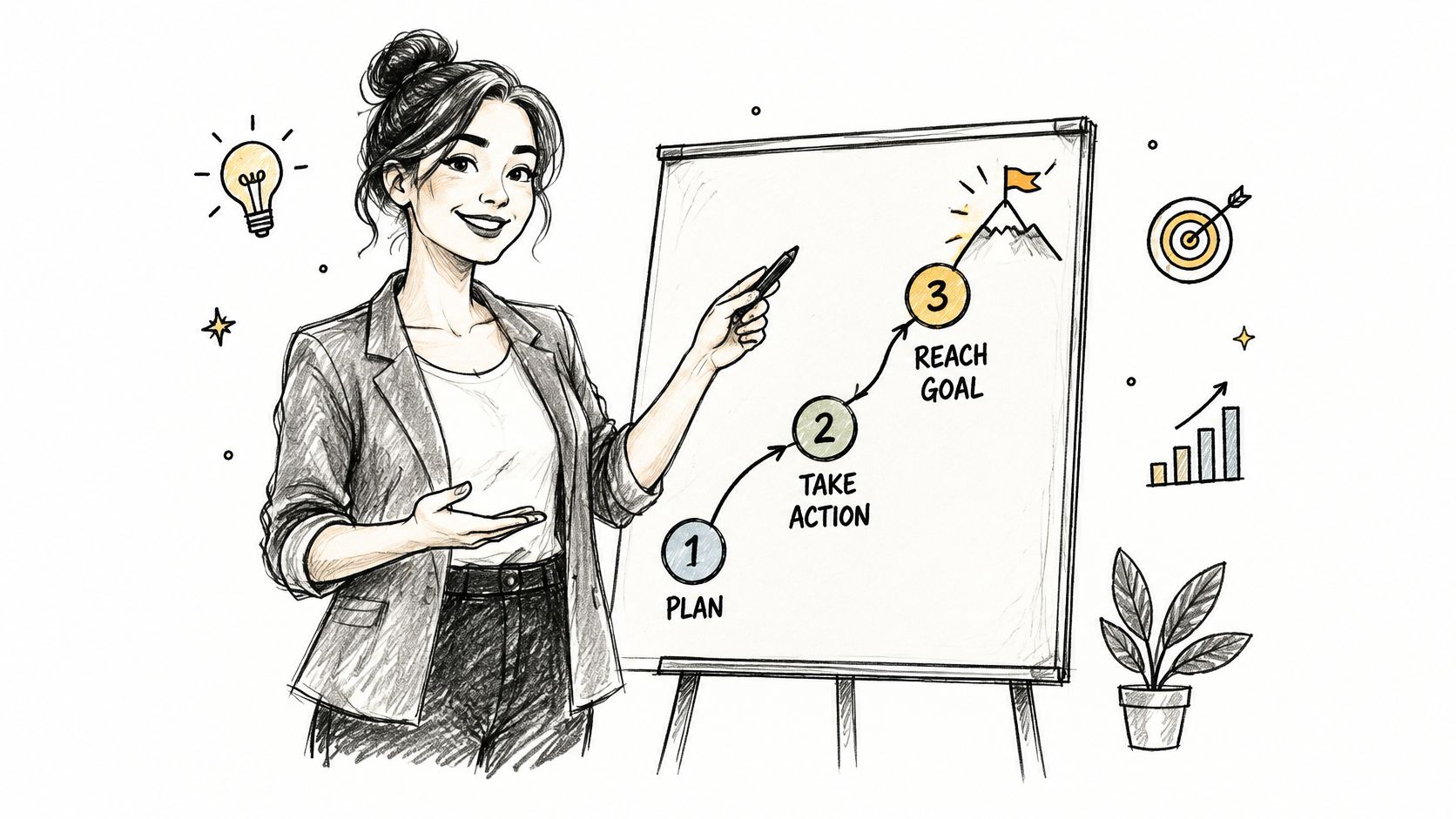
Build around an introduction, body, and conclusion. Your introduction needs an attention-getter, a thesis, and a preview. Your body develops a small number of clearly signposted claims. Your conclusion restates the thesis, synthesizes the main points, and closes with closure or a call to action. When you plan timing, the Amherst guidance on speech structure supports a useful benchmark of approximately 10% for the introduction, 80% for the body, and 10% for the conclusion, with no more than three main points for speeches under 10 minutes.
That limit isn't arbitrary minimalism. More than five main points in longer speeches can impair audience tracking and recall, so compression is part of the craft. Write your core message as a single sentence and make sure it appears in your opening. Then label transitions explicitly with words like "first," "next," and "finally." Listeners can't see your headings, so you have to say them.
If a listener missed the last thirty seconds, your next transition should tell them where they are.
For each body point, use a repeatable pattern. State the claim, support it with evidence or an example, explain why it matters, then summarize before you move on. That rhythm sounds predictable on paper. In a room, it's mercy.
3. Use the Rule of Three
Three is the smallest number that creates a pattern. One point is a claim, two points invite comparison, and three points give listeners a sequence they can anticipate, complete, and remember. That's why the rule of three shows up in classic oratory, product launches, and slogans that stick without effort.
Abraham Lincoln described government in the Gettysburg Address as "of the people, by the people, for the people." The phrasing is parallel, the rhythm builds, and the third element lands as a conclusion. Steve Jobs frequently structured product introductions around three highlights for the same reason. An audience can hold three items while you're speaking. Ask them to hold seven and they'll start dropping the early ones, usually the ones you cared about most.
Build Triads That Earn Their Place
Forcing three can expose weak material, and that's useful. If you can only find two strong examples, don't invent a flimsy third just to complete the set. Either strengthen the search or present two points well. A padded triad teaches the audience that your lists aren't trustworthy.
- Choose three strong examples: Drop the fourth and fifth weak ones instead of diluting the set.
- Put the strongest last: End the sequence on a climax so the final item carries the emphasis.
- Keep phrasing parallel: Use matched grammar, such as "fast, secure, and private," so rhythm does some of the memorability work.
Use triads at different scales. You can have three main points in the body, three reasons inside one point, and a three-word phrase in your close. Don't stack them so tightly that everything sounds like a slogan. One well-placed triad per section is usually enough to give listeners a handle without turning your speech into a jingle.
4. Build a Narrative Arc Using Contrast
Facts alone rarely hold a room. People stay with a speaker who creates tension between what is and what could be, then shows a credible path from one to the other. Nancy Duarte describes this pattern in Resonate as a sparkline that alternates between current reality and a better future, building energy with each swing.
Her analysis of Martin Luther King Jr.'s "I Have a Dream" shows repeated shifts between injustice today and a hopeful vision of tomorrow. Product pitches use a smaller version of the same arc. A founder describes slow workflows and manual data entry, then contrasts that pain with the improved future the product enables. The audience doesn't just learn features. They feel the gap the product is meant to close.

Weave Credibility, Emotion, and Logic
Classical persuasion gives you three checks for that arc. Ethos asks whether you've shown you're credible. Pathos asks whether the audience feels why the change matters. Logos asks whether your reasoning holds together. A speech heavy on emotion but thin on logic feels manipulative. A speech that's all logic can be correct and forgettable at the same time.
Describe the current problem in concrete terms your audience recognizes, not abstractions like "inefficiency" or "challenges." Paint the desired future with specifics, not vague optimism about excellence. Then end with one clear action the audience can take. If your contrast produces admiration but no next step, you've written a mood, not a speech.
5. Use Repetition and Anaphora for Emphasis
Repetition looks redundant in print. In speech, it's how you tell listeners what matters and give them a phrase to carry out of the room. Anaphora, repeating a word or phrase at the beginning of successive clauses, creates rhythm and builds emotional force because the audience starts to anticipate the pattern and lean into it.
King repeated "I have a dream" throughout his 1963 speech, and each return added a new image rather than restating the same one. Barack Obama's "Yes we can" worked as a unifying refrain in his 2008 campaign speeches. In both cases, the repeated line acted as an anchor. Listeners who lost a detail could re-enter at the refrain and recover the thread.
Repeat with Progression
The failure mode is filler repetition, where you say the same thing again because you haven't written the next thing. Audit every repeated passage by asking what new meaning each return adds. If the second and third versions don't sharpen, expand, or intensify the first, cut them and keep the strongest single statement.
- Limit the run: Keep anaphora to three to five repetitions per passage so the device stays emphatic.
- Add meaning each time: Let every repetition introduce a new example, consequence, or image.
- Pause after the phrase: Give the refrain a brief silence so it lands before you move on.
Don't reserve repetition only for grand moments. In a technical briefing, repeating your claim before and after supporting detail helps mixed-expertise listeners stay oriented. In a clinical update, restating the decision at the end of a section reduces the chance that a busy listener walks away with the data but misses the recommendation. Strategic repetition is a navigation aid, not just decoration.
6. Speak First, Then Edit by Drafting with Dictation
Many speakers don't have a writing problem. They have a starting problem. They can explain an idea clearly to a colleague in the hallway, then freeze at a blank page because typing invites editing before they've finished thinking. Drafting by speaking solves that sequence. You talk through the argument first, capture your natural voice, then edit for structure, precision, and tone.
Executives have dictated memos and speeches during commutes for years, then refined the result with an editor. Clinicians dictate visit summaries that are reviewed and signed, which is standard medical documentation practice. The principle transfers directly to speech writing. Spontaneity gives you momentum and phrasing you can actually say. Editing gives you order and cuts the wander.
A Dictation Workflow That Preserves Your Voice
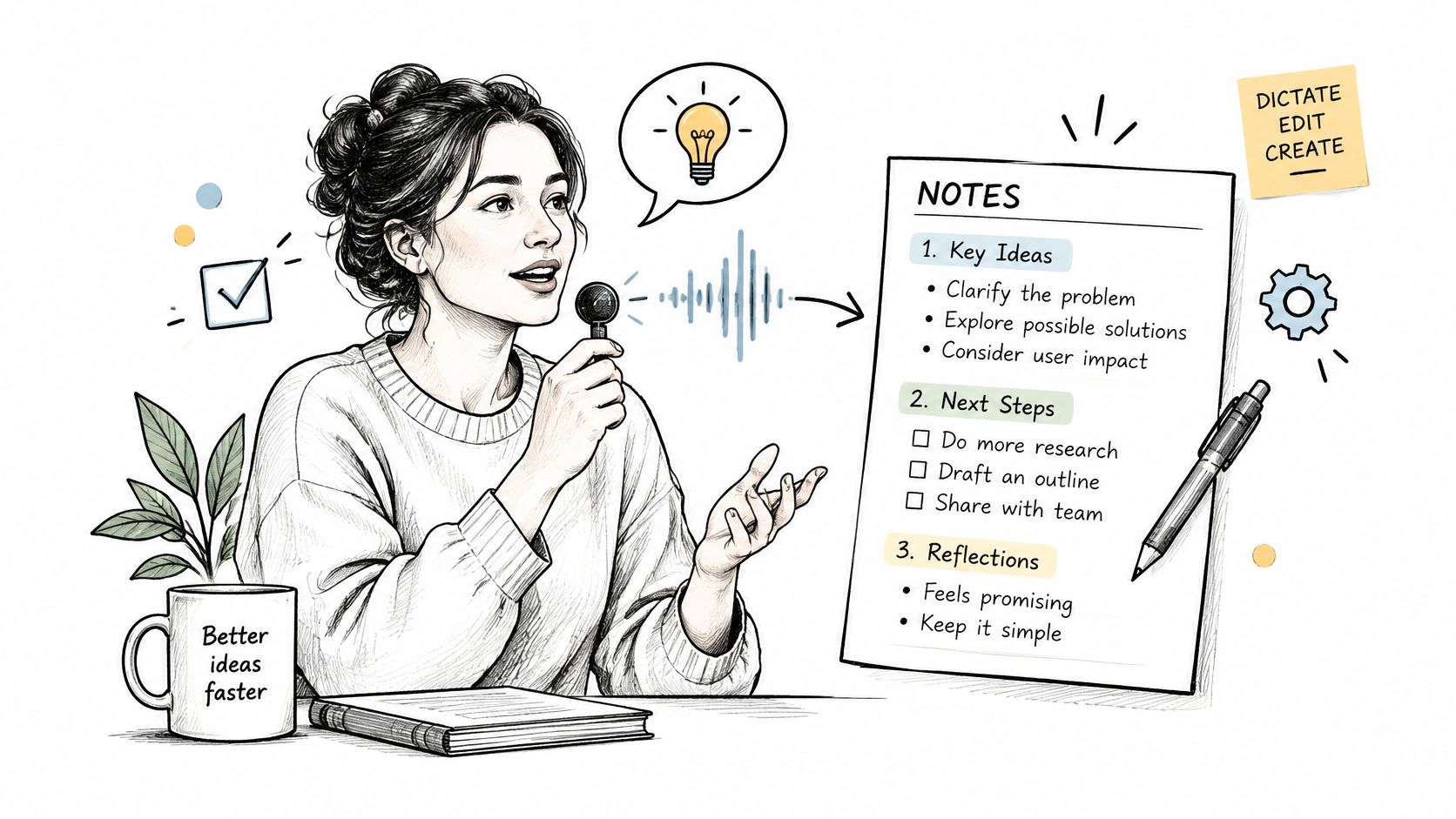
Start with your one-sentence core message and your three points written on a card. Dictate one section at a time, speaking in complete thoughts, and don't stop to fix errors mid-draft. If you lose your place, state the claim again and continue. You'll clean it later, and the restart often produces a cleaner version anyway. If you're new to this method, follow a step-by-step guide to dictating your first draft before you build your own routine.
Set up a custom dictionary for names, acronyms, and technical terms before you dictate, especially for medical, engineering, or product terminology that general recognition handles poorly. Then review the transcript for accuracy before you share or deliver it. Cleanup tools can remove filler and fix punctuation, but they can't know whether you meant one drug name or a similar-sounding alternative.
Practical rule: Dictate for voice and ideas. Edit for structure and truth. Never ask one pass to do both jobs.
The trade-off is volume. A spoken draft will be longer and messier than a typed one. That's acceptable if you treat it as raw material, not a near-final script.
7. Keep Sentences Short and Cut Filler Words
Short sentences aren't a style preference. They're a processing aid. Listeners must absorb words in real time, and delivery rate interacts with age and language background. In a 2016 University of Central Florida study of comprehension at 127 and 188 words per minute, younger adults performed significantly better than older adults at 127 words per minute, while the groups performed similarly at 188 words per minute, and English-first-language participants generally outperformed English-second-language participants. That evidence doesn't establish one perfect speed. It shows pacing belongs in the writing, not just the performance.
Write in short, clearly structured units so you can pause after each claim. Define unfamiliar terms when they first appear. Put important information where listeners have time to absorb it, not buried in the middle of a long sentence. Lincoln's Gettysburg Address shows how brevity can carry weight, and Kennedy's inaugural lines use short, direct clauses that are easy to remember because each one completes a thought before the next begins.
Edit for Breath and Clarity
Split any sentence with more than one main idea into two. Search your draft for "very," "really," "basically," and "just," and remove most of them. Those words often signal you're hedging a claim you should either support or soften. Then read the draft aloud to find sentences that require a breath mid-thought. Your lungs are a reliable editor.
Filler in a transcript needs the same discipline. Words like "um," "like," and "you know" make a speaker sound less focused when they're left in a script or repeated in delivery. Use cleanup to strip them from dictated drafts, including a dedicated approach to removing filler words from transcripts, then check that the cleaned sentence still says what you meant.
This matters even more for multilingual and mixed-expertise audiences. The UNC Writing Center advice on adapting speeches to audiences recommends adapting content, detail, and tone and avoiding overly complicated sentence structures. Take that further in your edit. Replace idioms and culture-specific humor, define acronyms on first use, and keep subjects and verbs close together. Conversational language isn't always inclusive if it depends on irony or compressed references only native speakers catch.
8. Rehearse Aloud and Plan for Delivery
A speech isn't finished when the draft looks clean. It's finished when you can say it, recover if you lose your place, and land within your time slot without rushing the ending. Rehearsing aloud exposes awkward phrasing that silent reading hides, and it lets you mark natural pauses before you're standing in front of people.
Plan your word count from your intended pace, then reserve time for pauses, emphasis, and audience reaction. Using the rates from the comprehension research noted earlier, a five-minute script contains about 635 words at the slower rate and about 940 words at the faster rate, which shows why guessing length from page count fails. Time a full run, compare it with your slot, and cut content rather than speeding up if you're over.
Watch how an experienced speaker handles pacing and pauses in practice before you record your own run.
Mark the Script for Performance and Recovery
Mark pauses with slashes in your script and underline key words you want to stress. Record a practice run on your phone, then listen back for filler words, rushed transitions, and sections where your energy drops. Speech coaches record practice runs for exactly this reason, and Steve Jobs was known for extensive rehearsal of product keynotes, which contributed to their polished delivery.
For anxious speakers, write recovery into the draft itself. Use chunked paragraphs, explicit transitions, and restart-friendly sentences that don't depend on remembering the previous clause. Keep a one-minute emergency version with your core message and three points. Don't overstate the problem, though. Coverage of a 2025 Chapman University survey finding 33.7% of U.S. adults afraid or very afraid of public speaking also cites cross-national research with a 4.0% lifetime rate for clinically defined social anxiety disorder. Ordinary nerves respond well to better writing and rehearsal. Clinically significant anxiety may call for coaching or professional support, not just a rewrite.
If you rehearse from dictated notes, check recognition quality on names and technical terms first. Small errors compound when you're nervous and reading quickly, so apply a few practical techniques for improving dictation accuracy before your final run.
8 Essential Speech Writing Tips Compared
| Technique | 🔄 Complexity & Resources | 📊 Expected Outcome | ⭐ Key Advantage | 💡 Ideal Use Case |
|---|---|---|---|---|
| Write for the Ear, Not the Eye | Low–moderate; draft conversationally and read aloud | Clearer, more natural spoken delivery | Improves listener comprehension and reduces awkward phrasing | Speeches for varied audiences, especially in noisy settings |
| Lead with Your Main Message and Signpost the Structure | Low; state the thesis, preview sections, and add transitions | Better audience orientation and retention | Gives listeners a clear mental map | Briefings, lectures, and stakeholder updates |
| Use the Rule of Three | Low; group ideas into three parallel points | More memorable, rhythmic messaging | Makes ideas feel complete without overwhelming listeners | Summaries, presentations, and slogans |
| Build a Narrative Arc Using Contrast | Moderate–high; research the current state and desired future | Greater engagement and a clearer call to action | Makes recommendations feel relevant and necessary | Pitches, proposals, and change presentations |
| Use Repetition and Anaphora for Emphasis | Low–moderate; plan a refrain and use it selectively | Stronger recall and emotional impact | Highlights key ideas through rhythm and repetition | Motivational, persuasive, and alignment messages |
| Speak First, Then Edit: Draft by Dictation | Moderate; dictate, then review and edit the transcript | Faster first drafts with a conversational voice | Helps overcome writer's block and capture ideas quickly | Long-form drafts, memos, and clinical documentation |
| Keep Sentences Short and Cut Filler Words | Moderate; edit for brevity, then check aloud | Clearer, more concise, confident delivery | Reduces cognitive load and improves precision | Technical talks, clinical notes, and concise speeches |
| Rehearse Aloud and Plan for Delivery | Moderate–high; requires repeated timed practice | Smoother pacing, fewer delivery issues, and better timing | Surfaces awkward phrasing and timing problems before the event | Keynotes, presentations, and time-limited speeches |
Build a Speech That Sounds Like You
Before your speech is finished, put it through three tests. The audience should understand the central message without effort. You should be able to deliver every line naturally, in your own rhythm. Every sentence should earn its place by advancing a claim, supporting it, or helping the listener move to the next idea. If a sentence fails all three, cut it, even if you're fond of how it reads.
That writing-first priority has evidence behind it. In a controlled study where researchers varied six delivery variables across ten conditions viewed by more than 220 subjects, the research on delivery and composition in a five-minute persuasive speech reported that delivery, as operationally defined, had virtually no effect on attitude change, recall-comprehension, or ethos when composition was effective. Delivery mattered mainly when composition was deliberately made ineffective. In practical terms, gestures and vocal variety amplify a well-built argument. They don't rescue a muddled one.
So build the argument first. Establish a clear purpose, state your central claim early, organize ideas logically, and support each point before you optimize performance. Test for structural weakness by asking whether a listener can name the problem, the proposed action, and the reason to care after one hearing. If they can't, your problem is composition, not charisma, and no amount of confident delivery will fix missing logic.
Then use the production process that keeps your voice intact. Write the rough draft by speaking, use cleanup tools to remove filler words and correct errors, then read and record the result aloud. A tool such as AIDictation can handle that cleanup stage for dictated drafts, including filler removal, punctuation, and formatting, but it can't replace deliberate argument design. A polished script with weak composition remains weak. Strong structure gives delivery techniques something useful to reinforce.
Keep your final speaking outline keyword-based rather than fully scripted where the setting allows it. A keyword outline supports extemporaneous speaking, eye contact, and audience engagement while reducing dependence on reading verbatim. Save the full script for drafting and timing, then compress it into claims, transitions, and prompts you can glance at and leave. That shift is where a speech starts sounding like a person thinking in front of an audience instead of a person reciting at them.
Make one final pass that focuses only on transitions, pacing, pauses, and emphasis. Don't rewrite ideas at that stage, or you'll overwork the draft and smooth out the conversational texture you worked to capture. Check that each transition announces where you are, each pause gives listeners time to absorb a claim, and each emphasized word deserves the stress. Then rehearse once more at full volume, standing up, with the timer running.
These speech writing tips won't make you sound like Kennedy, King, or Churchill, and they shouldn't. The goal is a speech that sounds like you on your clearest day, with a message your audience can follow, remember, and act on. Write it for ears, build it on a structure listeners can track, draft it in your own voice, and rehearse it until the words fit your breath. That's a process you can repeat for a stakeholder update, a clinical briefing, a technical explanation, or a toast, and it gets faster every time you use it.
Draft your next speech by speaking it first, then let AIDictation turn that spoken draft into clean, ready-to-edit text with AI cleanup, filler-word removal, and formatting that preserves your natural voice. It's a practical way to get from blank page to rehearsable script without losing how you really talk. Try it on your opening minute today, read the result aloud, and build the rest of the speech from there.
Frequently Asked Questions
What does 8 Speech Writing Tips for Clearer, Stronger Speeches cover?
You've got a talk Thursday morning, a blank document on your screen, and a rough sense of what you want to say. Then you start typing the way you'd write an email.
Who should read 8 Speech Writing Tips for Clearer, Stronger Speeches?
8 Speech Writing Tips for Clearer, Stronger Speeches is most useful for readers who want clear, practical guidance and a faster path to the main takeaways without guessing what matters most.
What are the main takeaways from 8 Speech Writing Tips for Clearer, Stronger Speeches?
Key topics include Table of Contents, 1. Write for the Ear, Not the Eye, Test Every Line Out Loud.
Ready to try AI Dictation?
Experience fast voice-to-text on your device. Free to download.
Download Free