How to Write a Legal Brief That Persuades and Wins
You're probably staring at a record that feels bigger than the brief you need to file. The facts are messy. The law is mixed. The partner wants a draft fast, but the court needs something calm, precise, and easy to follow. That tension is where most brief writing goes wrong.
A good brief doesn't read like the writer struggled. It reads like the answer was there all along.
That's a key lesson in learning how to write a legal brief. The job isn't to dump research into a document. The job is to turn a crowded file into one clean path for the judge. Under real deadlines, that takes judgment, triage, and a drafting process you can trust when your time is thin.
Table of Contents
- The Strategic Foundation Before You Write a Word
- Anatomy of a Powerful Legal Brief
- Building an Irrefutable Legal Argument
- A Modern Workflow for Efficient Drafting
- The Final Mile Formatting Filing and Avoiding Pitfalls
- From Draft to Decision
The Strategic Foundation Before You Write a Word
Start with the judge, not the template
The first hour on any brief is strategic, not mechanical. Before opening last month's motion or copying a caption, answer three questions.
Who is reading this? What exact relief are you asking for? What is the single theory that makes your client's position feel inevitable?
Most junior lawyers start with structure because structure feels safe. But the brief doesn't fail because it lacked a table of authorities on page one of the drafting process. It fails because the writer never decided what the case is really about.
Seattle University's law review recommends beginning with a compelling recitation of relevant facts, then accurately stating the governing legal standard, selecting only the strongest arguments, and presenting them clearly and concisely, while supporting every factual assertion with record citations and proofreading carefully so the brief can be understood from its structure alone (Seattle University Law Review guidance).
Practical rule: If you can't explain the case theory in two or three plain sentences, you're not ready to draft.
For a stronger sense of how seasoned advocates shape that theory on the page, this collection of strategies for persuasive legal writing is useful because it focuses on persuasion choices, not just formal parts.
Pick one objective and one theory
A brief usually collapses when it tries to do too much. You may have five arguments, but you still need one objective and one through-line.
Your objective is concrete. Deny the motion. Compel arbitration. Affirm dismissal. Reverse and remand. If the requested relief is fuzzy, the reasoning will be fuzzy too.
Your theory of the case is different. It's the sentence that gives emotional and legal coherence to the whole document. Examples:
- Contract dispute: The other side is trying to rewrite a bargain after performance exposed a bad business decision.
- Employment case: The employer acted first and invented a justification later.
- Discovery fight: The request is broad on paper but targeted in effect, and the burden has no meaningful limit.
Those aren't lines to paste into a brief. They're drafting instructions for yourself.
A practical way to protect that focus is to do your early thinking away from the polished draft. Many lawyers write better when they separate idea generation from sentence-level editing. If that's a problem for you, this piece on writing in flow gets at the core issue: don't force drafting and self-critique to happen at the same moment.
Read the record for sequence, motive, and pressure points
Don't read the record like a warehouse. Read it like a timeline with conflict inside it.
You're looking for three things:
- Sequence: What happened first, what changed, and what event matters?
- Motive: Why did each actor do what they did?
- Pressure points: Which facts make the legal rule feel sensible in your client's favor?
A judge doesn't need every fact you found. A judge needs the right facts in the right order.
That means separating important from interesting. An embarrassing email may be interesting. It may not be important. A routine letter may be decisive because it fixes notice, timing, or authority.
When the record is crowded, the winning move is often subtraction.
The lawyers who write clean briefs aren't seeing some magical version of the case file. They're making decisions earlier. They know what the judge must believe by the end of page two, and they build backward from there.
Anatomy of a Powerful Legal Brief
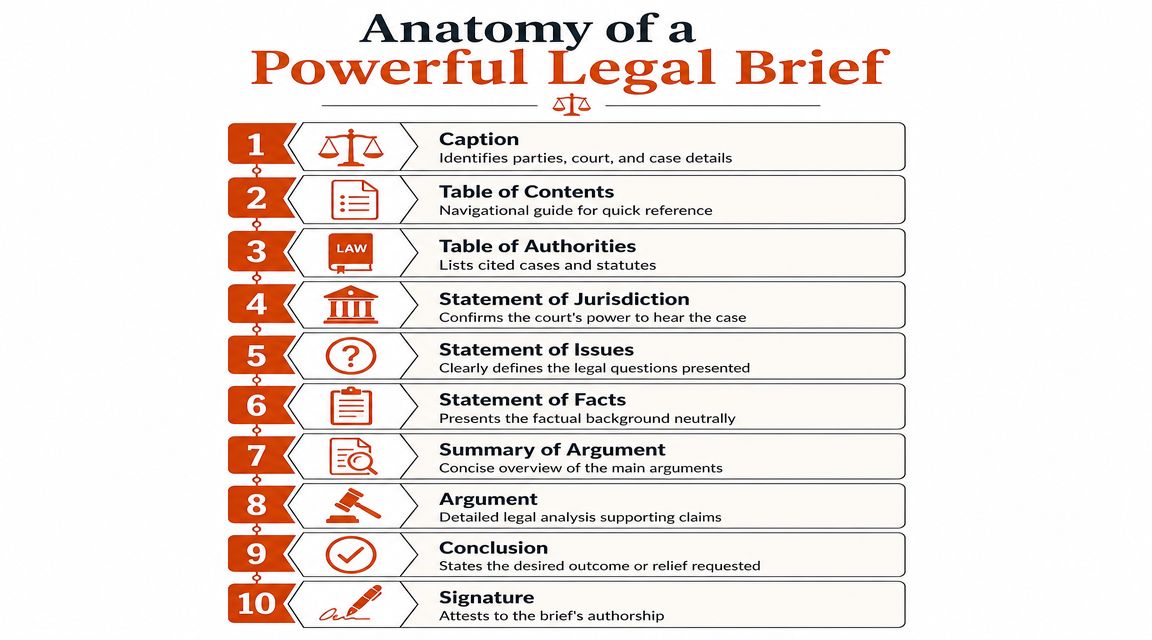
A powerful brief still follows the court's required parts. The difference is that each part earns its place. Nothing is just there because a rulebook said so.
If you need a basic orientation to appellate briefing before drilling into strategy, this overview of what is an appellate brief is a helpful primer for newer lawyers.
Every part has a job
Here's how I think about the usual components.
| Section | What it must do |
|---|---|
| Caption | Get the case details right. Sloppiness here poisons confidence early. |
| Table of Contents | Let the judge see your logic at a glance. If the headings wander, the argument probably does too. |
| Table of Authorities | Confirm that your authorities are real, current, and actually used for the propositions you cite. |
| Jurisdiction or procedural statement | Tell the court why it can act and where the case sits procedurally. |
| Questions Presented or issues | Frame the dispute in language that favors your theory without sounding manipulative. |
| Statement of Facts | Give the court a story, not a data dump. |
| Summary of Argument | Offer the road map. Don't repeat point headings mechanically. |
| Argument | Prove your headings. Show the law, the record, and the fit between them. |
| Conclusion and relief | State exactly what you want the court to do. |
| Signature and required certifications | Finish professionally and comply with filing rules. |
Weak versus strong framing
The issue statement and fact section usually separate average briefs from effective ones.
A foundational rule is to treat the statement of facts as a narrative, not a transcript. The San Francisco Bar advises building a chronology of events, then turning it into a story the judge can understand on its own, while avoiding a string of date-led sentences that “will kill your prose.” That same guidance aligns with issue statements that frame the deep issue in under about 75 words and end in a yes-or-no question (San Francisco Bar guidance on narrative facts and deep issue framing).
Weak issue statement
Whether the trial court erred in granting summary judgment to Defendant.
Stronger issue statement
Whether summary judgment can stand where the employer fired the plaintiff before completing its own investigation and the record contains evidence that the stated reason for termination changed over time?
The second version does two things. It narrows the dispute and loads the question with the facts that matter.
Weak facts opening
On March 3, the parties entered into a contract. On March 17, Defendant sent an email. On April 1, Plaintiff responded. On April 7, Defendant failed to perform.
Stronger facts opening
The dispute began after the parties agreed on a delivery schedule, accepted partial performance, and then disagreed only when market conditions changed. By the time Defendant declared breach, it had already treated the contract as valid when doing so served its interests.
The second opening still respects the record. It just gives the court a reason to care about the sequence.
Facts don't become persuasive because you add adjectives. They become persuasive because you arrange them honestly.
How the sections work together
A brief works when each section hands the next one a cleaner task.
- The questions presented frame the dispute.
- The facts make that framing believable.
- The summary states the answer in compact form.
- The argument cashes the check.
That means you shouldn't draft sections in isolation. If the facts don't support the issue statement, change one of them. If the argument section depends on details that never appear in the facts section, fix the front half of the brief.
The best briefs feel easy to read because the writer did the hard alignment work before polishing sentences.
Building an Irrefutable Legal Argument
The argument section is where discipline matters most. Lawyers often talk about structure as if it limits creativity. In practice, structure frees you to persuade.
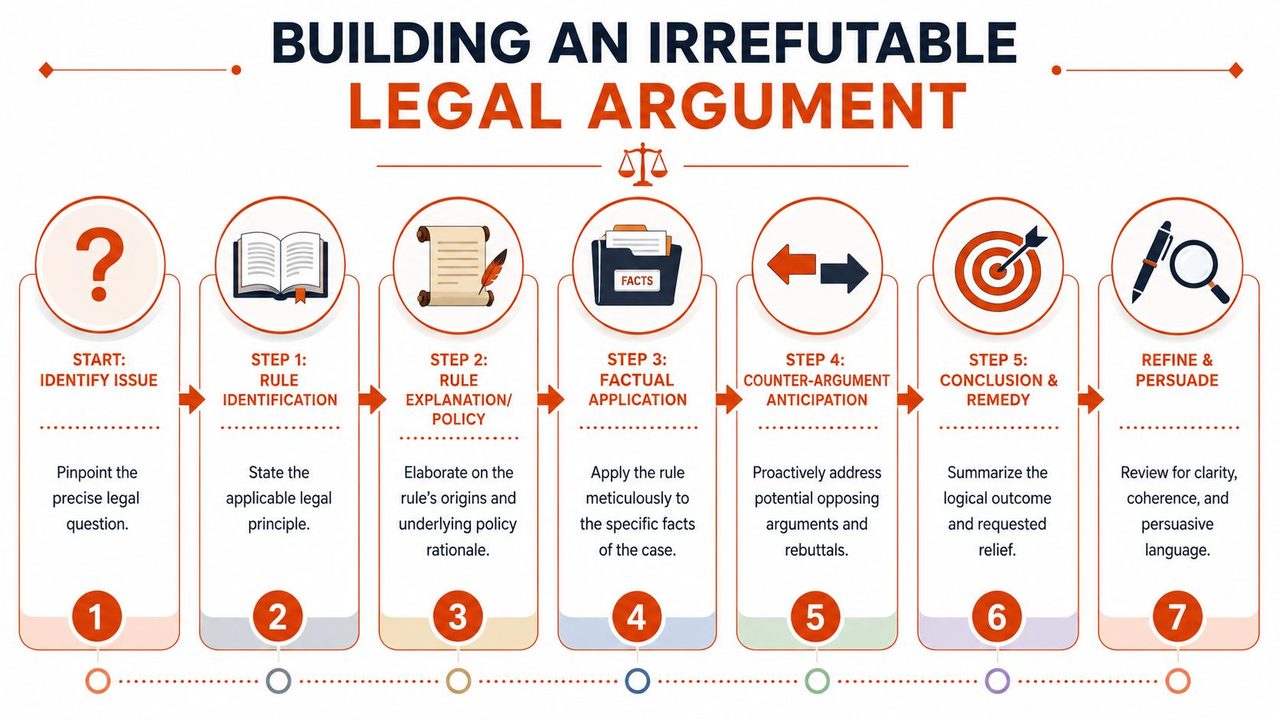
A persuasive legal brief should be built using a structured chain: Conclusion → Rule Synthesis → Rule Proof → Application → Counterargument → Restated Conclusion. CUNY Law emphasizes synthesizing multiple cases into general legal propositions and making each paragraph advance one connected concept so the court's reasoning is easier to follow (CUNY Law briefing guidance).
Structure is not a straitjacket
Most weak arguments have the same flaw. They report authorities one by one and hope the judge will assemble the doctrine.
Don't do that.
The court shouldn't have to infer the rule from a stack of block quotes. Your job is to synthesize the cases into a working principle, then prove that principle with authority, then apply it tightly to your record.
That's why I prefer a CRAC-style flow, expanded into something more useful for real motion practice:
- State the conclusion first. Tell the court where this section ends.
- Synthesize the rule. Distill the governing principle from the cases.
- Prove the rule with authority. Use the cases as support, not as a substitute for analysis.
- Apply the rule to your facts. Persuasion occurs at this stage.
- Address the best counterargument. Don't swat at weak points. Meet the strongest one.
- Restate the conclusion. Close the loop.
A mini argument built the right way
Take a simple hypothetical. A plaintiff seeks sanctions for spoliation after a company deleted chat messages once a dispute was already obvious.
Conclusion: Sanctions are warranted because the company failed to preserve evidence after its duty to preserve arose.
Rule synthesis: Courts generally look for a preservation duty, a failure to take reasonable preservation steps, and resulting prejudice or intentional misconduct, depending on the remedy sought.
Rule proof: Then cite the cases that establish those propositions. Not five paragraphs of case summaries. Just enough authority to show the rule is real and stable.
Application: The duty arose when counsel sent a preservation letter and the company's own managers were already discussing the expected dispute internally. Yet the company allowed auto-delete settings to continue and collected some records while ignoring the chat platform central to the decision-making at issue. That is not a close call.
Counterargument: The company will say routine deletion occurred under an ordinary retention policy. That point helps only if the policy was allowed to run before litigation became reasonably foreseeable. Once the duty arose, routine deletion stopped being routine.
Restated conclusion: Because the company let relevant evidence disappear after the preservation duty attached, the court should impose an appropriate remedy.
That sequence isn't formulaic. It's humane. It tracks how judges read.
What usually weakens the argument section
A few habits reliably drag the section down:
- Case dumping: One authority after another with no synthesis.
- Fact drifting: Starting with one issue and ending three pages later in a different dispute.
- Hidden concessions: Ignoring the worst fact or best case for the other side.
- Overlong paragraphs: If one paragraph does three jobs, it probably does none of them well.
Here's a practical test. Read only the first sentence of each paragraph in your argument section. If those sentences don't tell a coherent story, the section isn't ready.
Your headings and lead sentences should let the judge follow the argument even at speed.
That matters because judges rarely read under ideal conditions. They read with interruptions, with other cases waiting, and often with a tentative view forming early. Clean structure doesn't just help readability. It helps adoption.
A Modern Workflow for Efficient Drafting
Knowing the parts of a brief is one thing. Producing one quickly without wrecking the argument is another.
The gap in most guidance is process. One of the few process-oriented pieces recommends a sequence that's far more realistic than generic template advice: checklist the issues and facts, research, map ideas, outline everything, annotate the outline with supporting authorities, then revise. It also notes that many lawyers skip outlining even though it's valuable for time-pressed practitioners (process-oriented brief drafting sequence).

Two associates, two drafts
Associate One opens a blank document and starts typing. She writes the caption, inserts headings, then tries to draft the facts while still figuring out what matters. She stops every few sentences to check a citation, trim a phrase, or move a paragraph. Six hours later, she has text on the page but no real momentum.
Associate Two spends the first stretch building a serious outline. Not a skeletal list. A working outline with issue headings, factual themes, likely counterarguments, and record cites parked where they belong. When he starts drafting, he already knows the route.
The second associate usually writes the stronger first draft. Not because he's smarter. Because he isn't trying to decide, draft, edit, and cite-check all at once.
The outline is where speed comes from
A useful brief outline contains more than headings. It should include:
- The theory line: One sentence that states why your client should win.
- The facts bucketed by issue: Not by witness and not by document source.
- The rule section in synthesized form: The proposition first, authorities underneath.
- The application points: Short bullets tying law to specific record facts.
- The likely response: The best argument the other side will make.
- The citation placeholders: Enough record and legal support to prevent later scavenger hunts.
That's the version of outlining people skip because it feels slow. It isn't slow. It's the part that prevents a chaotic rewrite at midnight.
For lawyers building more repeatable drafting habits, this guide to voice dictation workflows is useful because it treats drafting as an operational process, not a burst of inspiration.
Why dictation helps on a hard first draft
Typing is good for precision. It's often terrible for momentum.
When lawyers get stuck, the problem usually isn't lack of ideas. It's friction. They hear the sentence, then edit it before it lands. Dictation can break that loop. Speaking forces movement. It also tends to produce more natural transitions, especially in fact sections and first-pass applications.
That doesn't mean dictating the final brief exactly as filed. It means using speech to generate a full-bodied first draft from a prepared outline, then tightening on revision.
A practical sequence looks like this:
- Build the outline first.
- Dictate one section at a time from the outline.
- Leave citation placeholders where needed instead of stopping every minute.
- Revise on the screen for precision, compression, and authority support.
A short demonstration of that kind of workflow can help if you haven't tried it before:
The key is simple. Don't confuse drafting with finishing. Fast drafters aren't careless. They just know which stage they're in.
The Final Mile Formatting Filing and Avoiding Pitfalls
A strong argument can still lose force if the filing looks careless. This is the point where many junior lawyers relax because the analysis is done. That's backwards. The last pass is quality control.
Your pre filing checklist
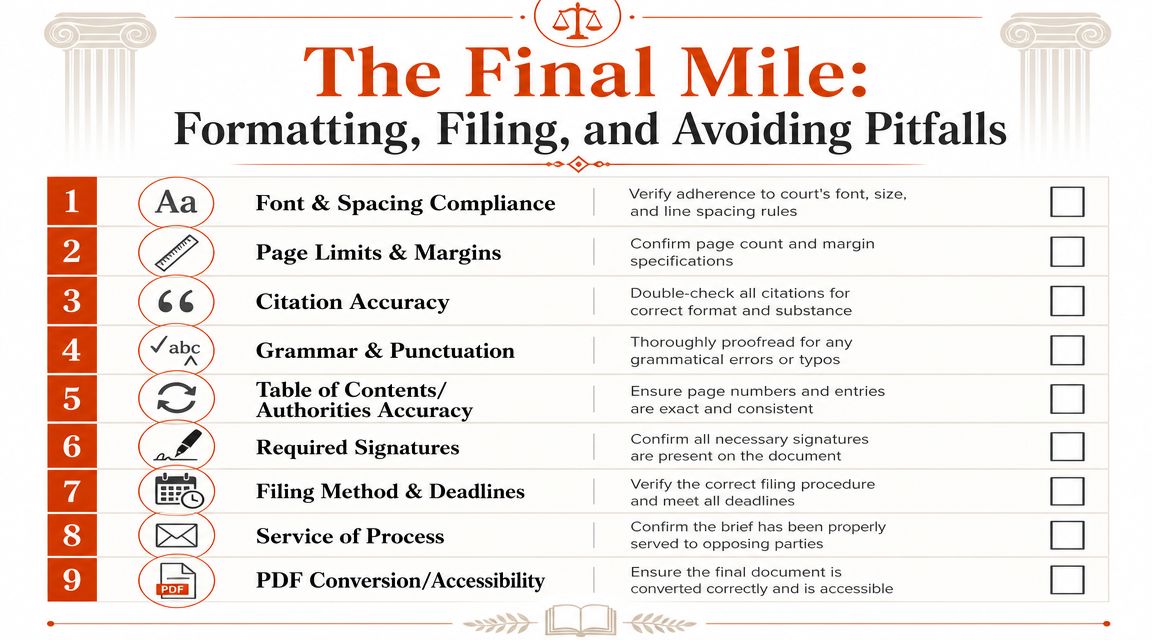
Before filing, run a clean procedural review separate from your substantive edit.
- Check local rules first: Font, spacing, margins, word limits, appendices, cover requirements, and certificate rules vary.
- Verify every citation: Legal citations and record citations both need review. Make sure the cited source says what you claim it says.
- Rebuild tables late: Tables of contents and authorities should be regenerated after the final pagination pass.
- Confirm requested relief: The conclusion should tell the court exactly what order you want.
- Review the PDF: Pagination, bookmarks if required, text recognition, seals, and exhibit labels can shift during conversion.
- Confirm service and filing method: E-filing systems have their own traps, especially with attachments and event codes.
A filing error is rarely interesting, but it can be expensive.
If you still handle paper courtesy copies, chambers bundles, or production-quality bound submissions, resources from Camelot Print & Copy Centers can help you think through the print side of legal document handling without improvising at the last moment.
Common mistakes and quick fixes
| Mistake | Solution |
|---|---|
| Passive, fuzzy prose | Rewrite with actors and actions. “Defendant terminated Plaintiff” is clearer than “termination occurred.” |
| Quoting too much law | Pull the rule into your own sentence, then use short quotes only when wording matters. |
| Citations that interrupt the sentence | Place citations where they support, not where they break rhythm. |
| Overstating facts | Keep the tone controlled. Credibility is worth more than heat. |
| Burying the ask | State the requested relief clearly in the introduction if appropriate and again in the conclusion. |
| Mechanical punctuation errors | Do a final read focused only on punctuation and consistency. A checklist like this list of punctuation is handy when you're cleaning a draft fast. |
File the document you meant to file
The final version should be reviewed as if you were opposing counsel looking for weaknesses.
Read the headings straight through. Skim for unsupported factual assertions. Open the PDF, not the Word file. Check that all signatures, exhibits, certificates, and attachments are included. Make sure the filed version is the same version the team approved.
Many avoidable problems happen in the final half hour. Wrong attachment. Old exhibit index. Missing declaration. Broken cross-reference. None of that helps the client, and all of it is preventable.
Good lawyers don't treat filing as clerical. They treat it as the last act of advocacy.
From Draft to Decision
Writing an effective brief is part analysis, part storytelling, and part process control. The legal reasoning matters, but so do the sequence of the facts, the discipline of the structure, and the habits you use under deadline.
That's why the best answer to how to write a legal brief isn't just a list of sections. It's a working method. Start with audience, objective, and theory. Build the brief so each part carries weight. Make the argument easy to adopt. Use a drafting workflow that gets you from record to polished prose without wasting motion. Then finish like someone who expects the court to notice details, because courts do.
Mastering that process is one of the clearest turning points in becoming a reliable advocate. Every brief after that gets a little faster, a little cleaner, and a little more confident.
If you want a faster way to turn a rough outline or spoken analysis into clean draft text, AIDictation is worth a look. It's a macOS voice-to-text app built for producing polished writing from speech, which makes it especially useful when you need to get a first draft moving without losing your train of thought.
Frequently Asked Questions
What does How to Write a Legal Brief That Persuades and Wins cover?
You're probably staring at a record that feels bigger than the brief you need to file. The facts are messy.
Who should read How to Write a Legal Brief That Persuades and Wins?
How to Write a Legal Brief That Persuades and Wins is most useful for readers who want clear, practical guidance and a faster path to the main takeaways without guessing what matters most.
What are the main takeaways from How to Write a Legal Brief That Persuades and Wins?
Key topics include Table of Contents, The Strategic Foundation Before You Write a Word, Start with the judge, not the template.
Ready to try AI Dictation?
Experience fast voice-to-text on your device. Free to download.
Download Free