Arthrogryposis Adaptive Equipment: A Family Guide
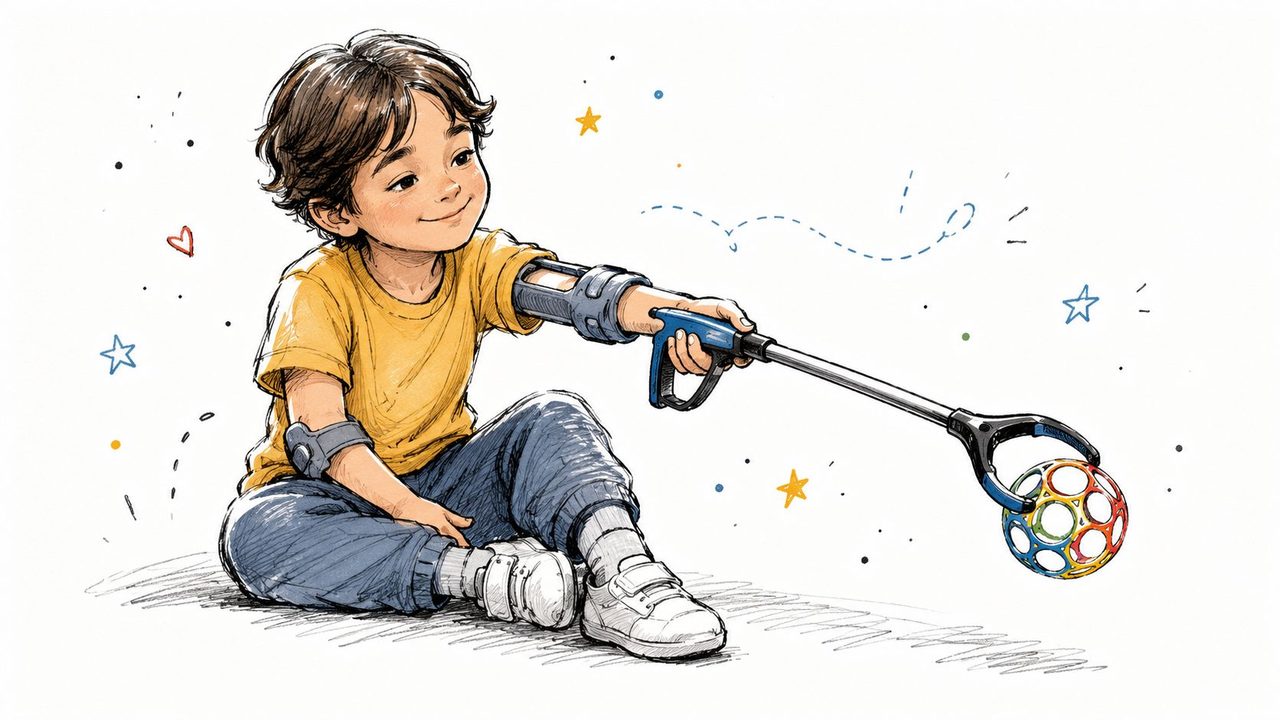
You're holding a diagnosis that can feel bigger than the room you're standing in. One minute you're learning a new medical term, the next you're wondering how your child will eat, sit, play, write, and keep up as they grow. Arthrogryposis adaptive equipment turns that uncertainty into a practical plan, because the right tools can support movement, reduce strain, and make everyday tasks possible in ways that are easier to build on over time.
Table of Contents
- Understanding Arthrogryposis and the Role of Adaptive Equipment
- Categories of Adaptive Equipment for Arthrogryposis
- What the Clinical Data Shows About Equipment Use
- Selecting and Fitting the Right Equipment
- Integrating Equipment Into Rehabilitation and Daily Life
- Funding and Sourcing Adaptive Equipment
- Safety and Maintenance Best Practices
- Professional Resources and Community Support
Understanding Arthrogryposis and the Role of Adaptive Equipment
The first weeks after an arthrogryposis multiplex congenita (AMC) diagnosis often bring a flood of small questions that all feel urgent. Can my child feed themselves? Will they walk? How do we make sure they're comfortable in a car seat, a high chair, or at preschool?
AMC is a condition with multiple joint contractures present at birth, and the pattern can be wide-ranging. A major review cited in the rehabilitation literature notes that 60 to 92% of classic cases involve all limbs symmetrically, while 7 to 24% involve only the lower limbs and 1 to 13% only the upper limbs, which is why one child may need a walker and another may need a feeding aid, or both. The same review also notes that neurogenic factors account for 70 to 80% of fetal akinesia cases presenting as AMC, which helps explain why many children need long-term functional supports instead of a short course of treatment. PMC review on AMC prevalence and patterns
What equipment means in daily life
Adaptive equipment is not a backup plan or a sign that therapy has failed. It's the bridge between a child's current movement and the daily task they want to do next. A reacher can make play possible, a seating system can make mealtimes safer, and an orthosis can help a child use the strength they do have more effectively.
That's why equipment planning in AMC usually spans both mobility support and upper-extremity support. The condition doesn't stay neatly in one joint group, so the equipment plan shouldn't either.
Practical rule: if the task matters to the child, the equipment should be judged by whether it makes that task more independent, safer, or less exhausting.
Families are often relieved when they hear that adaptive equipment is standard in AMC care. It's not an afterthought. It's part of how pediatric rehabilitation turns a diagnosis into a workable daily routine.
Categories of Adaptive Equipment for Arthrogryposis
Families usually meet equipment in clusters, not as one isolated device. A child may start with splints, move into seating supports, and later add a communication tool or a powered aid as school and play demands change. The challenge is figuring out which category solves which problem.
The main equipment groups
Mobility devices include walkers, gait trainers, and wheelchairs. A child with limited hip, knee, or ankle motion may use a walker for short distances and a wheelchair for longer outings, especially when endurance or safety becomes the bigger concern.
Seating and positioning systems include adaptive chairs, lateral supports, standing frames, and custom inserts. These tools help a child stay upright, stable, and comfortably aligned so they can eat, play, participate in therapy, or join class activities without fighting their own posture.
Orthoses and splints are often where AMC care starts. AFOs, KAFOs, wrist splints, and elbow-flexion assist devices can support weak or tight joints, improve alignment, and make movement more efficient.
Feeding and activities-of-daily-living aids cover adapted utensils, reachers, long-handled grooming tools, and bathing or toileting aids. These are often the difference between total help and partial independence in everyday routines.
Communication and assistive technology matters when hand function makes writing or device use hard. Switch access, voice-to-text, and environmental controls can extend independence beyond mobility into schoolwork and home life.
A useful way to think about the categories is by task, not by product. A child with symmetric four-limb involvement may need help in several categories at once, while a child with more isolated lower-limb involvement might need much more focus on mobility and positioning. That's why product lists alone rarely help families make good decisions.
If you're comparing broader assistive technology options, it can help to see how different diagnoses are approached in other pediatric settings as well, such as this overview of assistive technology and cerebral palsy. The details differ, but the logic is similar, match the device to the daily task and the child's movement pattern.
A related question families sometimes ask is whether a highly specialized device is always necessary. Sometimes the answer is no. In some cases, a well-chosen standard product or a locally adapted setup can meet the same functional goal if it's fitted carefully and used consistently. For broader access questions, even unconventional resources like browse wheelchair hyperbaric chambers from MedEq Fitness remind families that equipment ecosystems are wider than the most obvious pediatric catalog pages.
What the Clinical Data Shows About Equipment Use
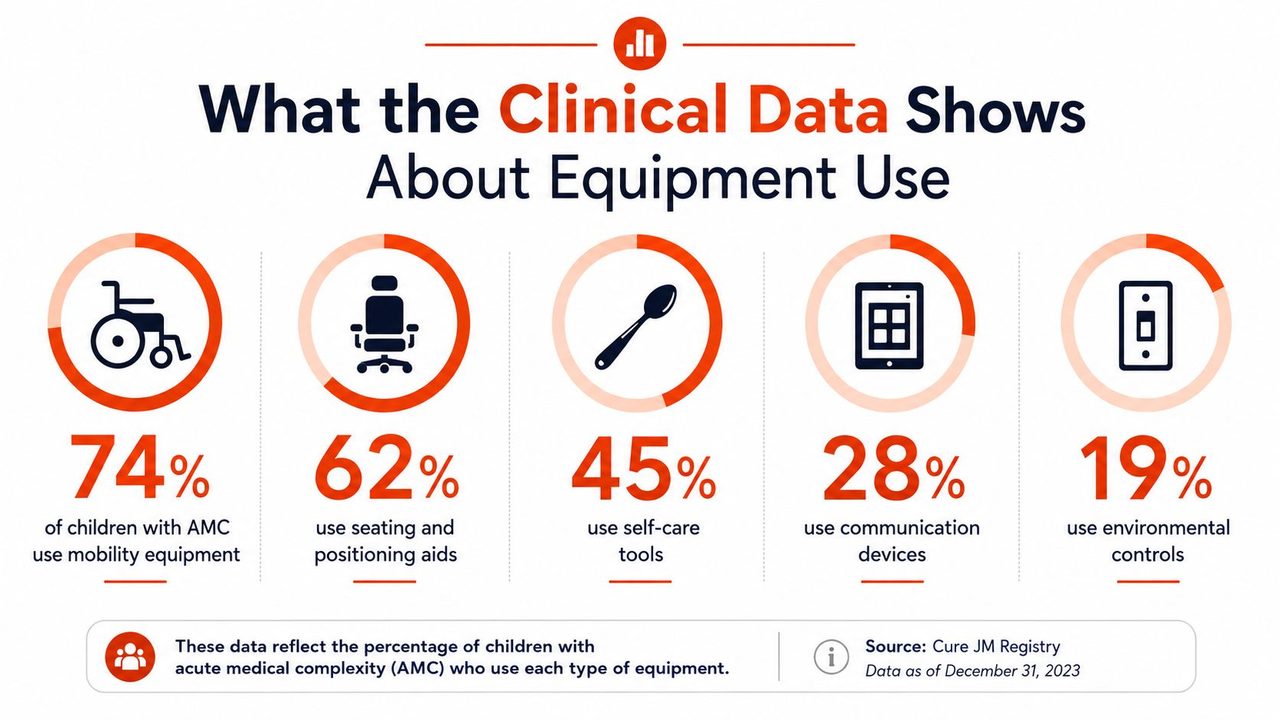
A newly diagnosed family often wants one clear answer about equipment, yet the clinical record shows a pattern that is more layered than a single device choice. Published AMC cohorts suggest that equipment use is part of routine rehabilitation planning, not an occasional add-on. In one review of 114 children with AMC, 42 children used orthoses during rehabilitation, including 31 who used ankle-foot orthoses (AFOs) and 11 who used knee-ankle-foot orthoses (KAFOs). 2020 AMC cohort review
Why lower-limb equipment shows up so often
Families usually notice the feet and ankles first because those joints often shape the first equipment decisions. In the same cohort, foot and ankle deformities were the most prevalent orthopedic issues, affecting 91.5% of children with amyoplasia and 85.7% with distal arthrogryposis. When those joints are involved that often, orthoses become one of the earlier tools in a child's rehabilitation plan.
Walking support also varied by subtype, and that difference matters when a team is deciding whether to start with positioning, bracing, or a mobility aid. Among children with amyoplasia who could ambulate, 52.1% needed a device when walking, while 98% of participants with distal arthrogryposis were independent ambulators. The same diagnosis family can still look very different from child to child, so equipment planning has to follow the child's movement pattern rather than a fixed checklist.
The subtype matters, the joint pattern matters, and the daily task matters. Families usually do best when the device plan follows those three facts instead of following a generic checklist.
What this means for families
If your child needs an orthosis early, that does not mean the same device will stay in place unchanged forever. An AFO may help with foot position and stability at one stage, then a different support may fit better later as growth, surgery, or activity demands change. Equipment staging works a little like building supports around a young tree. The support changes as the tree grows, but the goal stays the same, keep it upright and useful.
The clinical record also helps families frame the experience emotionally. Needing adaptive equipment is common in AMC rehabilitation, not a rare sign that everything is going badly. The 2020 AMC cohort review supports early planning, which gives care teams room to match the device to the child's stage instead of waiting until daily tasks are already hard.
Selecting and Fitting the Right Equipment
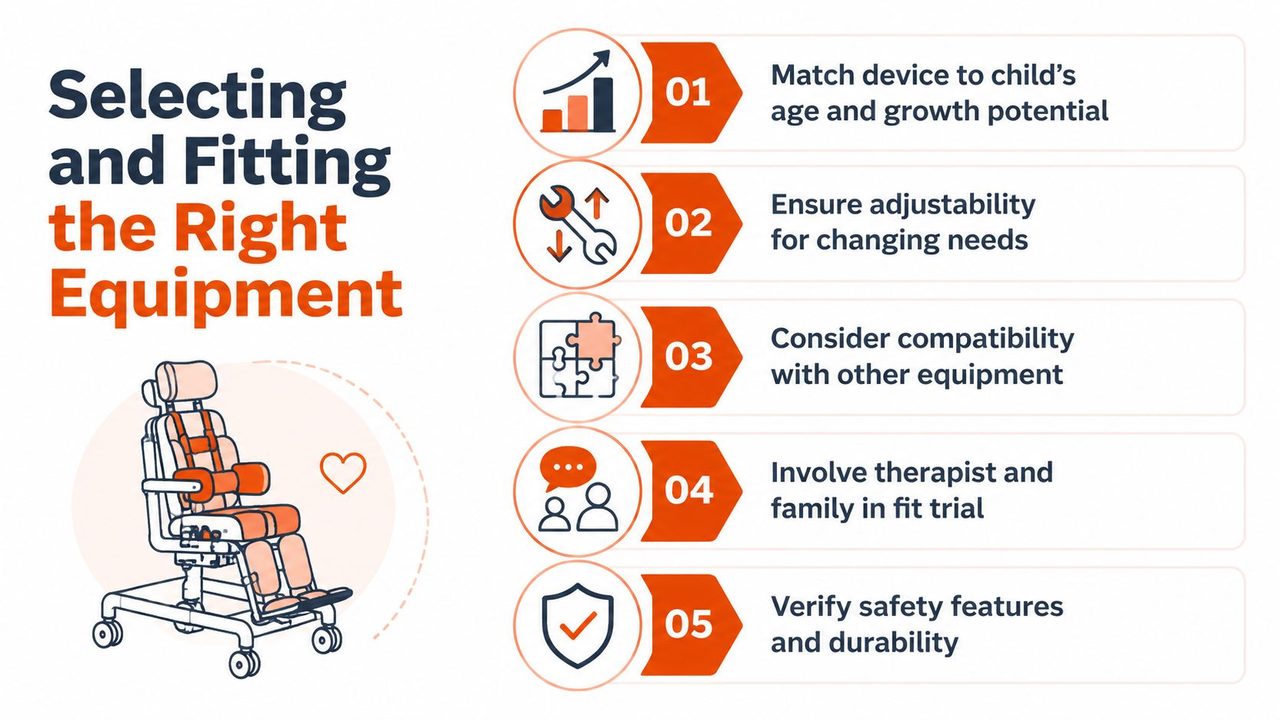
The biggest mistake families make is assuming equipment choice is a one-time purchase. In AMC, it's a moving target. Growth changes fit, surgery changes alignment, and new life stages change what “independent” needs to look like.
Start with the task, not the catalog
A child who can't bring a hand to the mouth needs a different answer than a child who can stand but can't keep balance long enough to play. That's why a spring-powered elbow-flexion assist orthosis was designed for a very specific problem, weak biceps output that made hand-to-mouth movement hard. In the published case, springs and a sliding joint increased elbow torque as flexion progressed, and active elbow flexion increased from 87° without the device to 120° with it. PubMed case report
Feeding tools need similar care. One assistive eating utensil prototype used a battery-powered stationary motor, a flexible drive cable, and a threaded rod/cylinder translation mechanism to move a utensil in a controlled linear path. It also included a preset maximum extension stop, a clutch to limit over-torque, and a rocker switch with forward, reverse, and off control. Those details matter because a child who has limited fine motor control also needs protection from over-travel and over-force. Penn State prototype description
Fit should change with growth
Orthotists, physical therapists, and occupational therapists all bring different eyes to the same child. The orthotist looks at alignment and skin pressure, the therapist looks at task performance, and the family sees what happens on a regular Tuesday at home, not just during a clinic trial.
A good fitting session checks whether the device matches current range of motion, current strength, and current routines. It also asks what's coming next, like preschool, handwriting demands, sports, surgery recovery, or a growth spurt.
Families can ask three useful questions at every fitting.
- What daily task does this device improve? If the answer is vague, the fit may be wrong.
- What happens if my child grows or improves? Some devices should be adjustable, others should be replaced.
- What sign means the fit is no longer safe? Redness, rubbing, slipping, or refusal to use the device usually need attention.
A child's equipment plan should be staged, not stacked randomly. The best plans usually come from matching the device to the child's current function, then revisiting the choice as life changes.
Integrating Equipment Into Rehabilitation and Daily Life
Equipment works best when it fits into real routines, not just therapy appointments. A standing frame that gets used during playtime, a walker that helps with short indoor trips, or a communication device that makes classroom participation easier all succeed for the same reason. They support a life the child already wants to live.
Therapy goals and daily routines should line up
AMC rehabilitation often includes range-of-motion work, stretching, orthotics, strengthening, standing, transferring, walking, recreational activity, and psychosocial support. That wide list matters because equipment is usually one piece of a larger pattern, not a replacement for therapy or practice. AMC rehab guidance summary
A toddler might use a standing frame during play so the device feels less like a medical event and more like part of the day. A school-age child may use a walker inside the classroom and switch to a wheelchair for longer outings so energy lasts for the activities that matter most. A teenager may rely on voice-to-text when hand position makes writing slow, painful, or exhausting.
For speech and writing supports, some families also look at software-based tools. One option is AIDictation, which turns speech into text and can help when typing or handwriting are hard. It's one of several possible tools, and the right choice depends on the child's language needs, privacy needs, and how much physical effort the task requires.
Confidence matters as much as function
Children notice how a device changes peer interactions. Some feel relieved because they can keep up. Others feel self-conscious because the equipment makes them stand out for a while.
The caregiver's job is to normalize the tool without minimizing the child's feelings. A brace, chair, or switch doesn't define the child, but it does shape how they participate in school, play, and family life. Over time, the most successful devices are the ones that help the child do something meaningful enough that the awkward first weeks fade into routine.
Funding and Sourcing Adaptive Equipment
Paying for equipment is one of the hardest parts of the process. Families often discover that the right device exists, but the key question is whether they can obtain it, replace it, and keep it updated as their child grows.
Compare the main pathways
| Funding Pathway for Adaptive Equipment | Typical Coverage | Key Considerations |
|---|---|---|
| Private insurance | Often covers medically necessary devices, depending on the plan | Prior authorization and documentation are usually the bottleneck |
| Medicaid and state programs | Can support medically necessary pediatric equipment in many settings | Eligibility and covered items vary by location |
| School-based provision | Can support equipment needed for educational access | The focus is educational participation, not every home need |
| Nonprofit grants and lending programs | May help with purchase, borrowing, or temporary access | Funding cycles can be limited, so timing matters |
| Local fabrication or low-cost alternatives | Can fill gaps when specialized products aren't available | Fit, safety, and follow-up still matter |
Look beyond high-income assumptions
A major access problem sits underneath all of this. WHO has said that about 90% of people who could benefit from assistive technologies lack access, and global studies have found large unmet need in places like India and Indonesia, with cost, limited availability, and lack of support standing out as common barriers. Lancet Global Health access analysis00073-2/fulltext)
That's why families in underserved settings often need a mixed strategy. A brace may be custom made locally, a school may help with a seating system, and a grant may cover a device that insurance won't approve. If you're actively searching for help, it can also be useful to find rare disease grants and compare them against your child's specific equipment needs.
Documentation helps everywhere. Keep therapy notes, photos of the child using the device, and a short description of the task the equipment solves. Insurance reviewers and grant programs both respond better when the need is tied to a concrete daily function.
Safety and Maintenance Best Practices
Adaptive equipment wears out. Children grow, straps loosen, screws shift, batteries weaken, and a device that fit well last month can start causing trouble this month.
Make safety checks part of the routine
Check straps, buckles, and padding on orthoses regularly. Look for skin marks that don't fade quickly, because that often means pressure is building in the wrong place. Test powered feeding aids and mobility devices on a regular schedule so a dead battery doesn't turn into a missed school day or a frustrating meal.
Supervision matters most during transitions. A standing frame should be used under guidance from the care team, and transfers between a wheelchair and a car seat need planning so the child isn't twisted or rushed. If the device starts slipping, rubbing, or limiting movement in a new way, it's time to call the orthotist or therapist.
Keep a simple home checklist
- Inspect contact points: Check skin, padding, and strap tension after use.
- Clean consistently: Follow the maker's cleaning instructions so parts don't degrade.
- Watch for fit changes: Growth often shows up first as redness, loose straps, or a child resisting the device.
- Charge and test powered items: Don't wait until the day you need them.
- Ask for adjustments early: Small corrections are easier than replacing a worn device later.
Families also benefit from general safety guidance when equipment use intersects with independence, privacy, and social life. Resources like find dating safety advice can be useful as older children and teens start navigating more independent routines and social settings.
Professional Resources and Community Support
The best outcomes usually come from a team, not a single appointment. Orthopedic surgeons, physiatrists, physical therapists, occupational therapists, orthotists, and assistive technology specialists each see a different piece of the puzzle, and families should expect those pieces to fit together.
One family might start with an orthosis for walking, then add seating support for school, then later ask for communication help when writing becomes harder than speaking. The common thread is coordination. When each specialist knows the child's current devices and goals, the plan changes faster and with less frustration. For families worried about sharing medical details across tools and apps, healthcare data security guidance is worth reviewing before adopting any digital support platform.
The strongest care plans are the ones a family can explain in one sentence at home. “This device helps with meals,” or “This chair helps at school,” is easier to follow than a stack of disconnected recommendations.
Peer support matters too. Arthrogryposis-specific groups and parent communities often share practical tips that don't appear in clinical handouts, like which straps hold up during growth, which straps irritate skin, or how families handled a transition from one mobility device to another. Those lived details don't replace medical guidance, but they make the long equipment journey feel less lonely.
Families don't need to solve everything at once. They need a team, a plan that can grow with the child, and enough information to ask for the right next piece of equipment at the right time.
If you're sorting out communication support, note-taking, or school documentation alongside physical equipment decisions, AIDictation can help turn speech into clean text on a Mac, including private local dictation and cloud-based cleanup when connected. Visit AIDictation to see how voice-to-text can fit into a daily routine that already includes therapy, paperwork, and care planning.
Frequently Asked Questions
What does Arthrogryposis Adaptive Equipment: A Family Guide cover?
You're holding a diagnosis that can feel bigger than the room you're standing in. One minute you're learning a new medical term, the next you're wondering how your child will eat, sit, play, write, and keep up as they grow.
Who should read Arthrogryposis Adaptive Equipment: A Family Guide?
Arthrogryposis Adaptive Equipment: A Family Guide is most useful for readers who want clear, practical guidance and a faster path to the main takeaways without guessing what matters most.
What are the main takeaways from Arthrogryposis Adaptive Equipment: A Family Guide?
Key topics include Table of Contents, Understanding Arthrogryposis and the Role of Adaptive Equipment, What equipment means in daily life.
Ready to try AI Dictation?
Experience fast voice-to-text on your device. Free to download.
Download Free